
Old Israeli Dump Threatens Water Resources in West Bank

west bank water research photo

Events over the past week indicate that Palestinian surface and ground water resources are in great danger.

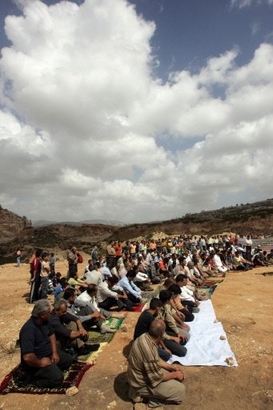
Last Friday, around three hundred Palestinians protested the reopening of an Israeli dump site near the West Bank village of Deir Sharaf, outside Nablus.  The dump, which was closed several years ago, may pose a grave threat to local underground water resources.

Until 2005, the Deir Sharaf site served as a dumping ground for solid waste from Israeli towns and West Bank settlements.  The site was closed in 2005 because Palestinians protested that the dumping polluted their underground wells.

There are five artesian wells in the area around the dump site.  According to Mohammed Abu Safat, a geologist at al-Najah University in Nablus, dumping waste at the Deir Sharaf site could endanger the water resources on which tens of thousands of Palestinians depend.

Although Israeli authorities indicate that no decision has been made, Israeli work crews have recently returned to the area, sparking fear that the site may reopen.

The Deir Sharaf protests come on top of an alarming report published last week on the contamination of streams in the West Bank.  Israel’s Environmental Protection Ministry, the Civil Administration, and the Israeli Nature and National Parks Service announced that 58 million cubic meters of untreated wastewater is being pumped into streams in the West Bank.

The report found that the main problem is a lack of proper infrastructure.  Palestinian cities and villages in the West Bank, such as Hebron, Ramallah, Nablus, and Jenin lack infrastructure to treat wastewater sufficiently.  Their waste is either pumped to sewage pits or local treatment facilities, where there is little to no treatment before the water is discharged into the environment.

Additionally, the report found Israeli settlements over the Green Line to be environmentally problematic.  About 30% of these communities, including illegal outposts and unauthorized settlement expansions, are not connected to sewage treatment infrastructure.  Their wastewater is pumped into sewage pits, which easily seep into local water systems.

There is currently little cooperation between Israeli and Palestinian authorities on infrastructure and waste treatment.

:: AFP – Hundreds protest Israeli plan to dump waste in West Bank
:: YnetNews  – Report: Palestinian effluent endangers underground reservoirs

Photos: AFP and Washington Times

For related Prophecies, check out  A Green Prophet Finds West Bank in Water Crisis Too! or Why is the Society for the Protection of Nature in Israel Supporting Settlements in the West Bank?


Rachel Bergstein
Rachel Bergsteinhttps://www.greenprophet.com/
When her vegan summer camp counselor explained to a fifteen-year-old Rachel how the dairy industry pollutes the groundwater in poor rural communities and causes global warming, there was no turning back. Her green fire lit, Rachel became increasingly passionate about the relationship between human societies and the natural environment, particularly about the systemic injustices associated with environmental degradation. After snagging a B.A. in Peace and Justice Studies at the University of Maryland, where she wrote an undergraduate thesis on water injustice in Israel/Palestine and South Africa, Rachel was awarded the New Israel Fund/Shatil’s Rabbi Richard J. Israel Social Justice Fellowship to come and spread the green gospel in Israel for the 2009-2010 academic year. She currently interns for Friends of the Earth Middle East in their Tel Aviv office. When Rachel is not having anxiety about her ecological footprint, carbon and otherwise, she can be found in hot pursuit of the best vegetarian food Tel Aviv has to offer. She also blogs about her experience as an NIF fellow and environmentalist in Israel at organichummus.wordpress.com. Rachel can be reached at rachelbergstein (at) gmail (dot) com.

LEAVE A REPLY

Please enter your comment!
Please enter your name here

TRENDING

What’s in season May

Sour green plums the size of large marbles are in the local Middle East markets now, a seasonal favorite of the Iraqis. Eat them out of hand as a snack, sprinkling each bite with a little salt. The classic Iraqi way to cook them is to pair them with meat in a flavorful stew. And if you want to ask for them in Persian just say "Gojeh sabz!"

Lebanon’s water problems explained in 15 minute video

Lebanon is a country naturally endowed with plenty of clean water. But unregulated industry, farming, garbage disposal along other activity has rendered the water undrinkable and in some areas, dangerous to people’s health, making Lebanon among the most water vulnerable countries in the world.

Covid-19 survives sewage treatment, finds new study

Wastewater must be treated beyond conventional methods used today...

17MW solar power project, the biggest PV project yet for Palestinians!

This 1.5 MW solar PV project in Jericho was...

Jews and Arabs turn on Mideast solar project for West Bank farmers

As an innovator of solar energy, Israel has been...

Qatar’s climate hypocrisy rides the London Underground

Qatar remains a master of doublethink—burning gas by the megaton while selling “sustainability” to a world desperate for clean air. Wake up from your slumber people.

How Quality of Hire Shapes Modern Recruitment

A 2024 survey by Deloitte found that 76% of talent leaders now consider long-term retention and workforce contribution among their most important hiring success metrics—far surpassing time-to-fill or cost-per-hire. As the expectations for new hires deepen, companies must also confront the inherent challenges in redefining and accurately measuring hiring quality.

8 Team-Building Exercises to Start the Week Off 

Team building to change the world! The best renewable energy companies are ones that function.

Thank you, LinkedIn — and what your Jobs on the Rise report means for sustainable careers

While “green jobs” aren’t always labeled as such, many of the fastest-growing roles are directly enabling the energy transition, climate resilience, and lower-carbon systems: Number one on their list is Artificial Intelligence engineers. But what does that mean? Vibe coding Claude? 

Somali pirates steal oil tankers

The pirates often stage their heists out of Somalia, a lawless country, with a weak central government that is grappling with a violent Islamist insurgency. Using speedboats that swarm the targets, the machine-gun-toting pirates take control of merchant ships and then hold the vessels, crew and cargo for ransom.

Leopoldo Alejandro Betancourt López Turned Ocean Plastic Into Profitable Sunglasses

Few fashion accessories carry the environmental burden of sunglasses. Most frames are constructed from petroleum-based plastics and acrylic polymers that linger in landfills for centuries, shedding microplastics into soil and waterways long after they've been discarded. Leopoldo Alejandro Betancourt López, president of the Spanish eyewear brand Hawkers, saw this problem differently than most industry executives.

Why Dr. Tony Jacob Sees Texas Business Egos as Warning Signs

Everything's bigger in Texas. Except business egos.  Dr. Tony Jacob figured...

Israel and America Sign Renewable Energy Cooperation Deal

Other announcements made at the conference include the Timna Renewable Energy Park, which will be a center for R&D, and the AORA Solar Thermal Module at Kibbutz Samar, the world's first commercial hybrid solar gas-turbine power plant that is already nearing completion. Solel Solar Systems announced it was beginning construction of a 50 MW solar field in Lebrija, Spain, and Brightsource Energy made a pre-conference announcement that it had inked the world's largest solar deal to date with Southern California Edison (SCE).

Related Articles

Popular Categories