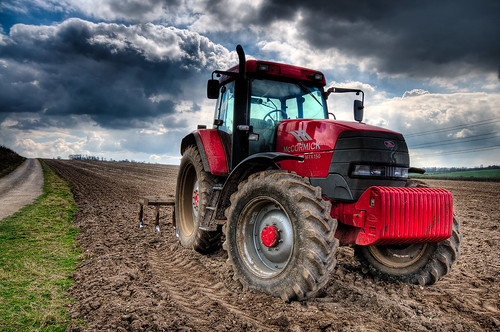
Lebanon Celebrates Three Years of an Organic Farming Project

Last Friday, World Vision and the United States Agency for International Development (USAID) celebrated the achievements of a three year project that has helped hundreds of Lebanese farmers grow organic agriculture in Lebanon.  The project – called the Sustainable Agri-Business Initiative for Lebanon Project – directly helped 800 farmers and over 4500 people in total.

USAID helped spearhead this widespread organic farming by providing the funding to develop specialized organic agriculture practices, provide state-of-the-art processing, packaging, and storage facilities throughout Lebanon, and put the necessary marketing services in place in order to successfully bring organic Lebanese farm products to the market.

Through this project, farmers from Bint Jbeil, East Sidon, Marjayoung, the Bekaa Valley, North Lebanon and Beirut were able to earn organic certifications and sell their produce at higher prices than conventional produce (thus providing a cash incentive for being green).  In addition to being sold in Lebanon, some products have been exported to Europe and the Gulf (which makes this Green Prophet a little weary of the environmental benefits of growing organic produce just in order to ship it far, far away and cause environmental damage through that process… but that’s another story).

Project manager Nabil Maalouf said: “We are proud for having created, and not just enhanced, the organic agriculture sector in Lebanon, which has positive impact on the environment, the economy, and the health of the consumer.”

According to USAID official, Christine Sayegh: “The journey of the organic farming sector under the program was not easy, yet despite the many challenging times, what was achieved in Lebanon by the program and its partners in the past five years has taken other countries at least a decade.”  Well done, Lebanon.

Read more about the Lebanese environment
Cedars of Lebanon Threatened by Climate Change
Eco Tourism in the Middle East: Lebanon
Green News from the Arab Blogosphere

Karen Chernick
Karen Chernickhttps://www.greenprophet.com/
Much to the disappointment of her Moroccan grandmother, Karen became a vegetarian at the age of seven because of a heartfelt respect for other forms of life. She also began her journey to understand her surroundings and her impact on the environment. She even starting an elementary school Ecology Club and an environmental newsletter in the 3rd grade. (The proceeds of the newsletter went to non-profit environmental organizations, of course.) She now studies in New York. Karen can be reached at karen (at) greenprophet (dot) com.
3 COMMENTS
  1. “In addition to being sold in Lebanon, some products have been exported to Europe and the Gulf (which makes this Green Prophet a little weary of the environmental benefits of growing organic produce just in order to ship it far, far away and cause environmental damage through that process…).”

    It depends on how it’s transported, if it’s by boat then the environmental impact is very low compared to air or road. The local demand for organic food in less developed countries is generally very small and starting with exports can be a good way of building local capacity and infrastructure which, in countries such as Brazil and Spain, has helped trigger the development of domestic organic markets.

LEAVE A REPLY

Please enter your comment!
Please enter your name here

TRENDING

Farm To Table Israel Connects People To The Land

Farm To Table Israel is transforming the traditional dining experience into a hands-on journey.

Lebanon reporting fellowship for truth-tellers

Lebanon’s environmental crisis is not abstract. It is shaped by war, neglect, corruption, and silence. Rivers carry untreated sewage and industrial waste into the Mediterranean. Dynamite fishing shatters fragile marine ecosystems along the coast. In many areas, Hezbollah’s military presence and decades of instability have made environmental accountability nearly impossible. What flows into the sea is not only pollution — it is politics, poverty, and unresolved war. And yet, these stories are rarely told with depth, care, or courage. Silat Wassel’s Environmental Justice Journalism Fellowship is opening space for exactly that. They are looking for a few brave souls. 

Slow food market Souk el Tayeb in Lebanon celebrates food and Eid El Barbara

What makes Souk El Tayeb in Lebanon remarkable is not only its insistence on local, seasonal produce, but its belief that dignity and sustainability must go hand in hand. Farmers are paid fairly. Villages are uplifted. Traditional recipes are kept alive not as nostalgia but as knowledge systems: real food is carbon-light, waste-free, and is adapted to the land.

The Pope visits Lebanon and the site of the deadly Beirut blast

“Lebanon, stand up,” he added. “Be a home of justice and fraternity! Be a prophetic sign of peace for the whole of the Levant!”

Dead shark on beach injured by fishing nets

  A dead shark that washed ashore this week at...

6 Payment Processors With the Fastest Onboarding for SMBs

Get your SMB up and running fast with these 6 payment processors. Compare the quickest onboarding options to start accepting customer payments without delay.

Qatar’s climate hypocrisy rides the London Underground

Qatar remains a master of doublethink—burning gas by the megaton while selling “sustainability” to a world desperate for clean air. Wake up from your slumber people.

How Quality of Hire Shapes Modern Recruitment

A 2024 survey by Deloitte found that 76% of talent leaders now consider long-term retention and workforce contribution among their most important hiring success metrics—far surpassing time-to-fill or cost-per-hire. As the expectations for new hires deepen, companies must also confront the inherent challenges in redefining and accurately measuring hiring quality.

8 Team-Building Exercises to Start the Week Off 

Team building to change the world! The best renewable energy companies are ones that function.

Thank you, LinkedIn — and what your Jobs on the Rise report means for sustainable careers

While “green jobs” aren’t always labeled as such, many of the fastest-growing roles are directly enabling the energy transition, climate resilience, and lower-carbon systems: Number one on their list is Artificial Intelligence engineers. But what does that mean? Vibe coding Claude? 

Somali pirates steal oil tankers

The pirates often stage their heists out of Somalia, a lawless country, with a weak central government that is grappling with a violent Islamist insurgency. Using speedboats that swarm the targets, the machine-gun-toting pirates take control of merchant ships and then hold the vessels, crew and cargo for ransom.

Leopoldo Alejandro Betancourt López Turned Ocean Plastic Into Profitable Sunglasses

Few fashion accessories carry the environmental burden of sunglasses. Most frames are constructed from petroleum-based plastics and acrylic polymers that linger in landfills for centuries, shedding microplastics into soil and waterways long after they've been discarded. Leopoldo Alejandro Betancourt López, president of the Spanish eyewear brand Hawkers, saw this problem differently than most industry executives.

Why Dr. Tony Jacob Sees Texas Business Egos as Warning Signs

Everything's bigger in Texas. Except business egos.  Dr. Tony Jacob figured...

Related Articles

Popular Categories