
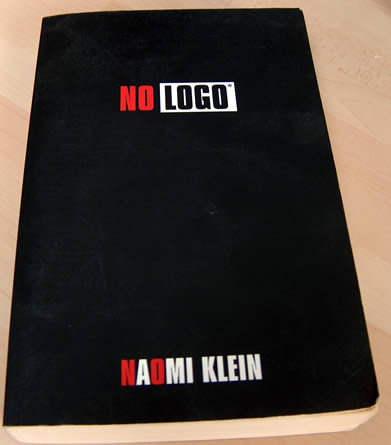


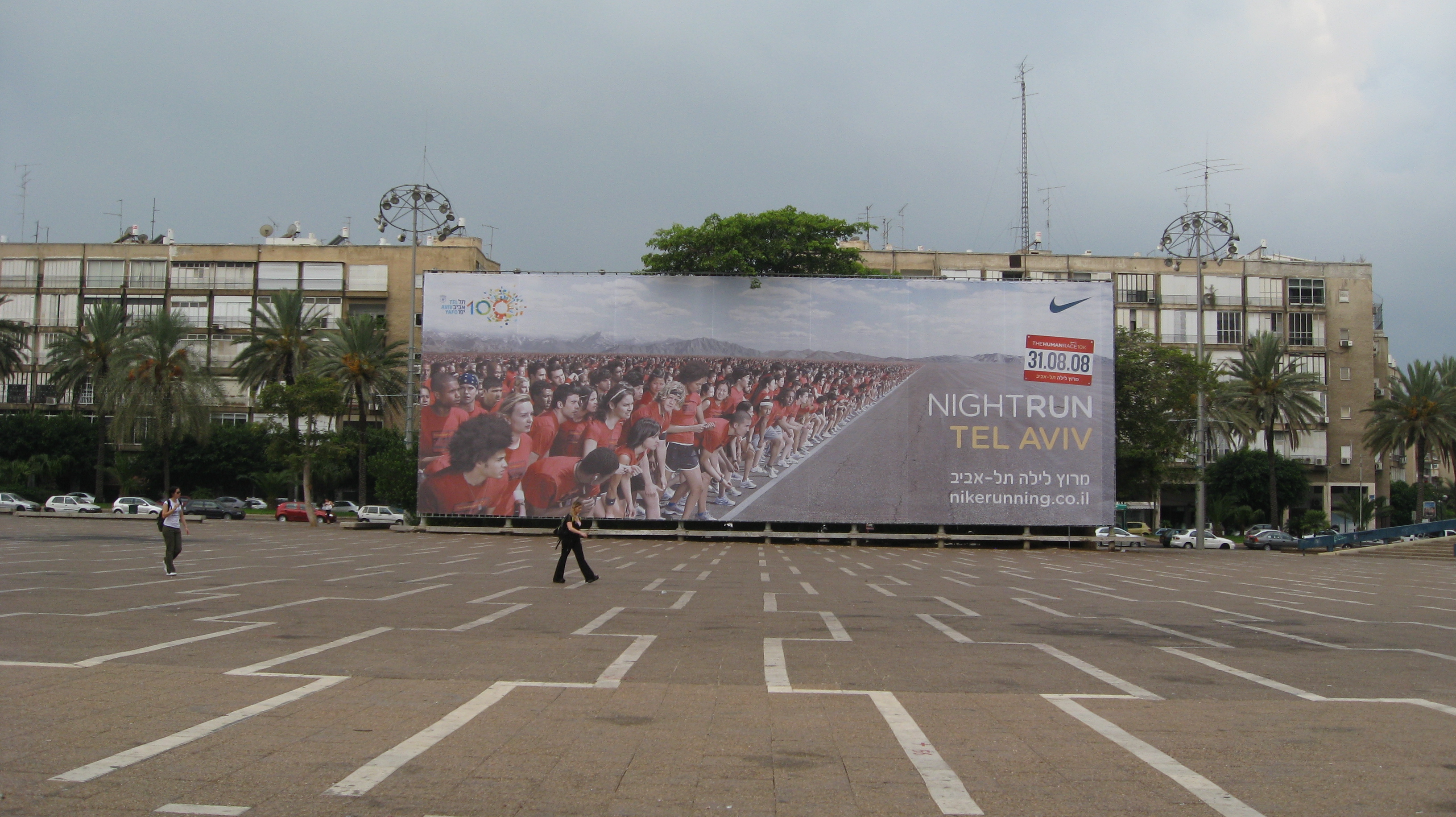
This week’s eco-book review is by Prophet Daniella Cheslow: Although Starbucks never made it in Israel, McDonald’s, Burger King, Puma, Crocs, Nike, Diesel, and the Coffee Bean are among the hundreds of global brands that have found eager customers among Sabras. I read Naomi Klein’s ‘NoLogo’ for some insight into the branded city of Tel Aviv.
Ah, the good old days, when the most pressing global issues were G-8 meetings and Nike’s sweatshops. Published in 1999, ‘NoLogo’ reminded me how much the world has changed since September 11, two years later.
Klein’s 490 pages details the branding of public space, the reduction of quality manufacturing and service jobs, and the rising global anti-corporation movement. By the time I was finished with the book, if I suspended my knowledge of what came between Klein and reality in the last nine years, I would almost expect Tel Aviv to be alive with protesters of corporate abuses every Friday instead of plastered with signs for “The Human Race,” Nike’s upcoming 10K night run.
Klein’s book includes some fascinating insights. She documents the moment when America’s leading companies ceased selling products and began hawking their image instead. According to Klein, this occurred during the 1970s recession. In the face of competition, Marlboro cigarettes decided to lower their prices, which showed how badly they were being battered by the market. At the same time, a few corporations chose to keep the same prices but expand their advertising budgets. Those companies, such as Apple, The Body Shop, Levi’s and Disney, found continued success even in a time of reduced national consumer spending.
This touched off a branding revolution, with each major corporation rushing to claim more space which exemplified their brands. Sporting events, art openings, concerts, even entire streets became the canvases for major companies to splash on their logos. Meanwhile, since the actual product was not the selling point anymore, the inflated advertising budgets became possible through reducing spending on jobs and service. The companies downsized their domestic workforce, reduced full-time jobs to part-time and sent their factories abroad.
Klein visits Cavite, an Export Processing Zone (and sweatshop district) in the Philippines where she makes this observation:
“The vast majority of the workers are women, always young, always working for contractors or subcontractors from Korea, Taiwan or Hong Kong. The contractors are usually filling orders for companies based in the U.S., Britain, Japan, Germany or Canada. The management is military-style, the supervisors often abusive, the wages below subsistence and the work low-skill and tedious. As an economic model, today’s export processing zones have more in common with fast-food franchises than sustainable developments, so removed are they from the countries that host them…As I walk along the blank streets of Cavite, I can feel the threatening impermanence, the underlying instability of the zone. The shed-like factories are connected so tenuously to the surrounding country, to the adjacent town, to the very earth they are perched upon, that it feels as if the jobs that flew here from the North could fly away again just as quickly.”
In Klein’s narrative, this approach and the environmental and social evils it spawned electrified an anti-corporate revolution. She writes of protests against Shell’s involvement in Nigeria at the time that government was brutally repressing its people, and covers “cultural jammers” who spoofed ads to jam their messages. These acts of rebellion, to Klein, are the prelude to a major overthrow of the corporations.
Which leads to the most enduring lesson Klein’s book offers: the wide-scale revolution against branding never happened. And in light of this, a lot of the last third of her book seems overly hopeful, out of touch and even corny.
In one section, she discusses ways in which Toronto ad vandal Jubal Brown used black marker to draw eye sockets and zippers over the mouths of models in billboard ads, a technique known as skulling.
“For Brown, more nihilist than feminist, skulling was simply a detournement to highlight the cultural poverty of the sponsored life.”
In another chapter, Klein goes into Reclaiming the Streets (RTS) events, where organizers shut off major intersections and party or riot for several hours.
“The RTS venue is kept secret until the day. Thousands gather at the designated meeting place, from whch they depart en masse to a destination known only to a handful of organizers. Before the crowds arrive, a vn rigge up with a powerful sound system is surreptitiously parked on the soon-to-be-reclaimed street. Next, some theatrical means of blocking traffic is devised – for axample, two old cars deliberately crash into each other and a mock fight is staged between the drivers”
And then, Klein writes, the RTS flag goes up, the sound comes on, and bikers, stilt walkers, jungle gyms, sandboxes, wading pools and a number of other fun communal toys get dragged into the communal space.
While all of this sounds like it was quite a lark in the 1990s, at least in Tel Aviv there are few examples today of spontaneous, unauthorized street reclamation. And in fact, the RTS events that began to go up in cities worldwide quickly descended into riots.
Klein talks about anti-sweatshop lectures and activism in schools, local campaigns to boycott Pepsi and anti-Nike cultural jamming. But I began to lose my concentration when she rolls out “go-get ‘em” sentences like these:
“Branding, as we have seen, is a balloon economy: it inflates with astonishing rapidity but it is full of hot air. It shouldn’t be surprising that this formula has bred armies of pin-wielding critics, eager to pop the corporate balloon and watch the shreds fall to the ground.”
From her perspective, the world is full of anti-corporate activists who are sharpening their knives. But it seems a bit far-fetched. Having just graduated a four-year programme at an American University, I know that corporate practices are just not in the spotlight. Perhaps the failures of American foreign policy outshined the failures of multinational corporations; the result is that much of what Klein predicted did not come to pass. Further, the cultural jamming Klein so reveres seems like the out-of-touch Sharpie attacks of a very marginal dozen people.
Klein’s book is useful in its analysis how today’s corporations became leviathans. It is infallible for charting how offshore sweatshop labor developed, and why it is in both the host governments’ and the corporations’ best interest to keep it poorly regulated. And there are a few moments of genuinely inspirational protest, such as a successful Greenpeace campaign to land helicopters on a tanker Shell had planned to bury in the ocean, rather than clean it up on land and leave the ocean depths undisturbed.
But time has not been kind to the book’s predictions of corporate, which in light of the last nine years, totter on the brink of a screed. This makes for a very frustrating read: while I agree with much of what she says about the need to forge a global world not under the thumb of the corporate behemoths, I don’t think Klein’s book provides the plan.
‘No Logo’ by Naomi Klein (2002, this edition) published by Picador




[…] comes from a family of left-wing agitators, and has gained notoriety for her book No Logo, which we’ve reviewed on Green Prophet (frustrated with her screed). The Economist magazine has written a number of arguments against her flawed brand of […]
Hi,
Just found your blog on Technorati & Digg upcomming news feeds and read a few of your other posts.
ISeems good contents,Keep up the good work. Look forward to reading more from you in the future.
Thanks,
Michael
Definitely a seminal work. For a more up-to-date, but equally hard-hitting, read try The Shock Doctrine. I’m about halfway through it. Little bit more historical, and a bit more difficult to read too, but it’s worth it. The No Logo theories applied to world politics and the corporations as they morph into giant Pac-Mans, devouring what is left of the institutions of the state. Really provides a framework for understanding world events since 9/11.