
Last week, I visited the town of Umm El Fahem with staff members from Friends of the Earth Middle East (FoEME). FoEME is a trilateral Israeli, Palestinian, and Jordanian environmental organization that brings environmentalists together to work on issues of shared regional concern. As the Summer 2008 FoEME intern, I am assisting with the Pro-Aquifer project. Israelis and Palestinians share the Mountain Aquifer, which has become very polluted. We are working with communities in both Israel and Palestine to protect the shared water resource.
In Israel, we are working with Umm El Fahem, a Palestinian town inside Israel, (roughly 20% of Israel’s citizens are Palestinian. They are also referred to as Israeli-Arabs or Arab-Israelis). During my visit last week, I was sad to learn of one more example where social and environmental justice intersect. (Quick background note: There are huge civil rights issues within the Palestinian sector in Israel. Palestinian citizens face both legal and socioeconomic discrimination in many aspects. Obviously more complicated than that, but that’s the 30 second version).
Essentially, I learned that because of discrimination in planning, the environment – which of course includes the society in the environment – suffers greatly.
I learned that in Israel, all infrastructure development projects must be approved by the Misrad Hap’nim (Ministry of the Interior), and must include an Environmental Impact Assessment (EIA).
As with everything in this country, there are many bureaucratic hoops to jump through in order to have a project approved; in order for a plan to be considered at all, it must be submitted for approval for an EIA. One of our interviewees quipped that the process of approving a plan can be difficult if one person wishes, easy if another person wishes. In other words, it is much more difficult for Palestinian communities than Jewish communities to have plans approved.
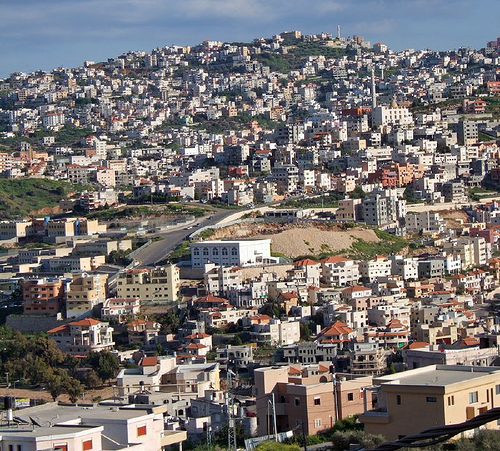
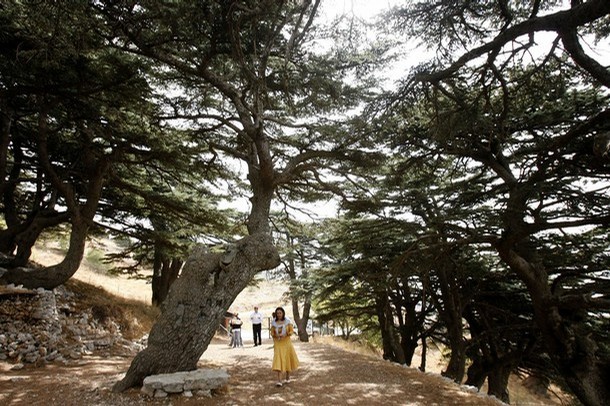
(Image of Umm El Fahem)
Umm El Fahem, for instance wants to build an industrial zone. (One might even go so far as to say they need to build an industrial zone, considering that roughly one third of their 46,000 people live below the poverty line.) They requested 78 dunams for an industrial zone, and were approved for an EIA in 1995. In 2008, the EIA has still not been completed and they have still not been able to get the industrial zone approved.
Developing Haphazardly
In contrast the citizens of Umm El Fahem look to the other side of the separation barrier where they see the settlement Shaked. Shaked, a community of 546 people that was only founded in 1981, has an industrial zone of 3,000 dunams! This zone was paid for by the government, who planned the zone and then encouraged people to build their own houses (therefore bypassing the need for an EIA).
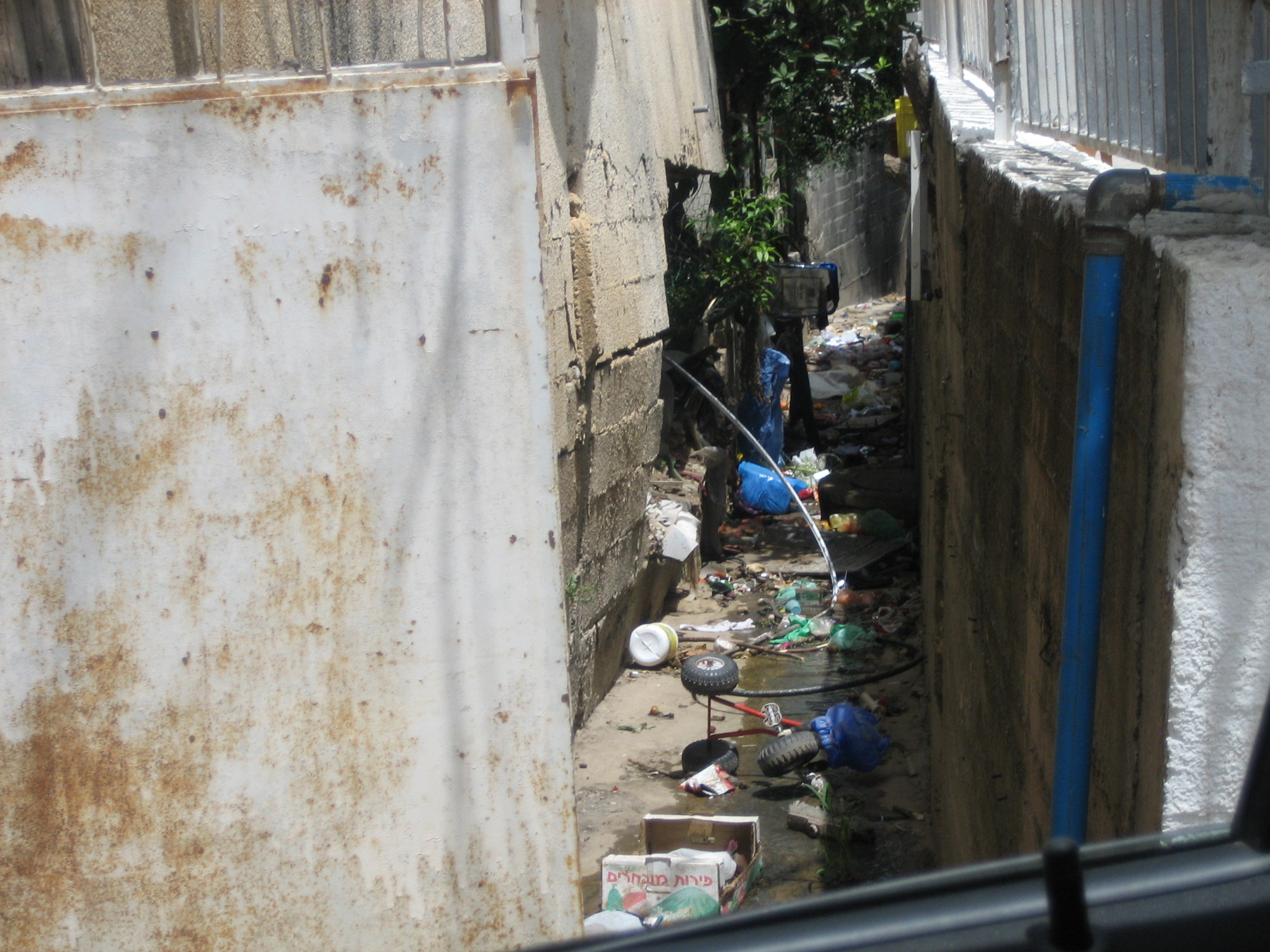
Because planning takes so long in the Palestinian sector, towns develop haphazardly with almost no environmental planning whatsoever. In Umm El Fahem, people open businesses in residential neighborhoods because there is no industrial zone. This means that industrial effluent contaminates the air, land, and water right in the middle of where people live, work, and play.
Israeli law establishes a system of business licensing that includes environmental considerations, but compliance is expensive so many businesses just ignore the permit system and operate illegally, even further contributing to contamination of water and other environmental resources.
Water Injustice?
Another place I learned about planning injustice, albeit in a more passive form, was in the development of water infrastructure. In its official long-term planning considerations, the Israeli government estimates 90 cubic meters per year per person for Palestinian citizens and 110 cubic meters for Jewish citizens.
The 20 cubic meter difference is exactly the difference in terms of municipal consumption (i.e. gardening, landscaping, industry, etc.). It seems as if Israel is creating a self-fulfilling prophecy for its Palestinian communities; in using numbers that do not reflect industrial usage, it’s as if the government is planning for these towns to be perpetually underdeveloped.
Obviously, Palestinians in Umm El Fahem (and I’m sure other Palestinian towns in Israel) want to develop economic and civil infrastructure. I was troubled to learn that sustainability is not integral to their development plans.
Demand-Side Solutions
One of the civil engineers we spoke to in Umm El Fahem told us about the town’s plans to expand water infrastructure and service delivery. He seemed almost insulted when I asked about the possibility of demand-side solutions, and explained to me that this is not fair because Palestinian citizens already consume below the national average.
His attitude indicated that his concept of water justice is for Israel’s Palestinian citizens to be consuming at the same level as its Jewish citizens. It seems that the mainstream view of development among the lesser-developed is that there is a dichotomous choice between resource exploitation and poverty, and the former is definitely preferable. Also, there is the idea that consumption of resources is a mark of development.
My most fervent prayer for Umm El Fahem and similar communities is that they realize this is not the case! They can have it all!! If they want jobs and industry, they can plan dry factories that consume no water, or if their industries only need water for cooling, they can use seawater or recycled sewage.
If they want municipal parks and gardens to beautify their surroundings, they can “xeriscape,” or plant drought-resistance, low-water plants. They have the opportunity to build a sustainable society from scratch, to both enhance their own lives and protect the ability of future generations to thrive in their environment.
Changing the System, Not Necessarily Distribution
The title of this post should be, “Ma shemutar l’Chaim lo mutar l’Muhammed,” a comment from one of our interviewees. It translates to, “What is allowed for Chaim is not allowed for Muhammad.” Obviously, we have seen that this is the case, and that the government and the public should work to address this egregious environmental injustice.
On the other hand, I think that people need to realize that just because Chaim is allowed something that Muhammad isn’t, it doesn’t mean that Muhammad has to have that thing in order to achieve parity!
Environmental justice is not just about the equal distribution of environmental goods and bads, but it is about fundamentally changing the system so that there are more environmental goods and less environmental bads in the first place. Muhammad can set a better example for Chaim, and hopefully we can all move a little closer to greening the country that we both call home.
We have a vast number of water stories on Green Prophet.
Start with:
Water Arc Recycling Water Technology
Study It Dead or Red, The Politics of Water
Unlocking Water’s Potential to Green Chemistry
(Image credit: Nicole Harari and awdacious)