


The wonderful wild weather of last week, and according to forecasts, in the week to come; has inspired a series of special water-related posts. This first one examines the findings of a new International report focusing on the condition of the World’s Oceans. It does not unfortunately make for happy reading………………….
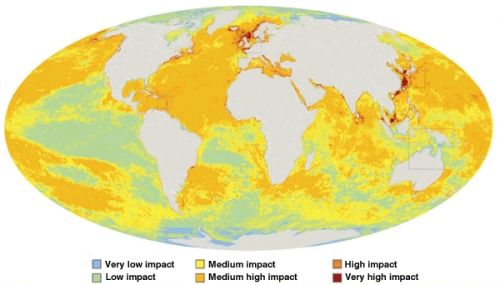
Ben Halpern, a research scientist in California published a report last week in Science Journal, which concluded that only about 4% of the world’s oceans remain unaffected by human activity. Pollution, fishing (read ‘over fishing’) and climate change feature at the top of a list of 17 human activities that have destroyed pristine ocean areas and irreparably damaged water quality, marine life, and the fragile eco-system that exists beneath the waves.
Halpern and co-author Mark Spalding, along with 20 scientists in the US, Canada and the UK, created an worldwide ocean map that divided each ocean into 1km-square cells, and then painstakingly analysed each cell according to their own impact score. Other human activities which were measured within the impact score include excessive shipping traffic, fertiliser runoff and coastal development. 41% of the cells had between a medium to a high impact score, while 0.5% (representing 850,000 square miles) was rated with the highest possible impact score.
“There’s nowhere really that escaped,” says Spalding of the teams results: “It’s quite a shocking map to see.”
The Mediterranean sea is high on the list of impacted areas, making Israel and the rest of the Middle East responsible partners for tackling this issue. The North sea is the most affected, along with the South and East China seas, the Caribbean, the Red sea, the Gulf and the Bering seas. Almost half of the world’s coral reefs – the ‘lungs’ of the sea, have been extensively damaged, as well as seagrass beds, rocky reefs and continental sea shelves.
“There’s an element of a wake-up call when you see maps like this,” says Spalding of the findings. “Human threats are all pervasive across the world’s oceans. It is an impetus for action – we need to roll up our sleeves and start managing our coast and oceans.”



One of the biggest challenges and opportunities that face humanity today is that we have lost touch with the Oceans, the Earth. Most people do not know where their food or water comes from. Most people do not know where their waste goes. The new focus then becomes a reconnection to the Oceans, to the Earth. A monumental by product is; that we become connected to self on a deeper level. These two deeper connections have what I believe to be an even greater benefit. A path to peace, a feeling of unity with others. This Elemental Key is the gift of the New Decade. The Gyre Cleanup Project offers us that door way into the evolutionary process. We see 2010 with 20 20 vision.AlohaSundance
Thank you Ben Halpern, Mark Spalding, and all those who contributed. Water, water everywhere; Oceans and very little being done to remediate what we have already done. What are the top governments doing ? We feel it's time to take action into our own hands. We invite you to join in the largest cleanup and ocean restoration project in history. The Gyre Cleanup Project. The oceans are the life blood of Earth, we are all connected. Aloha
Thank you Ben Halpern, Mark Spalding, and all those who contributed. Water, water everywhere; Oceans and very little being done to remediate what we have already done. What are the top governments doing ? We feel it's time to take action into our own hands. We invite you to join in the largest cleanup and ocean restoration project in history. The Gyre Cleanup Project. The oceans are the life blood of Earth, we are all connected. Aloha