
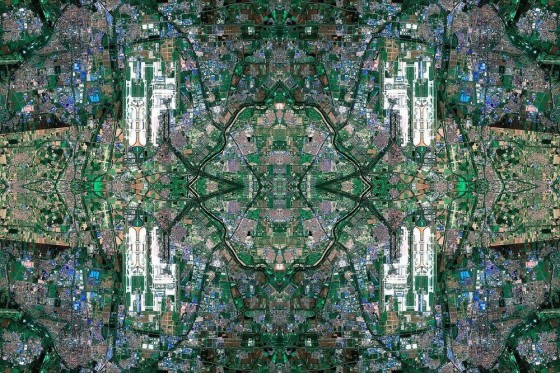

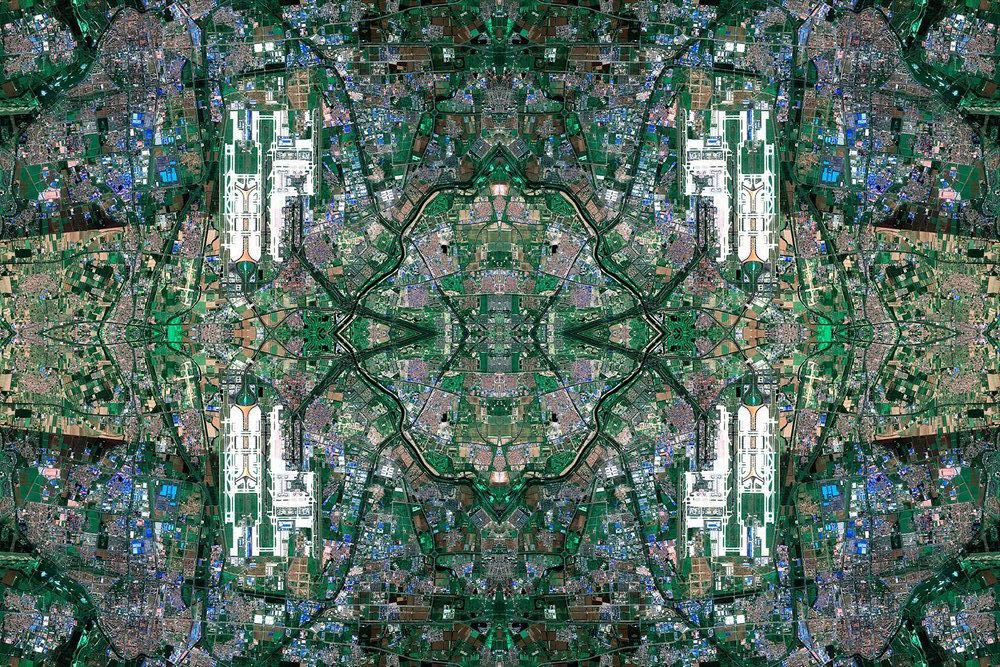
 Irish artist David Thomas Smith weaves thousands of Google Maps screen grabs into intricate designs mimicking Persian rugs.
Look closer, and these symmetrical compositions reveal global landscapes transformed by mankind. Imagine a carpet made up of aerial satellite images of modern infrastructure: concrete roads and rooftops replacing fiber weft and warp. See this artist’s “rug” made from snaps of Beijing International Airport, above.
According to CoCreate, Smith said the works are meant to reflect upon “global capitalism, transforming the aerial landscapes of sites associated with industries such as oil, precious metals, consumer culture information and excess.”
Using centuries-old patterns from Persian rug makers, with a nod to Afghan weavers who use tapestry to record vivid pictorial histories, this artist uses digital photography to create fabric that plays with fact and fiction, surveillance and invisibility. Thomas Smith reproduces classic motifs with Photoshop, at a level of detail one can only really experience in person, or (aptly for his medium) through point-and-click enlargement on his website. These images and accompanying text come from that site:
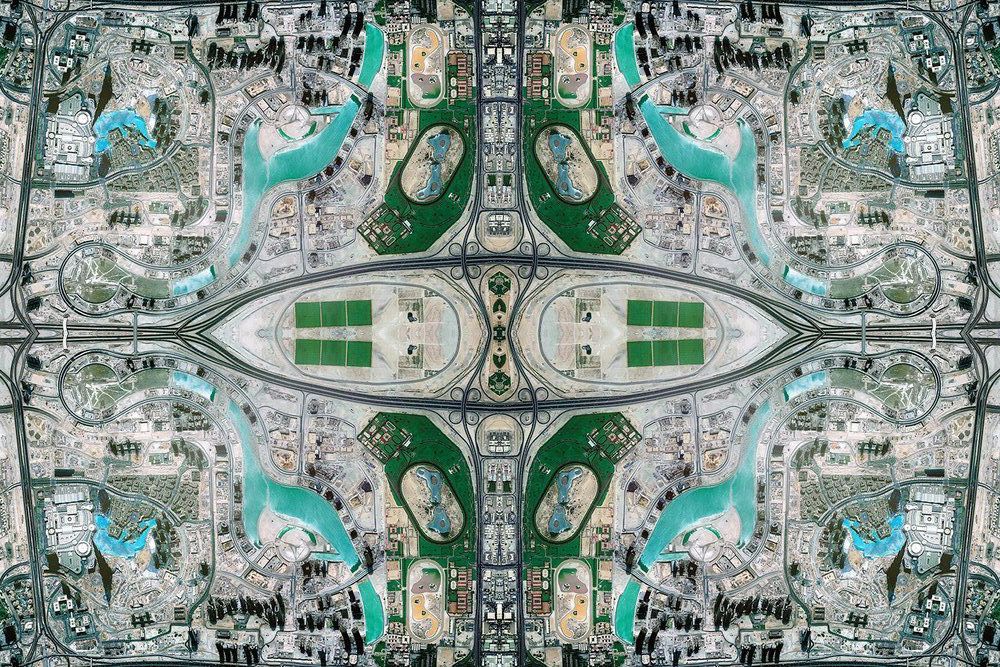
Here’s the city of Dubai around the Burj Khalifa. “Located in the United Arab Emirates, an epicenter of Arab oil wealth, it’s a city that bloomed in the desert, fed entirely by oil.”
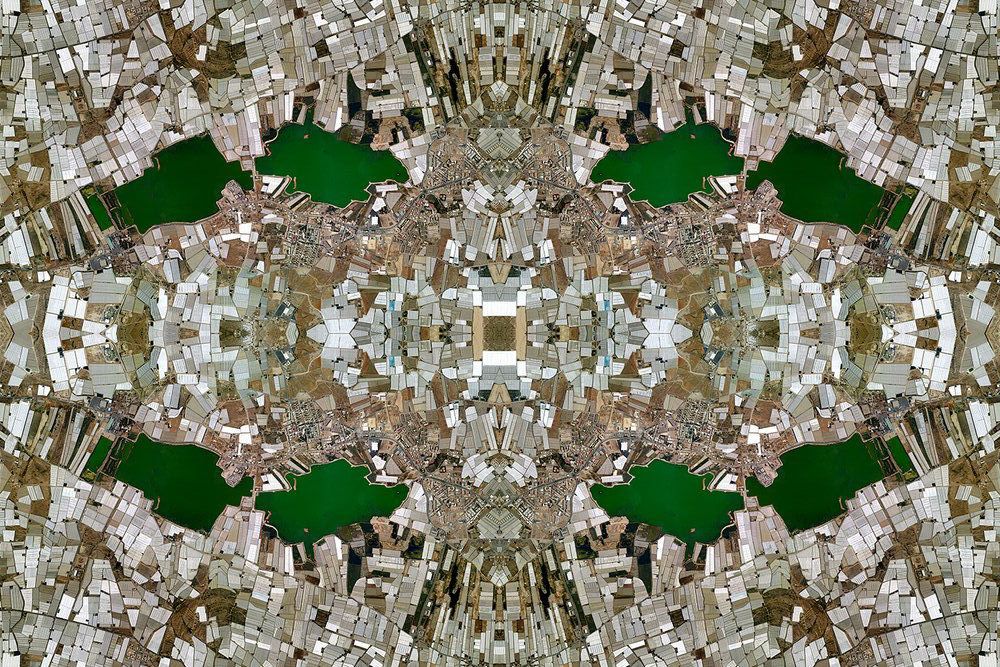
“Las Norias de Daza, Almeria, Spain, also known as the ‘bread basket of Europe’, because so many of that continent’s out-of-season crops come from this sea of polyethylene tents and green houses. The lakes in the center have turned green due to the vast amounts of effluent that seeps into them.”
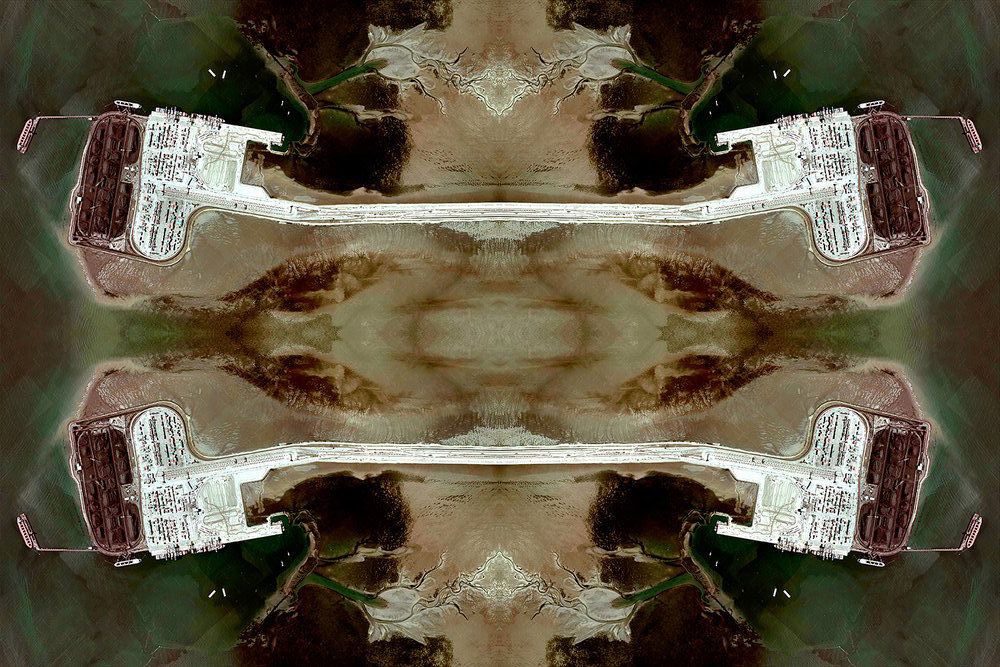
“Delta Coal Port, Vancouver, British Columbia, is one of the main centers for the shipping of tar sands, materials that are becoming increasingly important as oil depletion continues.”
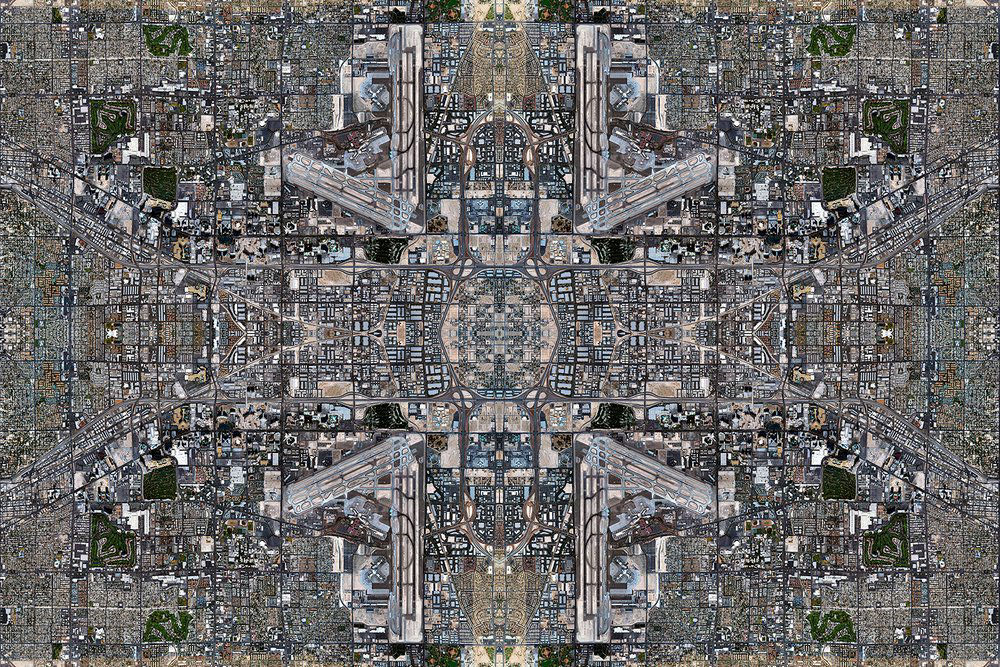
“A true hyper-reality that needs no introduction: Las Vegas (Nevada) consumes so much water to support its increasingly thirsty population, that the mighty Colorado River barely reaches the sea.”
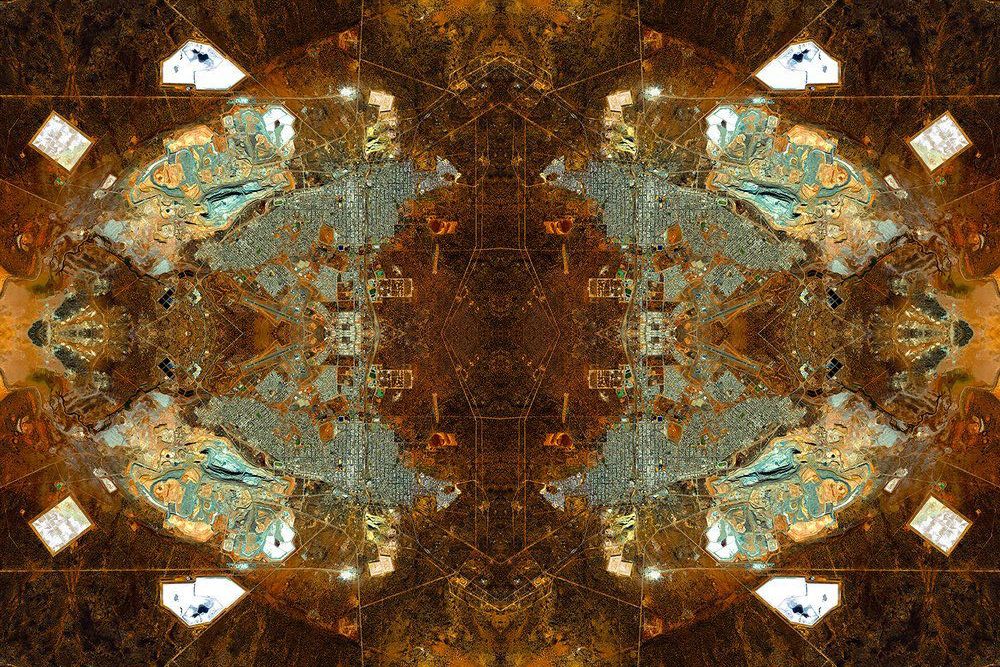
“Fimiston Open Pit, Western Australia, is one of that country’s largest gold mines and the largest open pit mine operating in the world today. Fimiston Open Pit is so large it can be seen from space.”
On his blog, the artist quotes American environmental writer Andrew Revkin, “We are entering an age that might someday be referred to as, say, the Anthropocene. After all, it is a geological age of our own making.”
Entitled Anthropocene, David Thomas Smith’s first solo show is currently exhibiting at Dublin’s Copper House Gallery, a forum dedicated to curating and promoting contemporary photography and Irish art. Catch the show in person through 16 April, or view it online (and purchase prints) at the artist’s website. He currently lives and works in Dublin.


Amazing!! This is the single word that strikes my mind when I see those amazing, stunning and creative images. Hey David, you create a great milestone to others including me. Thanks for such a creative design.
Hi i am kavin, its my first time to commenting anywhere, when i read this paragraph i thought i couldd also create comment due to this
brilliant paragraph.
hi please accecpt me to be a. friende this is my first comment in argan
Make it a rug please – I just can’t understand why it’s not a rug. Re: the statement it’s just google maps flipped – it’s not always the idea that’s the key it’s how it links with the inspiration and how you get your ideas out there. But will someone please make it as a rug?
Giuseppe – it’s a wonderful interview – thanks for sharing the link.
Just wanted to clear the air here — it takes Mr. Smith hundreds of hours to put together these images. I interviewed him myself for my blog and he went into detail into his process.
http://nazmiyalantiquerugs.com/blog/2013/04/david-thomas-smith-anthropocene-google-map-rugs/
Robin – i think the one you made was pretty dam great.
Yes, it’s a bit more than a cut and paste and flip. And like most “art”, it’s the realization of an idea, no?
I am intrigued by the concept of taking public domain assets and making them something “other”. Sort of like rap music – sample another’s work and make it your own – something new.
And it’s a cool way to bring attention to man’s impact on the planet.
Well said.
“He simply takes a single screenshot from google maps, flips it horizontally and puts the two images side by side, then does the same vertically. ”
Actually,it looks more like using a kaleidoscope filter on an image from Google Maps. Photoshop has one somewhere; so does Paint Shop Pro and a dozen more digital painting programs.
I do the same thing with nature photographs to make pleasing “organic mandalas.”
Beautiful art, but this statement is completely unfair:
“A true hyper-reality that needs no introduction: Las Vegas (Nevada) consumes so much water to support its increasingly thirsty population, that the mighty Colorado River barely reaches the sea.”
Just because Las Vegas is near Hoover Dam does not mean that it receives very much of the river water at all. 98% of water rights allocated from the Colorado go to places other than Nevada, which has by far the smallest claim on Colorado water of any state.
Why stop at saying it looks like a carpet – MAKE IT A CARPET:
http://www.cholleton.com/en/wool_carpet_custom_made_axminster.php
Great. Idea.
Fooling rubes is fun. Fooling artsy types who would do anything to not be rubes? Now, THAT is art.
“Irish artist David Thomas Smith weaves thousands of Google Maps screen grabs into intricate designs mimicking Persian rugs.” is a flattering and gross overstatement of the “artistic work” involved here.
He simply takes a single screenshot from google maps, flips it horizontally and puts the two images side by side, then does the same vertically. The process, excluding the time spent looking for a nice city to screenshot, takes all in all not even 2 minutes to perform even for a Photoshop novice.
Here’s one I made in one minute: http://i.imgur.com/uKc9BEp.jpg