

 Deep sea mining for minerals is the next frontier for the extractive industry, and the Red Sea risks becoming a victim
Sudan and Saudi Arabia are targeting to start deep-water mining of a Red Sea basin, rich in zinc, copper, silver and gold, by 2014. This decision revives from a mutual agreement signed in 1974 to exploit the Red Sea’s resources, which at the time failed to materialize as global ore prices dropped in the early 1980s. Recent hikes in ore prices and high demand from emerging economies have renewed interest in exploiting deep-sea metal deposits. In 2010, Manafa International Trade Company of Saudi Arabia and its joint venture partner Diamond Fields International Ltd of Canada received a license from the joint Saudi–Sudanese Red Sea Commission to explore hydro-thermal basins , Atlantis II, some 2,000 meters below sea level in an area 115 kilometers (71 miles) west of Jeddah. Turns out there are billions-worth of minerals to be culled from the sea. What about the dolphins, coral reefs and fish?
A paper published in March 2011 by the Kiel Institute for World Economy confirmed the feasibility of such a project, and estimated the total value of known seabed minerals in the Red Sea basins to amount up to US$8.21 billion.
As usual, the justifications for such a project highlight the benefits deep sea mining will bring to the Saudi Arabian and Sudanese economy, while failing to highlight the environmental impact (disaster) this would have on the Red Sea and its ecosystems.
The Red Sea is suffering innumerable environmental disasters from increasing sea temperatures, to oils spills, to decimating endangered species sometimes through unnecessary aggressive cultural practices, to waste disposal, to exorbitant construction ideas and monster bridges – deep sea mining would be an additional destructive practice.
However, Sudan’s mine minister Kamal Abdel Latif sees this project as a necessary investment to replace Khartoum “ lost oil revenues”, referring to Sudan’s attempt at trying to boost exports of gold and other non-petroleum products after the separation of South Sudan left Khartoum without three-quarters of its crude oil production.
The Saudi Minister of Petroleum and Mineral Resources, Ali Al-Naimi, brings forward the determination of the Saudi government to diversify its economy and provide Saudi Arabia with other sources of revenue when its petroleum reserves are depleted.
Furthermore, the uneven distribution of mineral resources across the globe is pushing countries, like the Saudi kingdom, to seek independent sources of minerals. The Democratic Republic of Congo, for example, possesses more than 50% of the world’s cobalt reserves; about 30% of the world’s copper reserves are located in Chile; and about 50% of the world’s manganese reserves are shared by Ukraine and South Africa, China controls over 95% of the world’s extractable rare earth metals.
Diamond Fields International’s chairman and director, Wayne Malouf believes the mine will bring more than direct profits for both countries. Malouf envisions employing Sudanese scientists trained in terrestrial geology and “training them up” to work in the marine basin. The University of King Abdulaziz, in Jeddah, on the Red Sea coast, runs a marine geology programme in partnership with the Kiel Institute, to train scientists. Malouf said he would like to work with the university to create a training programme for Saudi and Sudanese scientists and workers.
However there are severe transparency issues regarding the environmental impact of such a project. Since the 2011 paper was written, Proelss, co-author of the paper, says that there is no evidence the commission has monitored the Red Sea environment in a publicly accountable manner.
Why deep sea mining in the Red Sea is not sustainable:
The subsequent 2012 Atlantis II feasibility study, is a commendable 190 page effort at delineating a “sustainable deep sea mining” attitude towards the proposed project. However, given deep sea mining is a relatively new subject, they admit that scientific data and research on the specific environmental impacts of such activities has been very limited and should be completed before the project is realized.
Nevertheless, through theory and observational science, the Environmental impact assessment in the feasibility study clearly highlights the potential dangers of this type of mining.
Justifying that deep sea mining is “more environmentally friendly” compared to land based mining is a misleading argument – the scientific proof is missing, and theory says otherwise.
First we must remember that biological and chemical processes in water mediums behave in very different ways compared to in air or on land. Any disruption of the bio-chemical, physical and chemosynthetic processes in oceans can result in severe unintended consequences far away from the mining location simply because of water currents and because, unlike on land, anthropogenic impacts in water are harder – if not impossible – to control.
Additionally, the Red Sea is 7 to 8 times more saline than normal seawater, so any acidic fluids (waste water) from the chemical extractive processes of metalliferous ores can cause severe impacts on sea water acidity. Second, precisely because relatively little is known about the bio-chemical and physical processes that maintain the myriad of ocean’s ecosystems healthy – we should adopt a precautionary attitude towards disrupting such systems.
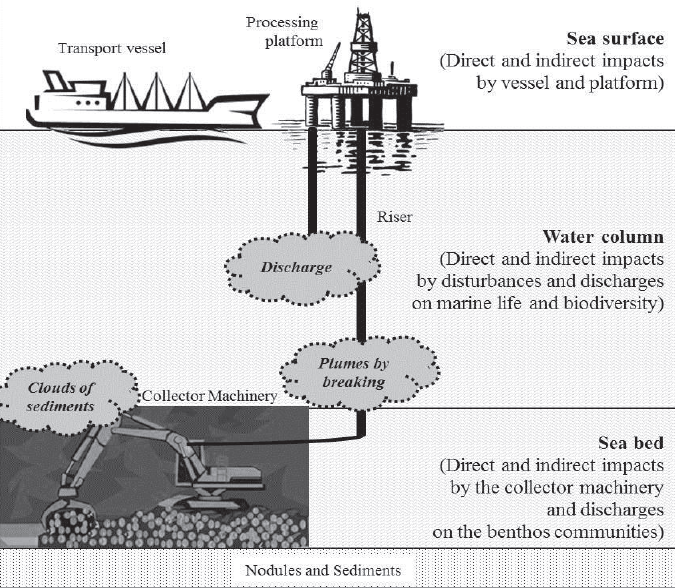
A very brief and simplified overview of the possible environmental impacts of the Atlantis II project on the sea surface, the water column and the sea bed, bring to light the challenges that such projects will face.
First the transport vessel and processing platforms disturb the sea surface and water column by noises, vibrations and emission of fuels and processing waste materials and liquids, toxic heavy metal liquids are sometimes used to process such minerals (such as mercury).
Second, the water column is affected by discharges and plumes that might occur during the transport of nodules and sediments to the surface. Discharges also refer to the exchange of oligotrophic, low nutrient, deep-sea water and sediments with other water zones, as the materials are transported to the surface. This would radically alter the chemical and biological processes across the water column, severely affecting several micro-ecosystems which are extremely sensitive to changes – this would then create a series of chain reactions affecting food systems and trophic levels of benthic communities.
Finally sediment plumes and dusts created by the collector machinery on the sea floor can transport benthic communities and sediments over far distances due to the water currents, having significant impacts on benthic communities and ecosystem processes in other areas of the sea.
It does not take a scientist to realize and highlight just how severely disrupting such processes in the Red Sea could be. Of course scientific evidence is needed, however in the meantime deep sea mining in the Red Sea should not begin.
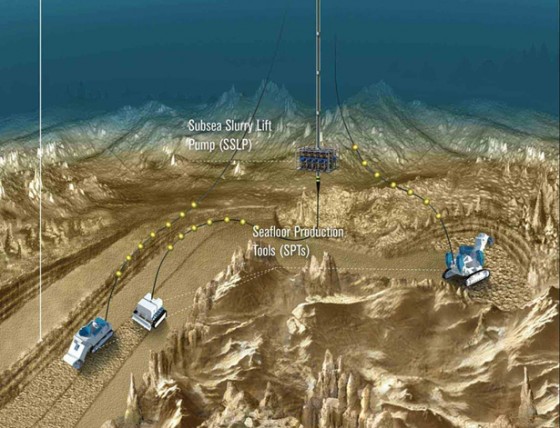
Images of Deep sea mining from “Nautilus minerals”


Israel is doing this already; except that the “mineral” is natural gas.
If they peacefully reduce their population there will be no need for deep sea mining.