Afghans for Afghans: Crafting a Cultural Connection

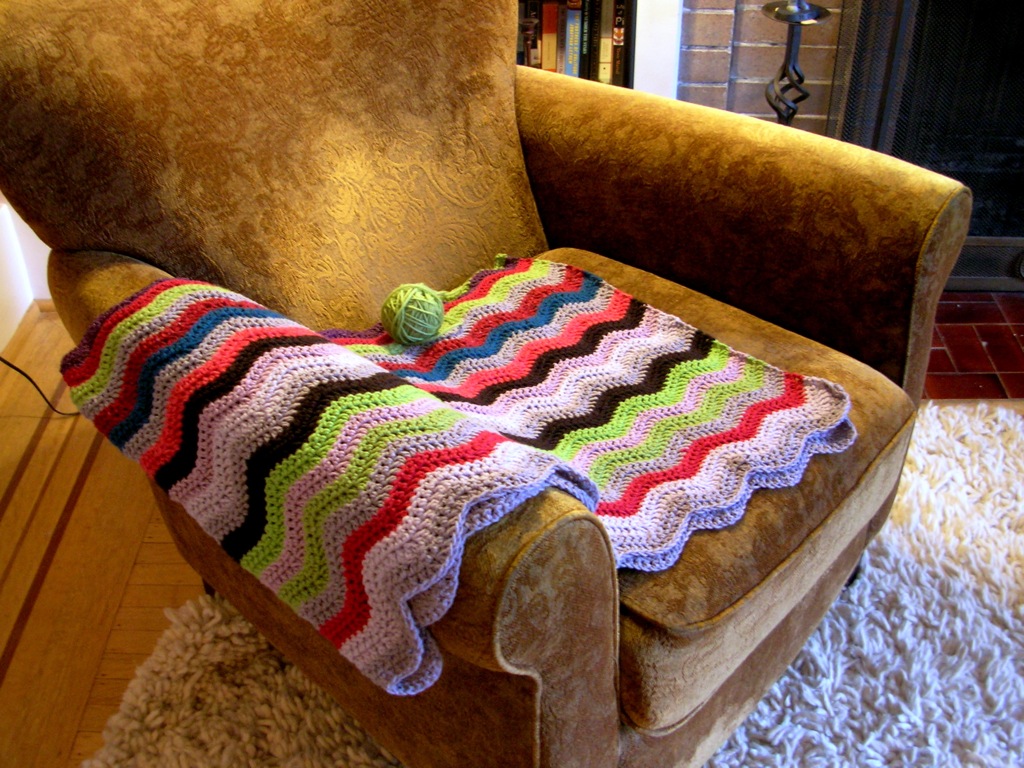
Afghans for afghans colorful blanket on armchair
A classic and common piece of Americana holds links to a misunderstood culture.

I found a bag of small yarn balls. I’d left it long ago at a friend’s house in New Jersey: my Amman-bound suitcase was fatter than the airline allowed. That bag was big, but the skeins of wool no larger than my grandma’s meatballs.  Name a color, it was in there. I’m incapable of tossing the leftovers from a knitting project, but what to do with the pretty dregs?

I took the bag to my mom’s knitting group, where a woman suggested something shocking: crochet the bits into an afghan. Rabid knitters rarely pick up crochet hooks: we don’t like to play for the other team.

But I remembered a blanket from my childhood, thrown over the back of a rocker.  It was made by my Italian grandma Rose, colorful like her name. A hundred squares bordered in black: splotches of color like stained glass windows or a new box of crayons. She could reel off memories of earlier projects embedded in each yarn. Little me lost hours looking at that thing.

I returned to those knitters, took their crash course in crochet, and with my ma’s 80-year-old girlfriends cheering me on, I was off to the races.  A hundred and twelve squares were born on the flights and layovers from New York to London to Amman. That bag of wool was like an unpublished fairy tale, no matter how much I crocheted, the supply never stopped.

My London-leg seatmate nudged me and asked, “Why didn’t Homeland Security let the old lady on the plane?” Long pause arose: me sending him fierce telepathy to go back to his novel. “Because she was knitting an afghan.  Get it?  An AFGHAN?”

He went back to his reading and left me to my project. And I started to wonder how blankets got to be called “afghans”.

I knew from the dining hall workers in my Ohio college, old women with Kentucky and West Virginia roots, that American southerners sometimes called these blankets “Africans”.

Horrified then, we figured it was somehow linked to slavery, perhaps to the Underground Railroad that was active in those parts.  But how different is that from calling them “Afghans”?  Why not “Cubans” or “Lithuanians”?

The knitted or crocheted blanket we call an afghan turns out to be named for the folks in Afghanistan.

“Afghan” first appeared in English usage in the late 1700’s as a name for the Pashtuns of eastern and southern Afghanistan.

That country is known for its distinctive textiles, colorful carpets and lustrous karakul wool, so it’s sort of logical that “afghan” was picked up to refer to knitted or crocheted blankets. The word went mainstream in America in the early 1800’s, describing blankets and shawls made from multi-hued yarn.

grandmother knit crochet squares afghan

According to a 1946 article attributed to the Oregon Worsted Company, the thrifty women of early America would  carefully save oddments of yarn, left-over colors, and fiber unraveled from old sweaters and socks.  As the yarn accumulated, it was crocheted into small squares; colors combined at the whim of the craftsman.
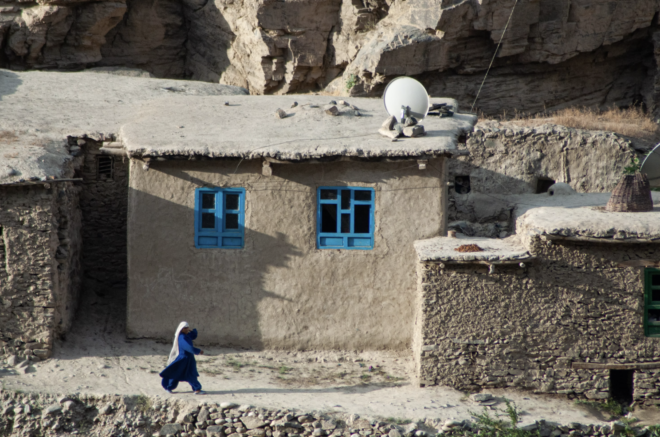
Afghanistan woman walking in village, blue windows

The squares were sewn together to make a blanket, a bedspread, a shawl, or a lap covering: functional for sleighing or sleeping,  and decorative to boot. These “motif” afghans came to be known as “Granny Square Afghans” as grandma was commonly its maker.

Made of many colors, it resembled a particular type of colorful Colonial-era rug brought over from England, by way of the Middle East. A plausible explanation as to how a blanket became an afghan.

Knitters have popularity problems.

We’re great with other knitters, can endlessly ooh and aah over yarn choices and technique. But if you know a knitter, you can probably recall the exact moment when you hit saturation for gifts of knitted goodness.  Dreading another sweater or scarf.  Straining to demonstrate appropriate gratitude for the hours of labor spent on that goofy hat.

If you’re a knitter, you’ve felt the pain of handmade gifts that miss their mark.  Suffered through lukewarm receptions for your latest creation; cringed through sightings of fine garments shrunk doll-size by someone ignorant in the ways of wool.

Thank God for Darwinian adaptation: knitters evolve into amped-up charity-goods machines.  An ideal solution, matching knitters with people who actually want knits. Prayer shawls, preemie blankets, chemo caps, and toys for tots.  Soldiers and sailors get socks and hats,  amputees get stump-warmers.  There’s a charity happy to receive most anything that flies off the needles. The internet is an enabler.

Afghans for Afghans is one of the most famous: a humanitarian project that sends handknit and crocheted goods to the good people of Afghanistan. Self-billed as an educational and “people-to-people” program, this grassroots effort was inspired by decades of Red Cross volunteers who made socks, slippers, and yes, afghans, for World War I and II refugees and soldiers.  Volunteers like my grandma Rose.

They work with reputable relief agencies to securely transport and distribute the goods to beleaguered Afghans.  Their website sells knitting patterns for Afghani-style garments; offers info on what needs to be knitted; and accepts cash donations.

So here I am making warm blankets from scraps of surplus yarn, in a style inspired by rich Eastern textiles, to be shared with the people who inspired the original.  The concept’s as brilliant as the colors in an afghan.

LEAVE A REPLY

Please enter your comment!
Please enter your name here

TRENDING

Levis is teaching Gen Z how to repair their clothes –– download all the teacher guides here

Somewhere between TikTok hauls and next-day delivery, we forgot how to fix things. We forgot how to cook without an app and a pre-made box, grow food without a kit, and sew a button back onto a shirt without throwing the whole garment away. Clothing, once stitched with intention (my mother made her ow dresses!), has become disposable. And with it, a quiet loss of skill, patience, and care.

Urban miner Sortera raises $45 million USD to pull aluminum from the scrap pile

Sortera Technologies, founded in 2020 by Nalin Kumar and Manuel Garcia, is emerging as a major U.S. circular-industry player. Led by CEO Michael Siemer, the company uses AI and advanced sensors to turn scrap metal into high-value aluminum alloys. Its new ~$45 million funding round signals investor appetite for industrial decarbonisation—where emissions cuts come not from PR-friendly solar installs, but from upgrading the materials that power EVs, solar frames, and construction.

Waste Reform from the Ground Up: How Trash Balers Are Helping Cities Rethink Sustainability

If you’ve ever watched a recycling truck weaving through city streets, you’ve seen the problem firsthand. Most of what we call “recycling” still depends on long-distance transportation and centralized sorting facilities. Those systems are energy-intensive and prone to contamination — the dreaded mix of wet food, plastic wrap, and paper that renders recyclables useless.

Afghanistan’s earthquake and mud-brick homes. Can they rebuild safer and more sustainably?

A 6.0-magnitude earthquake in eastern Afghanistan killed over 800 people as mud-brick homes collapsed in rain-soaked landslides. Here’s why traditional earthen houses failed, how human-driven slope damage worsened the disaster, and how sustainable, earthquake-resistant construction can save lives.

Scientists Crack the Code for Low-Cost, Low-Carbon Plastic Recycling

While enzymatic recycling offers hope for managing existing plastic waste, scientists and environmental advocates agree it must be paired with the development of bio-based plastics—materials made from renewable biological sources like corn starch, sugarcane, or algae. Unlike conventional plastics derived from fossil fuels, bio-based alternatives can dramatically reduce carbon emissions at the production stage and are often compatible with closed-loop recycling.

Qatar’s climate hypocrisy rides the London Underground

Qatar remains a master of doublethink—burning gas by the megaton while selling “sustainability” to a world desperate for clean air. Wake up from your slumber people.

How Quality of Hire Shapes Modern Recruitment

A 2024 survey by Deloitte found that 76% of talent leaders now consider long-term retention and workforce contribution among their most important hiring success metrics—far surpassing time-to-fill or cost-per-hire. As the expectations for new hires deepen, companies must also confront the inherent challenges in redefining and accurately measuring hiring quality.

8 Team-Building Exercises to Start the Week Off 

Team building to change the world! The best renewable energy companies are ones that function.

Thank you, LinkedIn — and what your Jobs on the Rise report means for sustainable careers

While “green jobs” aren’t always labeled as such, many of the fastest-growing roles are directly enabling the energy transition, climate resilience, and lower-carbon systems: Number one on their list is Artificial Intelligence engineers. But what does that mean? Vibe coding Claude? 

Somali pirates steal oil tankers

The pirates often stage their heists out of Somalia, a lawless country, with a weak central government that is grappling with a violent Islamist insurgency. Using speedboats that swarm the targets, the machine-gun-toting pirates take control of merchant ships and then hold the vessels, crew and cargo for ransom.

Leopoldo Alejandro Betancourt López Turned Ocean Plastic Into Profitable Sunglasses

Few fashion accessories carry the environmental burden of sunglasses. Most frames are constructed from petroleum-based plastics and acrylic polymers that linger in landfills for centuries, shedding microplastics into soil and waterways long after they've been discarded. Leopoldo Alejandro Betancourt López, president of the Spanish eyewear brand Hawkers, saw this problem differently than most industry executives.

Why Dr. Tony Jacob Sees Texas Business Egos as Warning Signs

Everything's bigger in Texas. Except business egos.  Dr. Tony Jacob figured...

Israel and America Sign Renewable Energy Cooperation Deal

Other announcements made at the conference include the Timna Renewable Energy Park, which will be a center for R&D, and the AORA Solar Thermal Module at Kibbutz Samar, the world's first commercial hybrid solar gas-turbine power plant that is already nearing completion. Solel Solar Systems announced it was beginning construction of a 50 MW solar field in Lebrija, Spain, and Brightsource Energy made a pre-conference announcement that it had inked the world's largest solar deal to date with Southern California Edison (SCE).

Related Articles

Popular Categories