After the Fire: Israel’s Carmel Forest Doesn’t Need Our Help

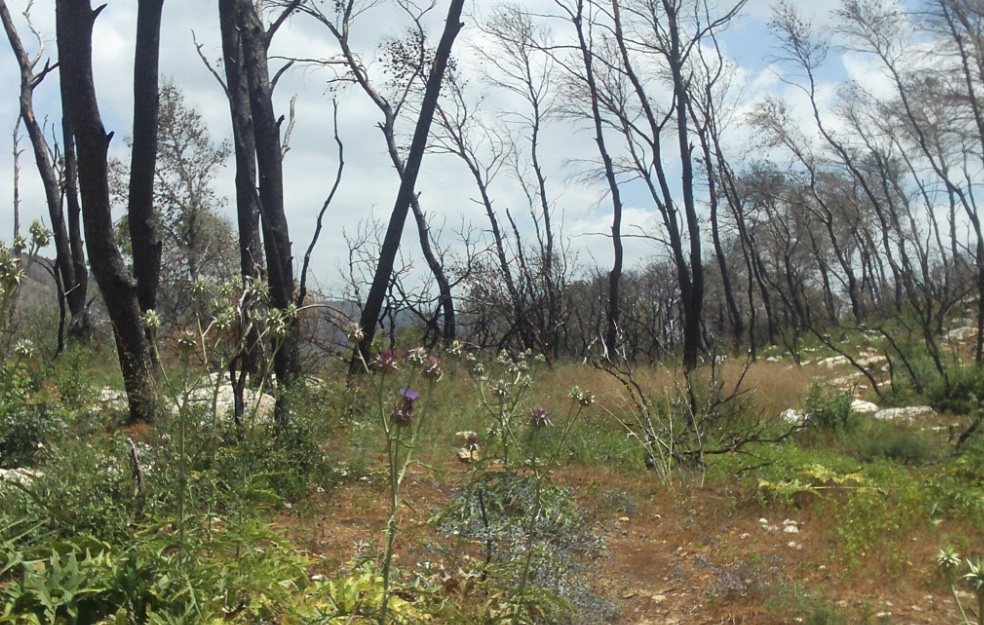
israel fire regrowthA year after the fire in Israel, Joshua finds new life at the ravaged Carmel Forest.

Israel experienced the largest wildfire in the country’s history nearly a year ago. The blaze broke out near Isifiya, in the Carmel region, on December 2, 2010.  Spreading over large swaths of land overnight, the fire quickly consumed 5,000 hectares before emergency crews extinguished it. Firefighters were able to gain the upper hand only after four days.  A large amount of fuel on the forest floor – dry material accumulated from a hot summer – hastened its progression.

It was a tragedy on both a geographic and human scale.  Fourty-four people perished. When the smoke cleared, a shocked country was left grieving and devastated.  After the funerals and memorials, Israelis considered their options.

The natural reaction for many was to begin replanting. The Zionist pioneers of Israel highly valued tree planting.  This act fulfilled a very basic tenet of Judaism.  Jews are obligated by the Torah to plant fruit trees to settle the land.  Additionally, planting trees provides agriculture, shade, a haven for wildlife, and aesthetic value.  So central are trees to Jewish life and philosophy that Jews refer to the Torah, their holiest book, as the “Tree of Life”.

But several ecologists warned that replanting too soon could be counterproductive as it may disturb nature’s own healing process.  The Jewish National Fund and the Society for Protection of Nature in Israel managed to convince the government not to replant immediately after the fire.  Their reasoning was that nature possesses far superior restorative abilities than man.

Researchers studying rehabilitation of the Sha’ar Ha-gai (just west of the Jerusalem Hills) Forest Fire in 1995 concluded that replanting is not necessarily successful in accelerating forest regeneration.  The Sha’ar Ha-gai study showed that areas which were replanted did not grow faster than areas left alone.

Thus, the government agreed to wait one year before making any decisions about rehabilitating the Carmel.  The advice of ecologists from the University of Haifa and elsewhere was very influential in the decision.

But as we approach the anniversary of the Carmel fire, there is mounting pressure on the government to begin a restoration campaign.  The forest, once a lush haven for hikers and nature enthusiasts, has become an eyesore.  Large swaths of blackened treetops can be seen from nearly every vantage point in the area.

The Israeli Cabinet authorized $15 million USD for the Carmel area this past summer, including an outlay for reforestation.  JNF crews have been active in the area recently, thinning brush and removing burned trees to ease the struggle of seedlings.  They have also surveyed the area to determine where to plant oak, cypress, pistachio, and pine trees.  The Carmel has the only population of Aleppo pine trees on the eastern Mediterranean coast.

And a month ago, Cyprus presented the State of Israel with 300 trees as a gift for the Jewish New Year.  After a ceremony honoring speedy Cyprian aid during the crisis, the attendees got to work planting the trees.

There is great momentum toward a full restoration effort.  But the rush to restore could be a mistake.   It could interfere with an important natural process.   Experts remark on the forest’s adaptation to fire regimes, which have existed throughout the region’s history.

Professor Ido Izhaki, Director of the Carmel Research Center at the University of Haifa, says we need not interfere too much.  “There are plant species [there] that have developed resilience to fire and those that have developed a dependency on fire, such as the Aleppo pine.”

The Aleppo pine cones actually require heat from fire to open.  This process releases their seeds to the ground.  “After this enormous fire, the Carmel will be covered with pine buds,” Izhaki says.

The once great Carmel Forest will return regardless of what we do.  But its return should be heralded by nature, not by the desperate acts of men.  What greater gesture of love for the forest than to leave it in peace?

Joshua Basofin
Joshua Basofinhttp://www.greenprophet.com
Joshua is an environmental attorney and writer living in Tel Aviv. He has worked for several conservation groups in his native United States, including The Nature Conservancy and Defenders of Wildlife. Joshua specializes in laws and policies aimed at protecting natural areas. He has a particular interest in freshwater and marine habitats. Growing up in the suburbs of Middle America, Joshua learned to escape into nature and leave the strip malls and parking lots behind. He has hiked and explored around the world, from South America to Australia to Thailand. Joshua is fascinated by the often polarizing worlds of tradition and modernity. He thrives on studying the intersection of environmental conservation, religion, and human culture. And he may have found his greatest challenge yet in Israel.

LEAVE A REPLY

Please enter your comment!
Please enter your name here

TRENDING

Earth building with Dead Sea salt bricks

Researchers develop a brick made largely from recycled Dead Sea salt—offering a potential alternative to carbon-intensive cement.

Farm To Table Israel Connects People To The Land

Farm To Table Israel is transforming the traditional dining experience into a hands-on journey.

Funeral for a Tree plays birdsong from tree rings of beloved oak

When a 65-year-old oak tree in Steve Parker’s yard died from fungal disease, he did not cut it into firewood or haul it away. He did not erase it. He cut the tree into disks and then turned them into records that play birdsong –– a touching tribute to the years that the tree was house and home to birds and all manners of creatures. 

Remilk makes cloned milk so cows don’t need to suffer and it’s hormone-free

This week, Israel’s precision-fermentation milk from Remilk is finally appearing on supermarket shelves. Staff members have been posting photos in Hebrew, smiling, tasting, and clearly enjoying the moment — not because it’s science fiction, but because it tastes like the real thing.

An Army of Healers Wins the 2025 IIE Goldberg Prize for Peace in the Middle East

In a region more accustomed to headlines of loss than of listening, the Institute of International Education (IIE) has chosen to honor something quietly radical: healing. The 2025 Victor J. Goldberg Prize for Peace in the Middle East has been awarded to Nitsan Joy Gordon and Jawdat Lajon Kasab, the co-founders of the Army of Healers, for building spaces where Israelis and Palestinians — Jews, Muslims, Christians, Druze, and Bedouins — can grieve, speak, and rebuild trust together.

Qatar’s climate hypocrisy rides the London Underground

Qatar remains a master of doublethink—burning gas by the megaton while selling “sustainability” to a world desperate for clean air. Wake up from your slumber people.

How Quality of Hire Shapes Modern Recruitment

A 2024 survey by Deloitte found that 76% of talent leaders now consider long-term retention and workforce contribution among their most important hiring success metrics—far surpassing time-to-fill or cost-per-hire. As the expectations for new hires deepen, companies must also confront the inherent challenges in redefining and accurately measuring hiring quality.

8 Team-Building Exercises to Start the Week Off 

Team building to change the world! The best renewable energy companies are ones that function.

Thank you, LinkedIn — and what your Jobs on the Rise report means for sustainable careers

While “green jobs” aren’t always labeled as such, many of the fastest-growing roles are directly enabling the energy transition, climate resilience, and lower-carbon systems: Number one on their list is Artificial Intelligence engineers. But what does that mean? Vibe coding Claude? 

Somali pirates steal oil tankers

The pirates often stage their heists out of Somalia, a lawless country, with a weak central government that is grappling with a violent Islamist insurgency. Using speedboats that swarm the targets, the machine-gun-toting pirates take control of merchant ships and then hold the vessels, crew and cargo for ransom.

Leopoldo Alejandro Betancourt López Turned Ocean Plastic Into Profitable Sunglasses

Few fashion accessories carry the environmental burden of sunglasses. Most frames are constructed from petroleum-based plastics and acrylic polymers that linger in landfills for centuries, shedding microplastics into soil and waterways long after they've been discarded. Leopoldo Alejandro Betancourt López, president of the Spanish eyewear brand Hawkers, saw this problem differently than most industry executives.

Why Dr. Tony Jacob Sees Texas Business Egos as Warning Signs

Everything's bigger in Texas. Except business egos.  Dr. Tony Jacob figured...

Israel and America Sign Renewable Energy Cooperation Deal

Other announcements made at the conference include the Timna Renewable Energy Park, which will be a center for R&D, and the AORA Solar Thermal Module at Kibbutz Samar, the world's first commercial hybrid solar gas-turbine power plant that is already nearing completion. Solel Solar Systems announced it was beginning construction of a 50 MW solar field in Lebrija, Spain, and Brightsource Energy made a pre-conference announcement that it had inked the world's largest solar deal to date with Southern California Edison (SCE).

Related Articles

Popular Categories