
School’s In: Turkish Teachers Learn How To Teach Ecoliteracy

How should teachers incorporate environmental ethics and lessons on sustainability into their classrooms? That’s the focus of a four-year educational ecoliteracy project — Turkey’s first — which has just begun.

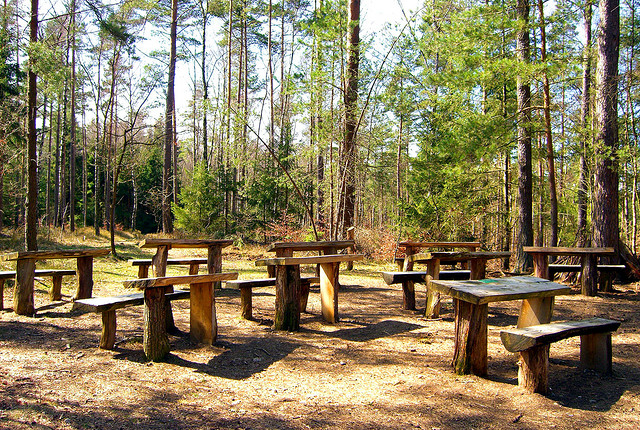
A training program for Turkish teachers kicked off this week in an unusual classroom: an arboretum in the northwestern province of Yalova. Beneath Yalova’s graceful willows, 75 teachers will spend the next week studying environmental issues from soil erosion to ethical forestry. They will be Turkey’s first certified “ecoliteracy instructors”, authorized by the Ministry of Education to share principles of sustainability with their schools.

Sponsored by the Ministry of Education and the Turkish Foundation for Combating Soil Erosion, Reforestation, and the Protection of Natural Habitats (TEMA), the project aims to certify 300 teachers over the next four years. Scientific experts and specially designed materials will be used to give each teacher participant a well-rounded educational in environmental issues, with a special focus on sustainability.

The need for ecoliterate education in Turkey

It’s appropriate that an ecoliteracy program is taking place in Yalova.

A major Turkish manufacturer, AKSA, is planning to build a coal- and natural gas-fired power plant in Yalova, an earthquake-prone but beautiful resort region. A previous AKSA plant caused huge damage to the area during the 1999 earthquake that devastated northwestern Turkey. When the Yalova Environmental Platform held a press conference to raise awareness about the potential danger of building a coal-fired plant in their region, AKSA sued the platform’s members.

Unfortunately, this story is being repeated at many sites around Turkey where thermal power plants are being built. It suggests that better environmental education is seriously needed at many levels of Turkish society.

“We need to plan accordingly so that we don’t make the same mistakes we do now,” said TEMA Education Head Burcu Arık.

“Nothing we have — whether it is the way we treat the environment or the education system — is sustainable. We must teach the next generation to live within the principles of nature.”

The four noble truths of the ecoliteracy program, according to Arık, are: everything is inter-dependent, everything is in flux, nothing lasts forever, and nature always has the last word.

Ecoliterate education: a global trend

This is Turkey’s first ecoliterate education program and one of the only nation-wide ecoliteracy projects in the world. Other schools throughout the Middle East have increasingly been incorporating environmental ethics into their curricula, however.

The 12th graders at the Al-Ain Liwa International School in the UAE, for example, designed a “green wall” for their school, which is just the first ina  series of “greenovation” projects the administration is taking. And last autumn, Bahrain University held a two-day exhibition of environmentally friendly projects designed by its students, including a water-recycling system for mosques and solar heating/cooling systems.

Of course, you don’t need to have government funding or even a school to promote environmental education. It can be as easy as giving the children in your life a patch of dirt: an environmental microcosm to care for, and on which to practice their sustainable stewardship.

:: Today’s Zaman

Read more about ecoliterate education:

Al-Ain Jungle School: Other UAE Institutes Are “Green” With Envy

Make Greener Children With A Patch Of Dirt

Bahrain University Exhibits Eco-Friendly Inventions Created By Students

Image via paraflyer

Julia Harte
Julia Hartehttp://www.greenprophet.com
Julia spent her childhood summers in a remote research station in the Rocky Mountains of Colorado, helping her father with a 25-year-old experiment in which he simulated global warming over a patch of alpine meadow. When not measuring plant species diversity or carbon flux in the soil, she could be found scampering around the forests and finding snowbanks to slide down. Now she is a freelance journalist living in Istanbul, where her passion for the environment intersects with her interest in Turkish politics and grassroots culture. She also writes about Turkish climate and energy policy for Solve Climate News.

Hot this week

The Christ’s thorn (sidr tree) is also a well-known folk medicine

Christ’s thorn jujube (Ziziphus spina-christi) also known as the sidr tree is a real, identifiable tree native to the Middle East, and it appears—directly or indirectly—in Islam, Judaism, and later Christian tradition. The connections between the three faiths are not theological agreements but overlapping uses, names, and symbolic associations rooted in the same landscape.

Farm To Table Israel Connects People To The Land

Farm To Table Israel is transforming the traditional dining experience into a hands-on journey.

The Lote Tree of the Utmost Boundary, explained

In Islamic tradition, there is a point where creation ends — a boundary that marks the limit of what any created being can reach. That boundary is called Sidrat al-Muntahā, often translated as “the Lote Tree of the Utmost Boundary.”

The Air Tea Kettle creates a new way to meet plants and herbalism

Air Tea is a new technology. Instead of drinking tea, you inhale herbal vapor through warm air extraction. There is no water and no combustion. The warm air releases essential oils that are often lost in hot water and digestion.

Why Health Systems Are Reaching a Turning Point

Health emerges from a continuous energy and material flow from water through food to human physiology. Technical energy systems support this cycle through water treatment, agriculture, and infrastructure.

Topics

The Christ’s thorn (sidr tree) is also a well-known folk medicine

Christ’s thorn jujube (Ziziphus spina-christi) also known as the sidr tree is a real, identifiable tree native to the Middle East, and it appears—directly or indirectly—in Islam, Judaism, and later Christian tradition. The connections between the three faiths are not theological agreements but overlapping uses, names, and symbolic associations rooted in the same landscape.

Farm To Table Israel Connects People To The Land

Farm To Table Israel is transforming the traditional dining experience into a hands-on journey.

The Lote Tree of the Utmost Boundary, explained

In Islamic tradition, there is a point where creation ends — a boundary that marks the limit of what any created being can reach. That boundary is called Sidrat al-Muntahā, often translated as “the Lote Tree of the Utmost Boundary.”

The Air Tea Kettle creates a new way to meet plants and herbalism

Air Tea is a new technology. Instead of drinking tea, you inhale herbal vapor through warm air extraction. There is no water and no combustion. The warm air releases essential oils that are often lost in hot water and digestion.

Why Health Systems Are Reaching a Turning Point

Health emerges from a continuous energy and material flow from water through food to human physiology. Technical energy systems support this cycle through water treatment, agriculture, and infrastructure.

Sustainability That Sells: How Profit and Purpose Come Together in the Hive

Whether you are a commercial grower, hobbyist beekeeper or retail equipment supplier, this system opens a new income stream with minimal environmental impact.

The Fitness App Revolution: Building the Future of Wellness Through Strategic Development

In an era where smartphones are ubiquitous and health consciousness is at an all-time high, the fitness industry has undergone a radical digital transformation. Fitness applications have moved far beyond simple pedometers, evolving into comprehensive wellness platforms that serve as personal trainers, nutritionists, and community hubs right in our pockets.

A Brief History of Basil From India to Italy

Beloved, fortunate, sweet, and royal; an herb with a long and storied history in Asia and across the world. Called by many names, basil has featured in previous Green Prophet articles, so enjoy another serving, a brief history of basil.

Related Articles

Popular Categories