Giant Squid Kraken Sea Monster Caught on Video

The journal Nature reports that a team of ocean researchers have captured the world’s first video of a giant squid (Architeuthis dux) in its natural environment. The video was captured 700 meters (2300 feet) beneath the Pacific near the Ogasawara archipelago,  about 1000 kilometers south of Tokyo Japan. The mission was funded by Japan’s NHK broadcasting commission and the US-based Discovery Channel, both of which will air programs about the giant squid encounter later this month.

Widder’s camera relied on a dim light in the red, near-infrared range. And you can see the results for yourself here:

[youtube]http://www.youtube.com/watch?v=uLRY1cNxL1I[/youtube]

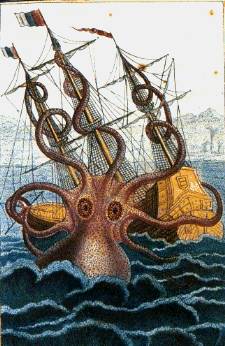
Sailors have known about giant squid for centuries. But ancient whalers and fishermen didn’t carry video equipment and so their fish stories were filed with tales of dragons, mermaids and other sea monsters. The Nordic tales of a sea monster named Kraken may have been based upon rare sightings of the giant squid.

It doesn’t help our believability that these tales were often exaggerated. The Kraken was said to reside in the deep ocean and attract many fish to itself. It was said to only briefly rise to the surface. So far this sounds very much like a giant squid, but the Kraken was also said to be so large that it was sometimes mistaken for an island. Its mouth was described to gape as large as the entrance to a fjord.

Well, fish stories are known for their exaggerations. The giant squid is estimated to grow as large as 15 meters (50 feet) in length, not quite the size of a fjord but something sure to frighten the daylights out of sailor. In his poem, The Kraken (1830), Alfred Tennyson writes:colossal octopus by pierre denys de montfort kraken giant squid
Below the thunders of the upper deep;

Far far beneath in the abysmal sea,

His ancient, dreamless, uninvaded sleep

The Kraken sleepeth: faintest sunlights flee

About his shadowy sides; above him swell

Huge sponges of millennial growth and height;

And far away into the sickly light…

In 20,000 Leagues Under the Sea, Jules Verne writes:

“I stared in my turn and couldn’t keep back a movement of revulsion. Before my eyes there quivered a horrible monster worthy of a place among the most farfetched teratological legends. It was a squid of colossal dimensions, fully eight meters long. It was traveling backward with tremendous speed in the same direction as the Nautilus. It gazed with enormous, staring eyes that were tinted sea green.

Its eight arms (or more accurately, feet) were rooted in its head, which has earned these animals the name cephalopod; its arms stretched a distance twice the length of its body and were writhing like the serpentine hair of the Furies. You could plainly see its 250 suckers, arranged over the inner sides of its tentacles and shaped like semispheric capsules. Sometimes these suckers fastened onto the lounge window by creating vacuums against it. The monster’s mouth–a beak made of horn and shaped like that of a parrot–opened and closed vertically. Its tongue, also of horn substance and armed with several rows of sharp teeth, would flicker out from between these genuine shears. What a freak of nature!”

Like the monster which attacked Captain Nemo’s submarine and the mythical Kraken, the giant squid spends much of its life in the silent darkness of the deep ocean. This is one reason so few have seen it alive. Occasionally a dead one would wash ashore but because this creature is adapted to cold high pressure water of the deep ocean, it quickly decayed on the surface as Tennyson’s poem ends:

Then once by man and angels to be seen,
In roaring he shall rise and on the surface die

Other clues to the giant squid’s existence are the scars its suckered tentacles leave on sperm whales. These squids are thought to be the only predator large enough to take on a beast of this size.

The first photograph of a giant squid in its native environment was taken by Tsunemi Kubodera of the National Science Museum in Tokyo and Kyoichi Mori of the Ogasawara Whale Watching Association in this same region of the Pacific ocean in the autumn of 2004.

The video taken by this more recent expedition relied on a camera system invented by Edith Widder, founder of the Ocean Research and Conservation Association in Fort Pierce, Florida. Widder believes that the key to this mission’s success was the focus on the squid’s keen sense of sight. Giant squids are accustomed to the darkness of the deep ocean, their eyes, the size of dinner plates, are sensitive to the dim light of bioluminescent prey, so bright camera lights would disturb it and possibly frighten it away.


Brian Nitz
Brian Nitzhttp://www.greenprophet.com
Brian remembers when a single tear dredged up a nation's guilt. The tear belonged to an Italian-American actor known as Iron-Eyes Cody, the guilt was displaced from centuries of Native American mistreatment and redirected into a new environmental awareness. A 10-year-old Brian wondered, 'What are they... No, what are we doing to this country?' From a family of engineers, farmers and tinkerers Brian's father was a physics teacher. He remembers the day his father drove up to watch a coal power plant's new scrubbers turn smoke from dirty grey-back to steamy white. Surely technology would solve every problem. But then he noticed that breathing was difficult when the wind blew a certain way. While sailing, he often saw a yellow-brown line on the horizon. The stars were beginning to disappear. Gas mileage peaked when Reagan was still president. Solar panels installed in the 1970s were torn from roofs as they were no longer cost-effective to maintain. Racism, public policy and low oil prices transformed suburban life and cities began to sprawl out and absorb farmland. Brian only began to understand the root causes of "doughnut cities" when he moved to Ireland in 2001 and watched history repeat itself. Brian doesn't think environmentalism is 'rocket science', but understanding how to apply it within a society requires wisdom and education. In his travels through Europe, North America, Asia and the Middle East, Brian has learned that great ideas come from everywhere and that sharing mistakes is just as important as sharing ideas.
2 COMMENTS
  1. The primary video that was shot for the Discovery Channel’s upcoming series was shot by Tsunemi Kubodera, his cameraman, and Jim Harris piloting the vehicle, a Triton 3300 submersible.

Comments are closed.

Hot this week

The Fitness App Revolution: Building the Future of Wellness Through Strategic Development

In an era where smartphones are ubiquitous and health consciousness is at an all-time high, the fitness industry has undergone a radical digital transformation. Fitness applications have moved far beyond simple pedometers, evolving into comprehensive wellness platforms that serve as personal trainers, nutritionists, and community hubs right in our pockets.

A Brief History of Basil From India to Italy

Beloved, fortunate, sweet, and royal; an herb with a long and storied history in Asia and across the world. Called by many names, basil has featured in previous Green Prophet articles, so enjoy another serving, a brief history of basil.

How Renewable Energy is Revolutionizing the Way We Power Our World

Solar has become the star of the transition thanks to modular hardware and straightforward installation. It fits dense cities and remote towns alike. Many companies are turning to rooftop arrays and carport systems - and exploring commercial solar installation as a practical way to lock in future savings.

How does one start prepping?

Faced with an extreme winter storm this year, Americans wonder how to be prepared for catastrophe. Miriam has lived through wars in the Middle East - so she's prepared on giving you a guide to prepping.

Fishermen sue tire manufacturers on behalf of the salmon

A federal trial in San Francisco has brought US tire manufacturers, fishing groups, and environmental scientists into court over a chemical most drivers have never heard of — but which scientists say may be silently reshaping aquatic ecosystems.

Topics

The Fitness App Revolution: Building the Future of Wellness Through Strategic Development

In an era where smartphones are ubiquitous and health consciousness is at an all-time high, the fitness industry has undergone a radical digital transformation. Fitness applications have moved far beyond simple pedometers, evolving into comprehensive wellness platforms that serve as personal trainers, nutritionists, and community hubs right in our pockets.

A Brief History of Basil From India to Italy

Beloved, fortunate, sweet, and royal; an herb with a long and storied history in Asia and across the world. Called by many names, basil has featured in previous Green Prophet articles, so enjoy another serving, a brief history of basil.

How Renewable Energy is Revolutionizing the Way We Power Our World

Solar has become the star of the transition thanks to modular hardware and straightforward installation. It fits dense cities and remote towns alike. Many companies are turning to rooftop arrays and carport systems - and exploring commercial solar installation as a practical way to lock in future savings.

How does one start prepping?

Faced with an extreme winter storm this year, Americans wonder how to be prepared for catastrophe. Miriam has lived through wars in the Middle East - so she's prepared on giving you a guide to prepping.

Fishermen sue tire manufacturers on behalf of the salmon

A federal trial in San Francisco has brought US tire manufacturers, fishing groups, and environmental scientists into court over a chemical most drivers have never heard of — but which scientists say may be silently reshaping aquatic ecosystems.

Listening to Water: Tarek Atoui’s Next Work for Tate Modern

Born in Beirut, Lebanon in 1980 and now living in Paris, Atoui has spent years building instruments that don’t sit comfortably in concert halls. Many of them involve water, glass, and ceramics — materials that react to sound instead of simply producing it.

Leading Through a Dual-Energy Transition: Balancing Decarbonisation with Energy Security

Experience in one area of the energy industry isn't enough to guarantee readiness across all the others. That's where a structured program like an MBA in energy can come in. Today's advanced curricula explore energy economics, finance, policy, and strategic management alongside the technical subjects. And when pursuing an energy MBA online, professionals can skill up and retrain without having to step out of the labor market -- an important perk at a time when skilled professionals are already in short supply.

From Green Energy to Healthy Societies: Why old systems thinking is becoming relevant again

Across the Middle East and North Africa, large investments are being made in green hydrogen, renewable energy, water infrastructure and sustainability. Most of these efforts are discussed in the context of climate change, decarbonization and economic diversification. That framing is important, but it may not capture their full value.

Related Articles

Popular Categories