

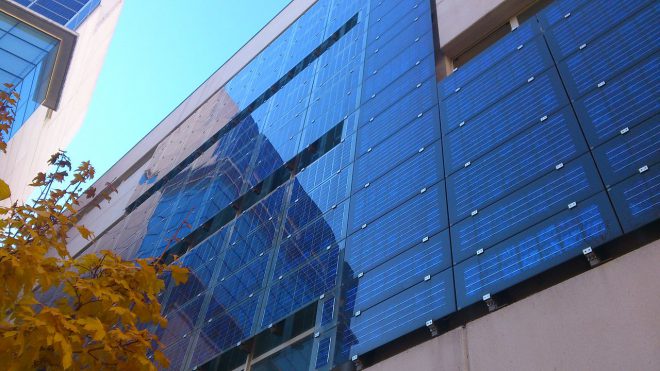
 Using data from NASA, double sided, tilting solar panels create 35% more energy, on average, than immobile single-panel photovoltaic systems, while reducing the cost of electricity by an average of 16%. Above photo via Solup.
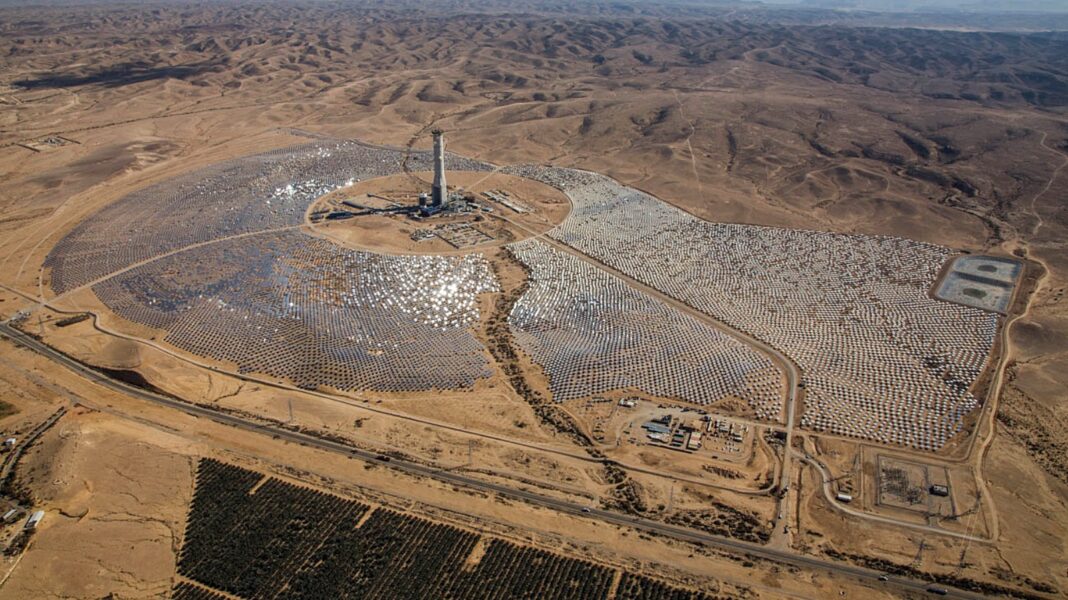
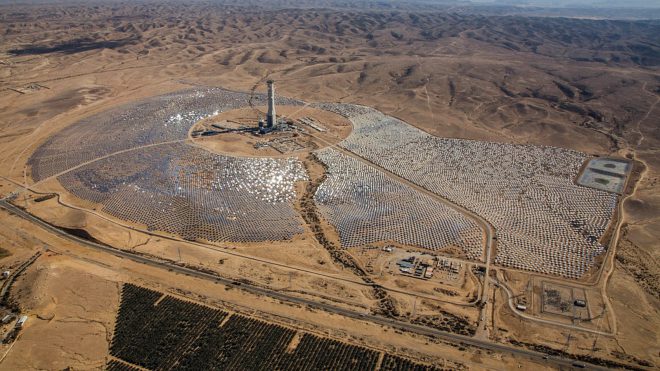
So many types of solar energy technology from panels to types of collection methods, have come and gone, or have come and gone but still been built despite no longer being efficient systems. This happened in Israel at its Ashalim plant, pictured below. What seemed like a great idea when it was financed with attractive feed-in tariff guarantees, no longer holds its salt when it’s built. The amount of energy gone into it costs more than the price of energy it can sell. Okay, of course, the environment wins, and so do investors but not taxpayers: The technology is already out of date. So how do solar energy companies prepare for tomorrow, or at least the next 10 years? They follow science and trends.
The price of oil has hit rock bottom so investment in renewables is up: Solar power systems with double-sided – known as bifacial solar panels in the industry– which collect sunlight from two sides instead of one — and a single-axis tracking technology that tilts the panels so they can follow the sun are the most cost effective to date, researchers now report. The study is released in the science journal Joule.
The scientists determined that this combination of technologies produces almost 35% more energy, on average, than immobile single-panel photovoltaic systems, while reducing the cost of electricity by an average of 16%.
“The results are stable, even when accounting for changes in the weather conditions and in the costs from the solar panels and the other components of the photovoltaic system, over a fairly wide range,” says first author Carlos Rodríguez-Gallegos, from the Solar Energy Research Institute of Singapore: “This means that investing in bifacial and tracking systems should be a safe bet for the foreseeable future.”
Research efforts tend to focus on further boosting energy output from solar power systems by improving solar cell efficiency, but the energy yield per panel can also be increased in other ways. Double-sided solar panels, for example, produce more energy per unit area than their standard counterparts and can function in similar locations, including rooftops.
This style of solar panel, as well as tracking technology that allows each panel to capture more light by tilting in line with the sun throughout the day, could significantly improve the energy yield of solar cells even without further advancements in the capabilities of the cells themselves. However, the combined contributions of these recent technologies have not been fully explored. A whole industry of companies that produce tracking technologies needs to be investigated.
To identify the global economic advantages associated with the use of a variety of paired photovoltaic technologies, Rodríguez-Gallegos and colleagues first used data from NASA’s Clouds and the Earth’s Radiant Energy System (CERES) to measure the total radiation that reaches the ground each day.
The researchers further tailored this data to account for the influence of the sun’s position on the amount of radiation a solar panel can receive based on its orientation, and then calculated the average net cost of generating electricity through a photovoltaic system throughout its lifetime.
Focused on large commercial PV systems
They focused on large photovoltaic farms composed of thousands of modules rather than smaller photovoltaic systems, which generally include higher associated costs per module. The team validated their model using measured values from experimental setups provided by three institutes and incorporated additional weather parameters to perform a worldwide analysis.
The model suggests that double-sided solar panels combined with single-axis tracking technology is most cost effective almost anywhere on the planet, although dual-axis trackers — which follow the sun’s path even more accurately but are more expensive than single-axis trackers — are a more favorable substitute in latitudes near the poles. But despite this technology’s clear benefits, Rodríguez-Gallegos does not expect this style of photovoltaic system to become the new standard overnight.
“The photovoltaics market is traditionally conservative,” he says. “More and more evidence points toward bifacial and tracking technology to be reliable, and we see more and more of it adopted in the field. Still, transitions take time, and time will have to show whether the advantages we see are attractive enough for installers to make the switch.”
While this work considers standard silicon-based solar cells, Rodríguez-Gallegos and colleagues next plan to analyze the potential of tracking systems combined with pricey, top-of-the-line solar materials with higher efficiencies (called tandem technologies), which are currently limited to heavy-duty concentrator photovoltaics and space applications.
“As long as research continues to take place, the manufacturing costs of these materials are expected to keep on decreasing, and a point in time might be reached when they become economically competitive and you might see them on your roof,” says Rodríguez-Gallegos. “We then aim to be a step ahead of this potential future so that our research can be used as a guide for scientists, manufacturers, installers, and investors.”



[…] already agree that when it comes to optimizing solar power efficiencies, two-sided solar panels are better than one. An MIT study (links to a PDF) shows major opportunities for 3D photovoltaic systems. Based on these […]