Cool innovation shocks salt from sea water

MIT-fracking-pond_0

Water, water everywhere but not a drop to drink!

Desalinating sea water is a costly and energy consuming way of providing fresh water in many parts of world. Though methods such as Graphene-Nanotechnology makes desalination more efficient, the end result is still problematic due to clogging of separation filters.

Returning heavily saline brine residue back to the sea makes seawater even more saline.

Rich countries and states like California, Saudi Arabia, Qatar and even Israel don’t care about cost of desalination to the national energy bill or to greenhouse gas emissions. We have said before and we will say again, desalination is not efficient and should only be used in a last-case scenario.

New research promises a more energy way to desalinate?
Mideast Israel Palestinians Water Source

A much more efficient way of separating salt from sea or brackish water by literally shocking the salt from the water is being developed by a research team at the Massachusetts Institute of Technology (MIT). Invented by an MIT research team, the system uses an electrically driven shockwave within a stream of flowing water that literally pushes salty water to one side of the flow and fresh water to the other.

This allows easy separation of the two streams without needing a filtration membrane.  The team leader, Professor Martin Bazant, a professor of chemical engineering and mathematics, says that the electrolysis process is a “fundamentally new and different separation system that forms a membrane-less separation of ions and particles.”

The new electrical shocking system works without using a traditional desalination system of reverse osmosis  or conventional electrodialysis, “This process looks similar to electrodialysis, but it’s fundamentally different,” says Bazant.

Besides the high costs involved, one of the biggest problems of conventional desalination is the clogging or fouling — a buildup of filtered material; or to degradation due to water pressure.

This often occurs with conventional membrane-based desalination, including conventional electrodialysis: “With our system, the charged salt particles, or ions, “just move to one side,” says Bazant.

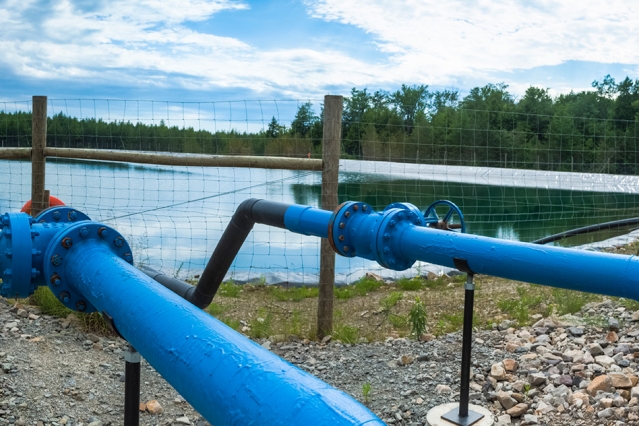
One of the more promising uses of the electrical shocking system is removing salt and other impurities from brackish water; including cleaning of large amounts of wastewater generated by hydraulic fracturing, or fracking.
saudi-arabia-desalination-jubail-500x352

Since the electro shocking process does not require the large infrastructure needed by conventional desalination, it can be used to clean saline waste water extracted by oil and gas wells: “The electric fields created by this process are pretty high, so we may be able to kill the bacteria in the water,” says Sven Schlumpberger, a graduate student also working on the project.

The electro shocking process being worked on by Professor Bazant and his colleagues is still in the developmental process; so it may be a while until it is actually put into use on a commercial scale. As a viable alternative to conventional desalination methods, it does appear to be promising.

What to do with the salt that “moves off to one side” willstill be an issue that will have to be dealt with, however.

Dive into our resources on desalination:

Graphene nanotechnology makes desalination 100 times more efficient
Cyprus gets new desalination plant with Mekorot Israel’s know-how
Going Green ends with Water from the Sea

Photo of fracking water pool, by MIT News: 

Maurice Picow
Maurice Picowhttps://www.greenprophet.com/
Maurice Picow grew up in Oklahoma City, U.S.A., where he received a B.S. Degree in Business Administration. Following graduation, Maurice embarked on a career as a real estate broker before making the decision to move to Israel. After arriving in Israel, he came involved in the insurance agency business and later in the moving and international relocation fields. Maurice became interested in writing news and commentary articles in the late 1990’s, and now writes feature articles for the The Jerusalem Post as well as being a regular contributor to Green Prophet. He has also written a non-fiction study on Islam, a two volume adventure novel, and is completing a romance novel about a forbidden love affair. Writing topics of particular interest for Green Prophet are those dealing with global warming and climate change, as well as clean technology - particularly electric cars.
2 COMMENTS
  1. Interesting concept. could you please help me to complete one project. its about desalination process n salt manufacturing and the process causes to the environment

  2. Thats an interesting concept, and should work alright on the small scale. the “shocking” refers only to the “shockwave”, not to the voltage required. Aquarious microbes need very little potential to kill.

LEAVE A REPLY

Please enter your comment!
Please enter your name here

TRENDING

EU Ports Still Power Russia’s Arctic Gas Exports Despite Phase-Out Pledge

The findings suggest that rather than declining, Europe’s reliance on Yamal LNG intensified in 2025. Yamal cargoes accounted for 14.3% of the EU’s total LNG imports, equivalent to roughly one in every seven LNG ships arriving at European terminals.The findings suggest that rather than declining, Europe’s reliance on Yamal LNG intensified in 2025. Yamal cargoes accounted for 14.3% of the EU’s total LNG imports, equivalent to roughly one in every seven LNG ships arriving at European terminals.

10 Proven Israeli Technologies to Help Somaliland Build Food, Water, and Energy Security

Israel’s water and agricultural technologies didn’t emerge from ideal conditions. They were developed under pressure: low rainfall, saline water, political isolation, lack of energy resources, and the constant need to feed a growing population with limited land. Over the years, I’ve written about many of these companies not as miracle-makers, but as problem-solvers. That’s what makes them relevant to places like Somaliland. Israel was the first country in the world to recognize Somaliland as an independent state although Ethiopia has been treating the nation as such for decades.

Dead shark on beach injured by fishing nets

  A dead shark that washed ashore this week at...

Investing in the Middle East? These 20 Energy consultants can de-risk your portfolio

For instance is your clean tech firm or company in wastewater treatment considering an office in Riyadh or should you stick with Dubai?  Below is a curated spotlight on 20 firms that shine for their deep expertise and proven ability to manage the complex risks of sustainable energy investment.

Choosing Riyadh over Dubai? What Investors Should Know

Saudi Arabia is deploying capital at unmatched scale to catalyze tourism and advanced industry while rewiring its power-and-water backbone. The investable frontier is widening—especially in renewables, grid storage, water efficiency/desal retrofits, and hospitality operating platforms. Prudent investors will insist on phased delivery, enforceable KPIs (energy, water, biodiversity), and RHQ/zone compliance—while pricing political-economy and reputational risks alongside growth upside.

Qatar’s climate hypocrisy rides the London Underground

Qatar remains a master of doublethink—burning gas by the megaton while selling “sustainability” to a world desperate for clean air. Wake up from your slumber people.

How Quality of Hire Shapes Modern Recruitment

A 2024 survey by Deloitte found that 76% of talent leaders now consider long-term retention and workforce contribution among their most important hiring success metrics—far surpassing time-to-fill or cost-per-hire. As the expectations for new hires deepen, companies must also confront the inherent challenges in redefining and accurately measuring hiring quality.

8 Team-Building Exercises to Start the Week Off 

Team building to change the world! The best renewable energy companies are ones that function.

Thank you, LinkedIn — and what your Jobs on the Rise report means for sustainable careers

While “green jobs” aren’t always labeled as such, many of the fastest-growing roles are directly enabling the energy transition, climate resilience, and lower-carbon systems: Number one on their list is Artificial Intelligence engineers. But what does that mean? Vibe coding Claude? 

Somali pirates steal oil tankers

The pirates often stage their heists out of Somalia, a lawless country, with a weak central government that is grappling with a violent Islamist insurgency. Using speedboats that swarm the targets, the machine-gun-toting pirates take control of merchant ships and then hold the vessels, crew and cargo for ransom.

Leopoldo Alejandro Betancourt López Turned Ocean Plastic Into Profitable Sunglasses

Few fashion accessories carry the environmental burden of sunglasses. Most frames are constructed from petroleum-based plastics and acrylic polymers that linger in landfills for centuries, shedding microplastics into soil and waterways long after they've been discarded. Leopoldo Alejandro Betancourt López, president of the Spanish eyewear brand Hawkers, saw this problem differently than most industry executives.

Why Dr. Tony Jacob Sees Texas Business Egos as Warning Signs

Everything's bigger in Texas. Except business egos.  Dr. Tony Jacob figured...

Israel and America Sign Renewable Energy Cooperation Deal

Other announcements made at the conference include the Timna Renewable Energy Park, which will be a center for R&D, and the AORA Solar Thermal Module at Kibbutz Samar, the world's first commercial hybrid solar gas-turbine power plant that is already nearing completion. Solel Solar Systems announced it was beginning construction of a 50 MW solar field in Lebrija, Spain, and Brightsource Energy made a pre-conference announcement that it had inked the world's largest solar deal to date with Southern California Edison (SCE).

Related Articles

Popular Categories