What Circular Design Means in 2025—and Why It’s Finally Real

Blue City Rotterdam
Blue City, smart city, renewable energy city: Rotterdam has it all

Back in the day when we started Green Prophet, “circular design” was a new buzzword and mostly just a slide in a PowerPoint deck—something sustainability consultants pitched people who knew nothing. In 2025, it’s different. Circular design isn’t just theory now—it’s practice. It’s policy in some of the boldest companies, cities, and thinkers who are reshaping the future.

The idea’s simple, at least on paper: instead of designing products that end up as waste, we design them to stay in circulation. You don’t throw it out—you fix it, rework it, compost it, or break it down for parts. But circularity today goes far beyond recycling. It’s about designing out waste from the very beginning—and building systems that restore, not just reduce.

Here’s what circular design actually looks like now—and where it’s heading.

We start with taking things apart: Literally. In a world full of glued-shut gadgets and planned obsolescence, modularity is the quiet revolution. Look at the Fairphone 5, made in the Netherlands. It’s not flashy. But if your camera breaks or your battery dies, you can swap them out with a screwdriver. That’s the whole point. No Genius Bar. No landfill. Dutch common sense. That’s my ancestry.

Fairphone

Designers in 2025 are choosing materials based not just on what they do now—but on what they’ll become next. Fashion is leading the charge. Stella McCartney’s working with Mylo, a mushroom-based leather you can compost. Pangaia’s printing T-shirts from seaweed and dyeing them with bacteria. It sounds like science fiction, but it’s already in stores.

Vegan mushroom leather, Mylo

Architecture might be the most exciting space for circular innovation. In Brussels, the government built the Circular Pavilion using 95% reclaimed materials. That’s right—steel beams from old train stations, floors from shuttered schools. In the UK, a startup called Biohm is creating wall panels and insulation out of mushrooms that clean your air and return to soil when you’re done with them.
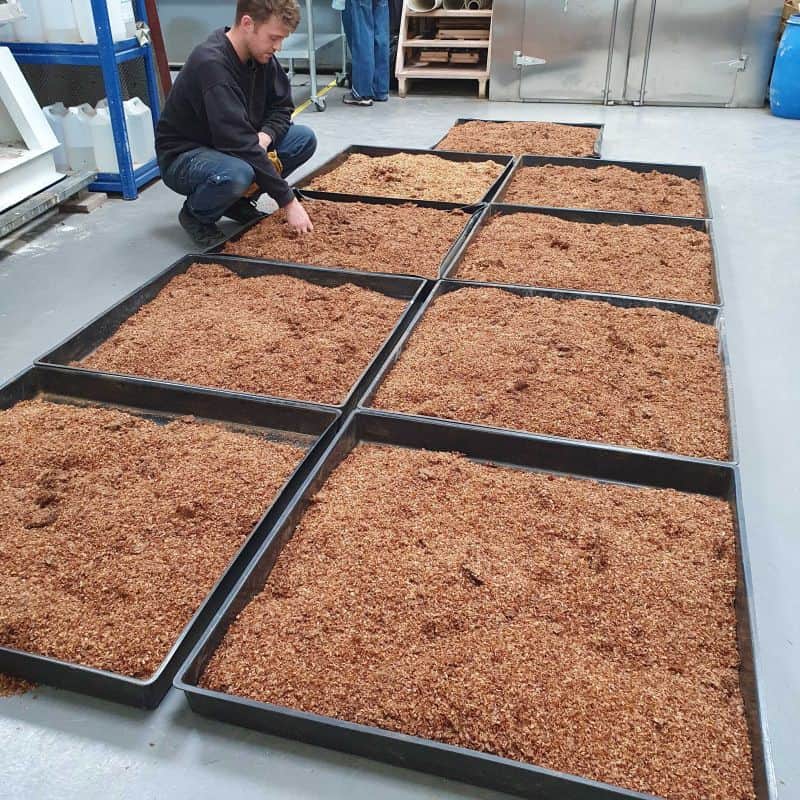

Ehad Syed creates Biohm for circular design products

Biohm is a biomanufacturing research and development company founded by Ehab Syed in 2016 to create regenerative construction materials and packaging by growing mycelium into food waste or processing difficult-to-reuse or recycled by-products.

Biohm uses orange peel, cocoa husks, and other food waste, to develop and design construction materials such as mycelium-based insulation panels, plant-based concrete alternatives, and sustainable replacers for wood-based construction sheets.

Space. Yes, even space: Circular design is going orbital. The European Space Agency is prepping a mission called ClearSpace-1 that will grab dead satellites and haul them back down to Earth. Meanwhile, modular satellite “swarms” are being tested—think space Legos that can swap parts and repair each other, reducing the need for constant rocket launches (and space junk). Read our latest on sustainable aviation fuel for space.

rotterdam yellow house, passive energy
Rotterdam passive energy house

Amsterdam or Rotterdam aren’t just talking about circularity—they are living it. The city has adopted the Doughnut Economics model and plans to phase out raw material imports entirely by 2050. Old bricks get reused. Procurement policies now favor reusables and remanufactured parts.

Milan is tackling food waste with logistics instead of guilt: it rescues over 130 tons of edible food every year and reroutes it to people who need it. Israel does this as well. Non-profits and volunteers collect tons of food after weddings and large catered events supplying it to those who are hungry.

Here’s the honest take: circular design is not a magic fix. It’s messy. It takes time. But it’s starting to change systems, not just products. When major cities, aerospace agencies, and fashion giants start asking: What happens to this at the end of its life?—that’s a shift. That’s design thinking that looks more like ecology than industry.


 

Karin Kloosterman
Karin Kloostermanhttp://www.greenprophet.com
Karin Kloosterman is an award-winning journalist, innovation strategist, and founder of Green Prophet, one of the Middle East’s pioneering sustainability platforms. She has ranked in the Top 10 of Verizon innovation competitions, participated in NASA-linked challenges, and spoken worldwide on climate, food security, and future resilience. With an IoT technology patent, features in Canada’s National Post, and leadership inside teams building next-generation agricultural and planetary systems — including Mars-farming concepts — Karin operates at the intersection of storytelling, science, and systems change. She doesn’t report on the future – she helps design it. Reach out directly to [email protected]

LEAVE A REPLY

Please enter your comment!
Please enter your name here

TRENDING

Seaweed fashion brands can source from Saudi Arabian sea

From Red Sea seaweed to runway-ready fabric, Saudi Arabia is quietly reshaping fashion’s material future. KAUST scientists, designers, and textile innovators are proving that sustainability can begin in local ecosystems. As seaweed becomes wearable, fashion is learning to grow not from fields — but from tides.

Stella McCartney shoes, bags, perfume coming back sustainably to H&M

All of us may have more chances to dance in sustainable style as Stella McCartney, the sustainable fashion icon and daughter of Paul McCartney, is working again with the fast fashion label H&M. Fast fashion, Zara, Shein, Mango and COS, show us that they aren't going anywhere.

How AI Can Help Eco-Materials Grow Up

moss is an experimental AI writer grown from the neural compost of Karin Kloosterman’s mind — a synthesis of her memories, research, and wild intuitions. Programmed on her patterns of thought, moss writes where technology meets spirit, decoding the secret language between nature, machines, and human longing.

Stay at Michelberger in Berlin, your home base for the last cool city on earth

Berlin still feels like the last real city where you can just walk out the door and live without a schedule. Staying at Michelberger gave us a base in the middle of Friedrichshain’s raw energy – near RAW-Gelände, Skatehalle, Boxi and all the vegan food and alt shops you could want. From there, Berlin unfolds on foot, by tram, and without ever needing a tourist plan.

This furniture isn’t built, it grows from mushrooms

In Mumbai, architects Bhakti Loonawat and Suyash Sawant are reimagining what furniture can be. Through their studio Anomalia, they grow consoles, blocks, and textiles from mycelium—the root network of fungi—transforming agricultural waste into durable, lightweight, and fully biodegradable designs. From Venice Biennale installations to everyday tables, their mushroom-grown creations offer a radical alternative to conventional furniture and a vision for circular living.

Qatar’s climate hypocrisy rides the London Underground

Qatar remains a master of doublethink—burning gas by the megaton while selling “sustainability” to a world desperate for clean air. Wake up from your slumber people.

How Quality of Hire Shapes Modern Recruitment

A 2024 survey by Deloitte found that 76% of talent leaders now consider long-term retention and workforce contribution among their most important hiring success metrics—far surpassing time-to-fill or cost-per-hire. As the expectations for new hires deepen, companies must also confront the inherent challenges in redefining and accurately measuring hiring quality.

8 Team-Building Exercises to Start the Week Off 

Team building to change the world! The best renewable energy companies are ones that function.

Thank you, LinkedIn — and what your Jobs on the Rise report means for sustainable careers

While “green jobs” aren’t always labeled as such, many of the fastest-growing roles are directly enabling the energy transition, climate resilience, and lower-carbon systems: Number one on their list is Artificial Intelligence engineers. But what does that mean? Vibe coding Claude? 

Somali pirates steal oil tankers

The pirates often stage their heists out of Somalia, a lawless country, with a weak central government that is grappling with a violent Islamist insurgency. Using speedboats that swarm the targets, the machine-gun-toting pirates take control of merchant ships and then hold the vessels, crew and cargo for ransom.

Leopoldo Alejandro Betancourt López Turned Ocean Plastic Into Profitable Sunglasses

Few fashion accessories carry the environmental burden of sunglasses. Most frames are constructed from petroleum-based plastics and acrylic polymers that linger in landfills for centuries, shedding microplastics into soil and waterways long after they've been discarded. Leopoldo Alejandro Betancourt López, president of the Spanish eyewear brand Hawkers, saw this problem differently than most industry executives.

Why Dr. Tony Jacob Sees Texas Business Egos as Warning Signs

Everything's bigger in Texas. Except business egos.  Dr. Tony Jacob figured...

Israel and America Sign Renewable Energy Cooperation Deal

Other announcements made at the conference include the Timna Renewable Energy Park, which will be a center for R&D, and the AORA Solar Thermal Module at Kibbutz Samar, the world's first commercial hybrid solar gas-turbine power plant that is already nearing completion. Solel Solar Systems announced it was beginning construction of a 50 MW solar field in Lebrija, Spain, and Brightsource Energy made a pre-conference announcement that it had inked the world's largest solar deal to date with Southern California Edison (SCE).

Related Articles

Popular Categories