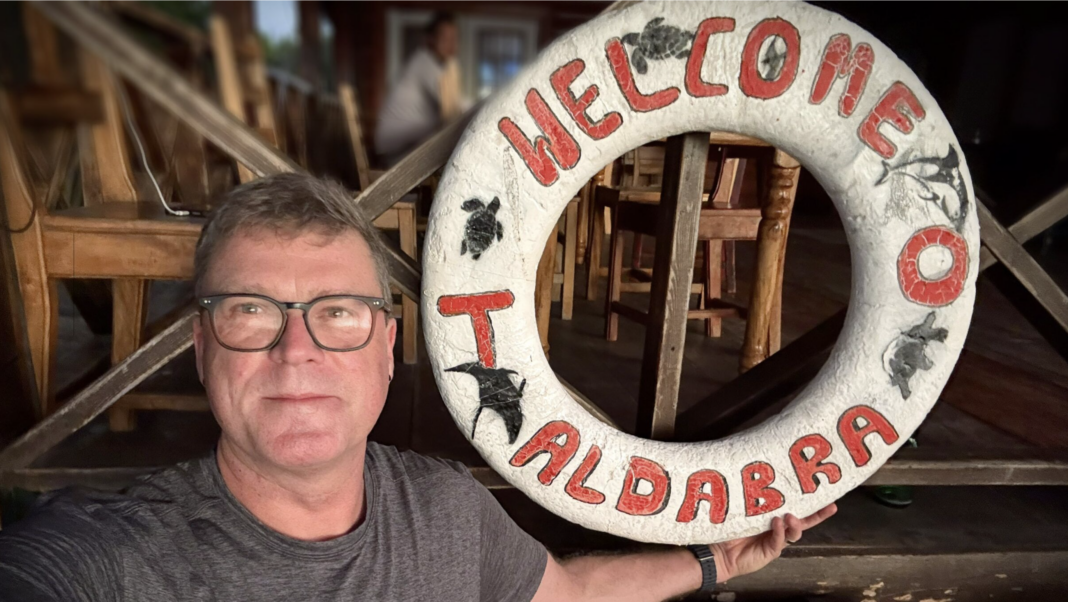
“They Knew They Shouldn’t Be There”: Journalist Kevin Gepford Witnesses Rising Pressures on Aldabra Atoll

Kevin Gepford on Aldabra Island, The Tortoise Project

Portland-based environmental journalist Kevin Gepford, currently researching a book on global tortoise conservation spent two months on Seychelles’ Aldabra Atoll between December and January, living at the island’s remote research station with 16 other people. It’s so isolated out there—about 1,000 miles from Seychelles’ main island Mahé—that it might as well be Mars. He agrees that change will be coming fast.

Aldabra’s nearest island neighbor, Assomption, is becoming a playground for Qatari royalty and affluent Middle Eastern tourists. A Qatar-based investment company called the Assets Group, and a reported $25 million USD land-lease agreement with the Seychelles government, means that developers, against public concerns, have extended the landing strip to accommodate international flights, and about 1,000 construction workers are on the island currently laying out plots for 40 high-end villas—touted as a luxury resort. Most suspect they will become private villas.
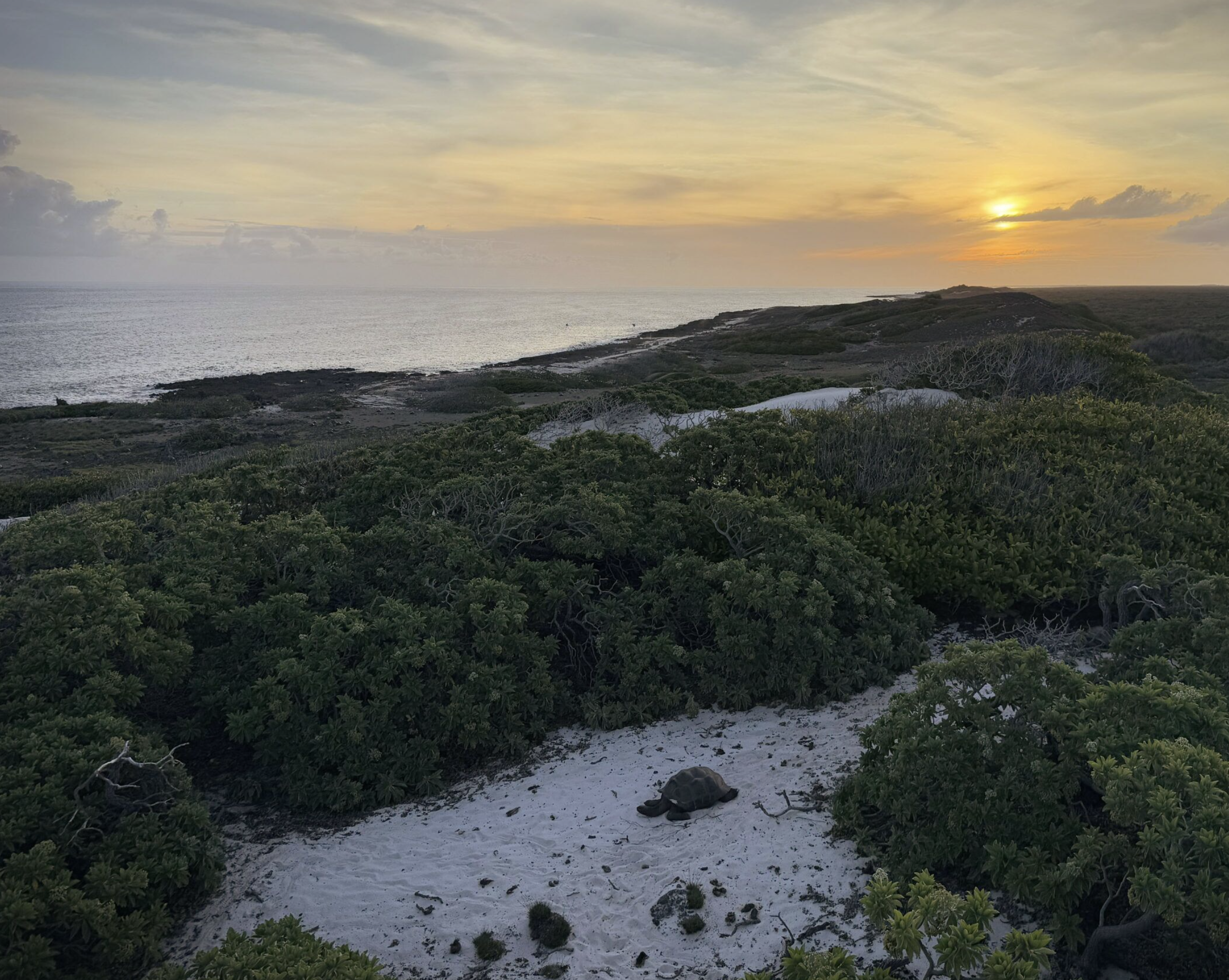
Kevin Gepford on Aldabra Island, The Tortoise Project
Tortoise on Aldabra, Kevin Gepford – The Tortoise Project

Conservationists we spoke with from Mahé say that no one knows what’s happening on Assomption right now. Access and photos are not allowed. Presidential candidate Maarco Francis says they are building as fast as possible because the current president Wavel Ramkalawan believes construction will be irreversible once the elections are held in September. 

A UNESCO World Heritage Site, Aldabra is one of the most ecologically pristine places left on Earth—home to more than 100,000 giant tortoises and the last surviving species of flightless rail in the Indian Ocean. It is managed by the Seychelles Islands Foundation (SIF) and is considered an outpost of evolution. Gepford says what he witnessed there shows how fragile that isolation has become.

Adabra Atoll and Assomption Island
Adabra Atoll and Assomption Island are about 20 miles from each other. Image via Google Earth

“I went there to understand how tortoises live—talk with experts about their ecology, and really understand what pressures they and the atoll are facing.”

He observed these pressures in real time:

“I went along with the island staff on a trip around the atoll for an inspection—a part of the day—and unexpectedly came across a catamaran at the edge of the reef,” despite prohibitions on coming close. 
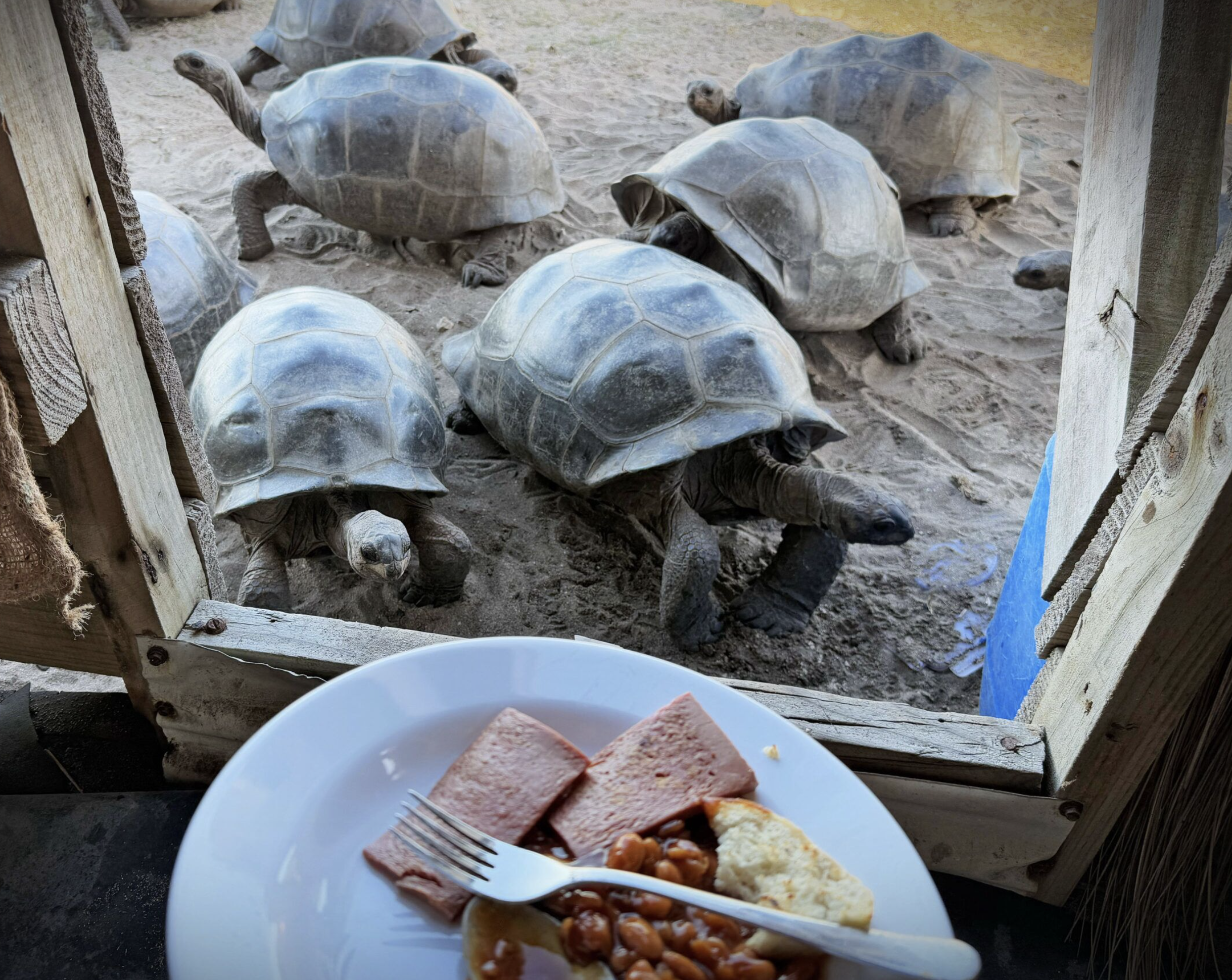
Kevin Gepford on Aldabra Island, The Tortoise Project
Tortoises and breakfast on Aldabra Island, The Tortoise Project

Maritime maps say not to approach within a 40 km radius around the atoll or Assomption Island, says turtle expert Dr. Yaniv Levi who lived and worked as a divemaster on Aldabra for more than two years in the late 1990s. Skippers know that these islands are protected, he tells Green Prophet. 

“It was a really nice yacht,” says Gepford. 

The skipper of the boat hailed the vessel. “We shouted to talk to us on their hand-held radio on a certain channel—and asked, ‘What are you doing here?’ 

“We expected them to blame either the weather or engine trouble,” says Gepford, 

“They said, ‘We just got blown off course because of the cyclone and thought we’d come by for a look. We’re sailing  to Mahé.’”

Gepford said it was clear the crew knew they had crossed a line, and SIF’s skipper warned them to be prepared for a biosecurity inspection when they reached Mahé.

“We took pictures of the yacht  and reported it back to the authorities in the Seychelles—to be aware,” Gepford said.

The concern isn’t symbolic. Aldabra’s team enforces one of the most rigorous biosecurity protocols in the Indian Ocean.

“They picked out seeds from my shoes with tweezers, and made me wash the blades of my handheld fan. Look through everything—and look at it twice,” said Gepford. “It’s invasive species, seeds, pathogens—anything that could damage the ecosystem.”

The chartered yacht, he later learned, had come from Zanzibar. Its passengers appeared to be South African or European tourists. As for the charter companies: “That’s their business—to take wealthy people to the ocean and see different things.”

A Growing Worry: Assomption Island
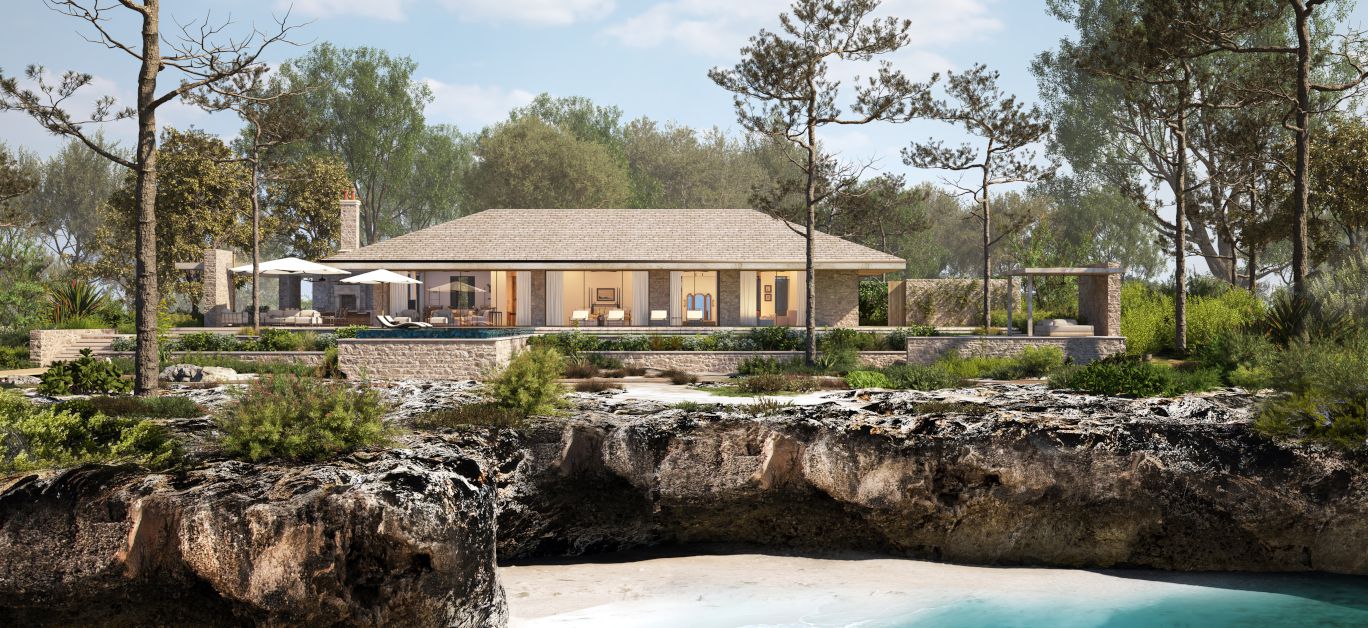
Assets Group image of the ultra-wealthy development on the Seychelles Island of Assomption
Assets Group plans for 40 ultra-luxury villas on the sand dunes of Assomption.

Gepford’s presence on Aldabra coincided with escalating concerns over the neighboring island of Assomption, the only access point to Aldabra by air. The Assomption runway, once a modest strip, has recently been extended, with signs of construction and development activity tied to Middle Eastern investment.

“Access to Aldabra is through Assomption. Historically, there’s been a runway on Assomption. It’s been extended at both ends  because of the development that’s happening,” Gepford said.

Assomption, long ignored by development, now appears poised to shift. That shift is deeply worrying to those stationed on Aldabra.

“From Aldabra’s perspective—they’re worried. Assomption is one of the last undeveloped islands in the Seychelles, and it’s less than 20 miles away. Assomption’s development  will bring a lot of commercial activity, people, boats, and airplanes very close. One of the things that historically helped save Aldabra along with its ecosystems and unique plants and animals has been its sheer inaccessibility.”

This isn’t just a hypothetical threat. The atoll’s recent conservation successes—especially for sea turtles—demonstrate how delicate these ecosystems are. Green turtles have been protected on Aldabra for more than 50 years.
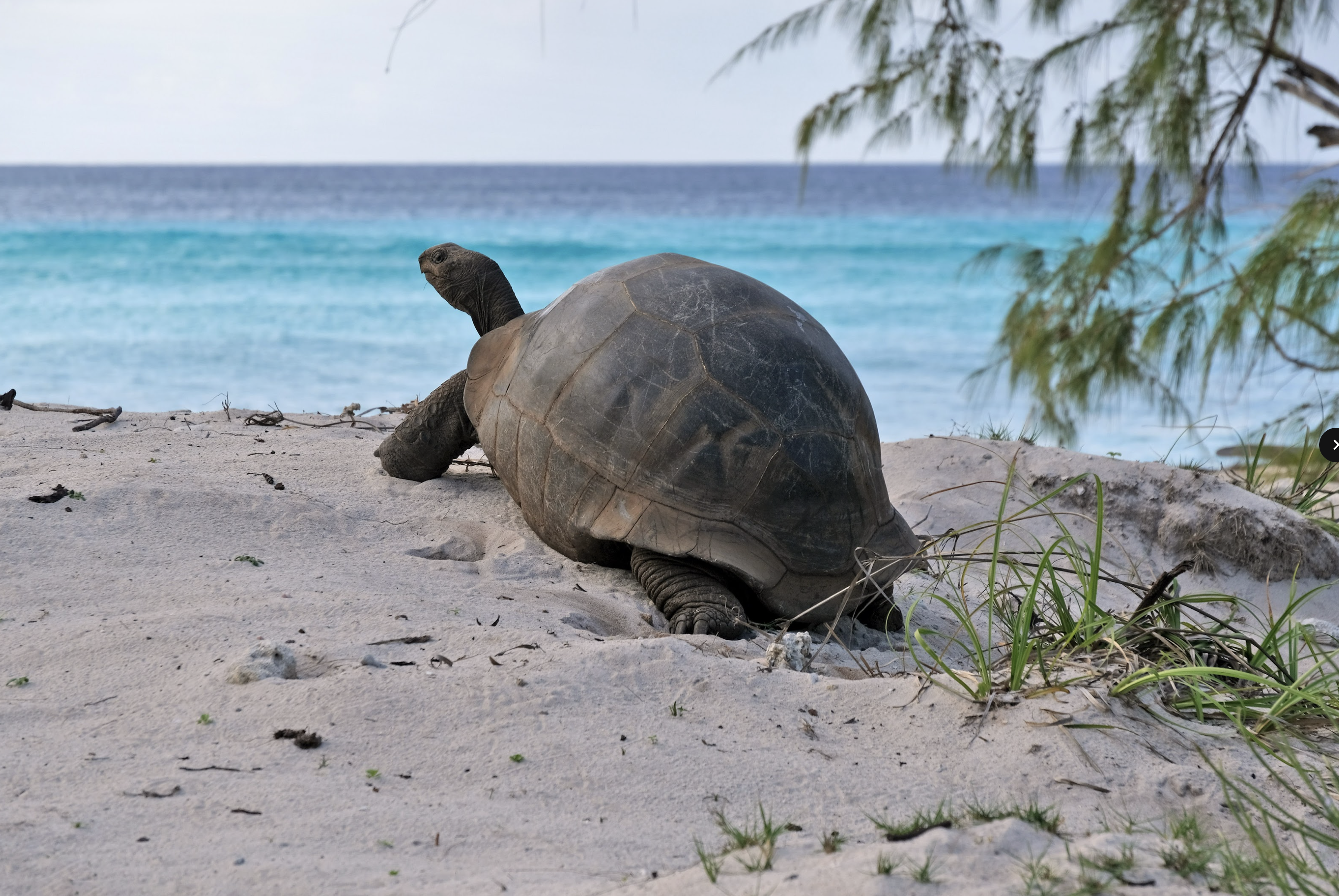
Aldabra tortoise, Kevin Gepford

“The green turtle recovery on Aldabra has been astounding—from less than 2,000 to 3,000 clutches per season in the 1960s to more than 15,000,” he noted. “Assomption may  be just as important as a nesting site. But that beach has not  been studied for sea turtle research.”

How a small team of Seychellois can defend that is anyone’s guess—but for now, Gepford doesn’t think that’s the biggest threat. 

A Book Rooted in Observation
Kevin Gepford
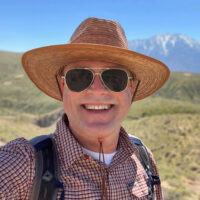
Kevin Gepford

Gepford is documenting this, from a tortoise perspective, for a nonfiction book for W. W. Norton & Company that follows the story of tortoises—and the people trying to save them—from Madagascar to Mauritius, the Galápagos, and now the Seychelles.

“Tortoises in the western Indian Ocean are a microcosm of the challenges facing the natural world today. What’s happening in Assomption reflects broader patterns globally.”

“The biggest challenge globally for nearly every wild species is habitat loss… Our cities are growing, and wildlands are converted to farmland—this crowds out animals of all kinds. Tortoises and turtles are hit really hard.”

The deeper message behind his project is about limits—what we encroach on, and what we choose to leave intact.

“What is our place in the world? Can we tread more lightly, and live with care and concern for all God’s creatures?”

Gepford’s book comes out in 2026.

::The Tortoise Project


Karin Kloosterman
Karin Kloostermanhttp://www.greenprophet.com
Karin Kloosterman is an award-winning journalist, innovation strategist, and founder of Green Prophet, one of the Middle East’s pioneering sustainability platforms. She has ranked in the Top 10 of Verizon innovation competitions, participated in NASA-linked challenges, and spoken worldwide on climate, food security, and future resilience. With an IoT technology patent, features in Canada’s National Post, and leadership inside teams building next-generation agricultural and planetary systems — including Mars-farming concepts — Karin operates at the intersection of storytelling, science, and systems change. She doesn’t report on the future – she helps design it. Reach out directly to [email protected]

LEAVE A REPLY

Please enter your comment!
Please enter your name here

TRENDING

The US leaves 66 United Nations organizations to “put America first”

The world needs a reset and to restart well intentioned cooperation projects from start. Because right now the UN and EU projects look like software built on code from the 80s, rickety, patched, slow to adapt, and prone to crashing under the weight of outdated assumptions.

UNESCO forest being developed in Iran

Environmental activists in Iran often face significant personal risk when speaking out about illegal land grabs, deforestation, or the destruction of protected areas. In recent years, several high-profile environmentalists have been detained, interrogated, or imprisoned on broad national-security charges, sometimes without transparent legal proceedings.

Iran’s rarest forest is on fire

It's full of rare and endemic species, and it's a UNESCO heritage site. Iran's natural treasure, a 1000-kilometer forest, the Hyrcanian forest has been on fire for several days. It stretches from the Caspian Sea and into neighboring Azerbaijan and is home to more than 3,200 kinds of plants. 

Images of Assomption Island development show extensive beach development

Researchers who have studied the island for decades describe it as a key ecological buffer for Aldabra, helping to protect the atoll from pollution, invasive species, and light disturbance. If Assomption’s natural systems collapse, they warn, Aldabra could be next.

Seychelles activists sue government for Qatari development on turtle nesting sites

The luxury resort now under legal challenge on Assomption Island is being developed by Assets Group, a Qatar-based real estate company that advertises the project on its own website as a collection of high-end villas and spa facilities in the Seychelles. According to multiple reports, including Mongabay and The Seychelles Nation, the developer is tied to Qatari investors and has relied on the London-based PC Agency to promote the project internationally. Environmental groups allege that Assets Group’s expansion near the UNESCO-protected Aldabra Atoll risks introducing invasive species and undermining decades of conservation work.

Qatar’s climate hypocrisy rides the London Underground

Qatar remains a master of doublethink—burning gas by the megaton while selling “sustainability” to a world desperate for clean air. Wake up from your slumber people.

How Quality of Hire Shapes Modern Recruitment

A 2024 survey by Deloitte found that 76% of talent leaders now consider long-term retention and workforce contribution among their most important hiring success metrics—far surpassing time-to-fill or cost-per-hire. As the expectations for new hires deepen, companies must also confront the inherent challenges in redefining and accurately measuring hiring quality.

8 Team-Building Exercises to Start the Week Off 

Team building to change the world! The best renewable energy companies are ones that function.

Thank you, LinkedIn — and what your Jobs on the Rise report means for sustainable careers

While “green jobs” aren’t always labeled as such, many of the fastest-growing roles are directly enabling the energy transition, climate resilience, and lower-carbon systems: Number one on their list is Artificial Intelligence engineers. But what does that mean? Vibe coding Claude? 

Somali pirates steal oil tankers

The pirates often stage their heists out of Somalia, a lawless country, with a weak central government that is grappling with a violent Islamist insurgency. Using speedboats that swarm the targets, the machine-gun-toting pirates take control of merchant ships and then hold the vessels, crew and cargo for ransom.

Leopoldo Alejandro Betancourt López Turned Ocean Plastic Into Profitable Sunglasses

Few fashion accessories carry the environmental burden of sunglasses. Most frames are constructed from petroleum-based plastics and acrylic polymers that linger in landfills for centuries, shedding microplastics into soil and waterways long after they've been discarded. Leopoldo Alejandro Betancourt López, president of the Spanish eyewear brand Hawkers, saw this problem differently than most industry executives.

Why Dr. Tony Jacob Sees Texas Business Egos as Warning Signs

Everything's bigger in Texas. Except business egos.  Dr. Tony Jacob figured...

Israel and America Sign Renewable Energy Cooperation Deal

Other announcements made at the conference include the Timna Renewable Energy Park, which will be a center for R&D, and the AORA Solar Thermal Module at Kibbutz Samar, the world's first commercial hybrid solar gas-turbine power plant that is already nearing completion. Solel Solar Systems announced it was beginning construction of a 50 MW solar field in Lebrija, Spain, and Brightsource Energy made a pre-conference announcement that it had inked the world's largest solar deal to date with Southern California Edison (SCE).

Related Articles

Popular Categories