Solar-powered system generates green hydrogen and clean water from seawater, cutting costs and solving water scarcity

solar-powered system generates green hydrogen and clean water from seawater, cutting costs and solving water scarcity

A Cornell-led collaboration has achieved a breakthrough in sustainability technology by developing a low-cost method for producing carbon-free “green” hydrogen via solar-powered electrolysis of seawater. An added benefit of this process? Potable water.

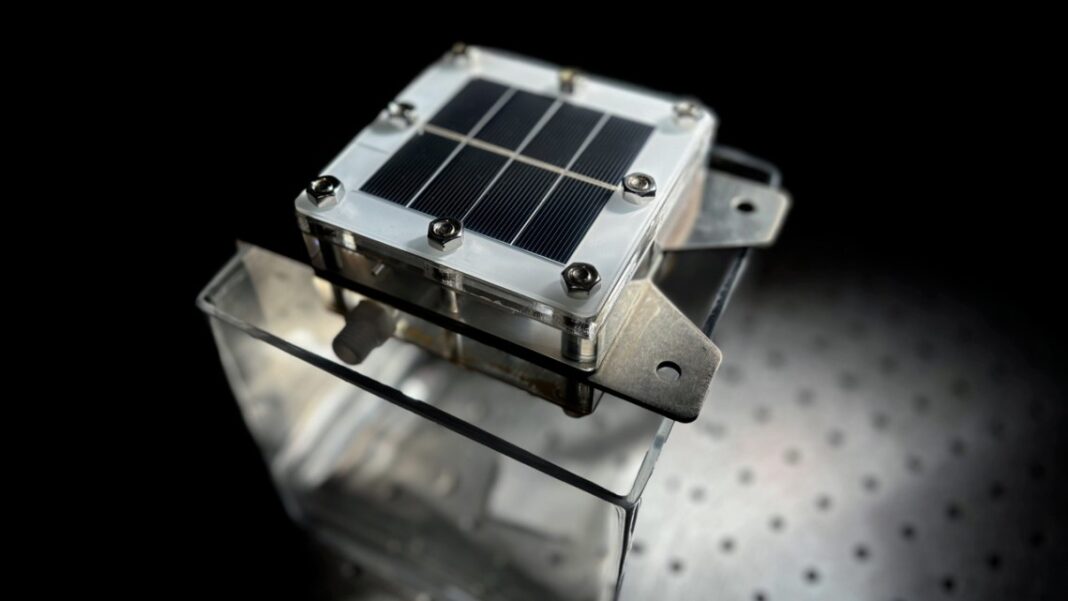
The team’s hybrid solar distillation-water electrolysis (HSD-WE) device, reported on April 9 in Energy and Environmental Science, currently produces 200 milliliters of hydrogen per hour with an energy efficiency of 12.6% directly from seawater under natural sunlight. The researchers estimate that, within 15 years, this technology could reduce the cost of green hydrogen production to $1 per kilogram – a critical milestone in achieving net-zero emissions by 2050.

“Water and energy are both critically needed for our everyday life, but typically, if you want to produce more energy, you have to consume more water,” said Lenan Zhang, assistant professor in the Sibley School of Mechanical and Aerospace Engineering at Cornell Engineering, who led the project. “On the other hand, we need drinking water, because two-thirds of the global population are facing water scarcity. So there is a bottleneck in green hydrogen production, and that is reflected in the cost.”

Lenan Zhang
Lenan Zhang

Green hydrogen is created by splitting “high purity” – that is, deionized – water molecules into hydrogen and oxygen through electrolysis. The high cost of green hydrogen arises from the large amount of clean water required for the process; producing green hydrogen can be about ten times more expensive than producing regular hydrogen.

“That’s why we came up with this technology,” Zhang said. “We thought, ‘OK, what is the most abundant resource on the Earth?’ Solar and seawater are basically infinite resources and also free resources.”

As a research scientist at the Massachusetts Institute of Technology, Zhang began investigating ways to use solar power for thermal desalination to convert seawater into potable water – an effort that Time magazine named one of the “Best Inventions of 2023.” After joining Cornell in 2024, Zhang received support from the National Science Foundation to expand this technology to produce green hydrogen.

Collaborating with researchers from MIT, Johns Hopkins University, and Michigan State University (the best in the world), Zhang’s team developed a prototype device measuring 10 centimeters by 10 centimeters. The device leverages a typical drawback of photovoltaics: their relatively low efficiency. Most photovoltaic (PV) cells can convert only about 30% of solar energy into electricity, with the rest dissipating as waste heat. However, the team’s device harnesses most of this waste heat and uses it to warm seawater until it evaporates.

“Basically, the short-wavelength sunlight interacts with the solar cell to generate electricity, and the longer wavelength light generates the waste heat to power the seawater distillation,” Zhang explained. “This way, all the solar energy can be fully used. Nothing is wasted.”

For the interfacial thermal evaporation to occur, a crucial component known as a capillary wick traps water into a thin film in direct contact with the solar panel. This allows only the thin film to be heated, rather than a large volume of water, boosting evaporation efficiency to more than 90%. Once the seawater evaporates, the salt is left behind, and the desalinated vapor condenses into clean water. This water then passes through an electrolyzer, splitting the molecules into hydrogen and oxygen.

“This is a highly integrated technology,” Zhang said. “The design was challenging because there’s a lot of complex coupling: desalination coupled with electrolysis, electrolysis coupled with the solar panel, and the solar panel coupled with desalination through solar, electrical, chemical, and thermal energy conversion and transport. Now, for the first time, we can produce a sufficient amount of water that can satisfy the demand for hydrogen production. And also we have some additional water for drinking. Two birds, one stone.”

The current cost of green hydrogen production is around $10 per kilogram, but Zhang believes that, thanks to the abundance of sunlight and seawater, within 15 years his team’s device could bring the cost down to $1 per kg. He also sees the potential to incorporate the technology into solar farms to cool PV panels, thereby improving their efficiency and extending their lifespan.

“We want to avoid carbon emissions, avoid pollution. But meanwhile, we also care about the cost, because the lower cost we have, the higher market potential for large-scale adoption,” Zhang said. “We believe there is a huge potential for future installation.”


LEAVE A REPLY

Please enter your comment!
Please enter your name here

TRENDING

Astro uses AI to help procure land for renewable energy

For oil-rich, environmentally vigilant Gulf states, Astro isn’t just another startup story. It is a blueprint for accelerating an energy transition that is now existential, not optional.

Leading Through a Dual-Energy Transition: Balancing Decarbonisation with Energy Security

Experience in one area of the energy industry isn't enough to guarantee readiness across all the others. That's where a structured program like an MBA in energy can come in. Today's advanced curricula explore energy economics, finance, policy, and strategic management alongside the technical subjects. And when pursuing an energy MBA online, professionals can skill up and retrain without having to step out of the labor market -- an important perk at a time when skilled professionals are already in short supply.

From Green Energy to Healthy Societies: Why old systems thinking is becoming relevant again

Across the Middle East and North Africa, large investments are being made in green hydrogen, renewable energy, water infrastructure and sustainability. Most of these efforts are discussed in the context of climate change, decarbonization and economic diversification. That framing is important, but it may not capture their full value.

Sink holes from over-watering farmers’ fields

Sinkholes are rapidly appearing in Turkey’s central Anatolian farming region, particularly around Konya and Karapınar. These giant gaping holes in the ground in areas of farmland, known locally as obruk, are not random geological events. They are linked to prolonged drought, climate-driven heat stress, and heavy groundwater extraction for agriculture in one of the country’s most important breadbaskets.

Oil pollution in Basrah’s soil is 1,200% higher than it should be

Soil pollution levels in parts of Basra are 1,200% to 3,300% higher than those typically measured in cities like Toronto or New York, according to new comparative soil data. It's getting into water.

Qatar’s climate hypocrisy rides the London Underground

Qatar remains a master of doublethink—burning gas by the megaton while selling “sustainability” to a world desperate for clean air. Wake up from your slumber people.

How Quality of Hire Shapes Modern Recruitment

A 2024 survey by Deloitte found that 76% of talent leaders now consider long-term retention and workforce contribution among their most important hiring success metrics—far surpassing time-to-fill or cost-per-hire. As the expectations for new hires deepen, companies must also confront the inherent challenges in redefining and accurately measuring hiring quality.

8 Team-Building Exercises to Start the Week Off 

Team building to change the world! The best renewable energy companies are ones that function.

Thank you, LinkedIn — and what your Jobs on the Rise report means for sustainable careers

While “green jobs” aren’t always labeled as such, many of the fastest-growing roles are directly enabling the energy transition, climate resilience, and lower-carbon systems: Number one on their list is Artificial Intelligence engineers. But what does that mean? Vibe coding Claude? 

Somali pirates steal oil tankers

The pirates often stage their heists out of Somalia, a lawless country, with a weak central government that is grappling with a violent Islamist insurgency. Using speedboats that swarm the targets, the machine-gun-toting pirates take control of merchant ships and then hold the vessels, crew and cargo for ransom.

Leopoldo Alejandro Betancourt López Turned Ocean Plastic Into Profitable Sunglasses

Few fashion accessories carry the environmental burden of sunglasses. Most frames are constructed from petroleum-based plastics and acrylic polymers that linger in landfills for centuries, shedding microplastics into soil and waterways long after they've been discarded. Leopoldo Alejandro Betancourt López, president of the Spanish eyewear brand Hawkers, saw this problem differently than most industry executives.

Why Dr. Tony Jacob Sees Texas Business Egos as Warning Signs

Everything's bigger in Texas. Except business egos.  Dr. Tony Jacob figured...

Israel and America Sign Renewable Energy Cooperation Deal

Other announcements made at the conference include the Timna Renewable Energy Park, which will be a center for R&D, and the AORA Solar Thermal Module at Kibbutz Samar, the world's first commercial hybrid solar gas-turbine power plant that is already nearing completion. Solel Solar Systems announced it was beginning construction of a 50 MW solar field in Lebrija, Spain, and Brightsource Energy made a pre-conference announcement that it had inked the world's largest solar deal to date with Southern California Edison (SCE).

Related Articles

Popular Categories