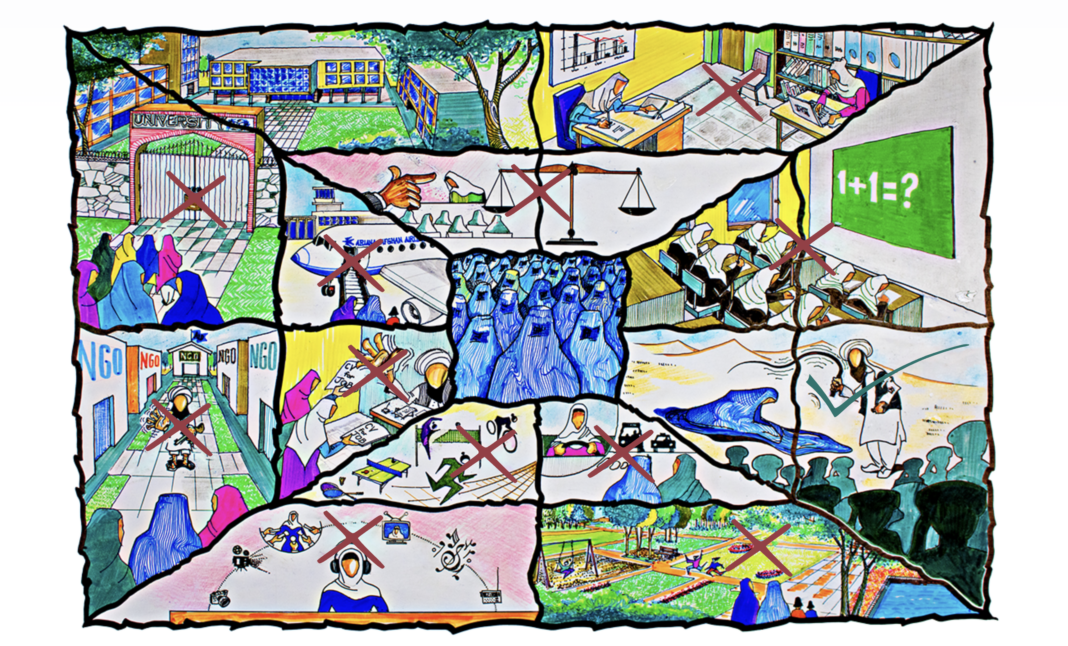

Women in the Taliban-controlled country of Afghanistan are already banned from showing their bodies and faces in public. A new blow to dehumanizing women is the ban of the sound of women’s voices in public.
Like the regime in Iran that controls women singing in public and showing their hair, the restrictions in Afghanistan are more fierce and among them ban women from being friends with non-Muslims and from entering national parks. Women are not allowed to work at NGOs that support women. Women can’t work in any legal profession, they can’t work for the government, or go to the gym or drive.
The Taliban published a list of “vice and virtue” laws this past summer which were approved by their supreme leader Hibatullah Akhundzada. The vice and virtues edicts are exhaustive and oppressive: Afghan women must completely veil their bodies – including their faces – in heavy clothing at all times in the public setting so men will not be led to temptation and vice.

Among religious Jews, women are not encouraged to sing in public so men refrain from attending women’s concerts if they so choose. But women are allowed to speak in public, even encouraged to do so. But in Afghanistan and in Iran women’s voices are considered an instrument of vice and will not be allowed to be heard talking in public under the new restrictions. They cannot sing or real aloud if it can be heard from outside their home.
“Whenever an adult woman leaves her home out of necessity, she is obliged to conceal her voice, face, and body,” the new laws state.

In some areas in Afghanistan women sneak to the gym but in head to toe hijab.
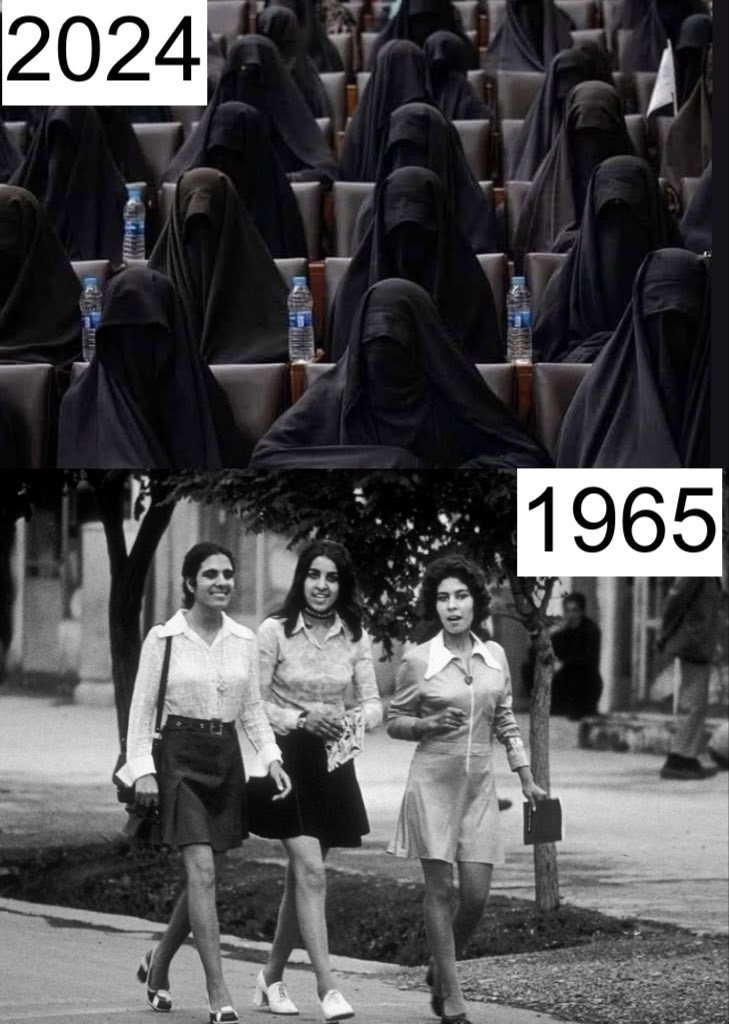
It wasn’t always like that.

Other restrictions on women, pointed out by the US Institute of Peace (we have edited the exhaustive list):
- March 31, 2024: Taliban closed several female educational centers in Kabul for registering female students beyond 6th grade.
- April 2024: The Taliban’s Education Department of Kabul Province issued a commitment letter to owners of private schools, outlining a series of ten points to which the owners/administrators are pledging adherence. One of these points declares, “I confirm my agreement to adhere to the decision to suspend schooling for female students from grades 7 to 12…” Source: copy of the letter
- June 4, 2024: The Department of Education in Bamyan issued a letter, signed by Qari Enayatullh Sahaar, stating that in all schools where students follow both Hanafi and Jafari jurisprudence, but only use textbooks based on one of these jurisprudences, the textbooks will be replaced with books from both Hanafi and Jafari traditions. Source: copy of the letter
- March 24, 2024: The Taliban leader stated that the public stoning of women shall be enforced, and the Taliban will not bend to the pressure of the West.
- December 30, 2023: The Taliban’s Ministry of Economy issued a letter calling on local and international organizations to refrain from implementing projects focused on peace, conflict resolution, advocacy and public awareness as they are not considered a need. Source: copy of the letter
- August 15, 2024: The Taliban’s department of economy instructed NGOs to remove the word “woman” from their organizational names. Source: contacts on the ground
- February 28, 2024: The Taliban’s spokesperson for the Ministry of the Promotion of Virtue and Prevention of Vice, Abdul Ghaffar Farooq, announced that women appearing on television must wear black hijab and with their faces covered only leaving their eyes visible.
- April 2024: The Taliban in Helmand verbally instructed media outlets to refrain from airing women’s voices. Source: field contacts
- April 2024: Media outlets were verbally instructed to ban women from co-hosting shows with male journalists and refrain from reporting on women’s rights and violence against women. Source: media contacts
- May 5, 2023: Banned young and unmarried women from going to health centers and shrines in Kandahar province.
- January 2024: In Farah, the governor has issued a verbal order making wearing of black color hijab, face mask and gloves mandatory. Source: contacts on the ground
- January 2024: In Logar, the religious police made announcements through loudspeakers in mosques and in public stating that women and girls should refrain from wearing white pants, and shoes when going out and that those ignoring the order have no right to complain about the consequences. Source: contacts on the ground
- January 2024: In Paktia, the vice and virtue authorities announced through mosques that women are prohibited from wearing black Arabic hijabs, as they reveal the eyes. Instead, women are mandated to exclusively wear burqa. Source: contacts on the ground
- February 14, 2024: Mullah Abdul Haq Waseeq, head of the Taliban’s General Directorate of Intelligence, has directed its units to stop organizations from taking inappropriate photos (mixed male/female) during aid distribution, and during meetings, particularly of women. Violators are instructed to be reported to the directorate for appropriate action. Source: copy of the letter
- May 26, 2024: The Taliban required couples in Herat to present their “marriage certificate” to allow them to eat together in restaurants.
- July 3, 2024: The religious police in Daikundi issued an announcement mandating that women must comply with the hijab requirement within five days. The specified hijab style must be Arabic. After the deadline, violators will face punishment and imprisonment, with responsibility falling on both the individual and her family. Source: copy of the announcement and sources on the ground
- July 5, 2024: The religious police in Daikundi issued an announcement mandating that women must comply with the hijab requirement within five days. The specified hijab style must be Arabic. After the deadline, violators will face punishment and imprisonment, with responsibility falling on both the individual and her family. Source: copy of the announcement
- July 17, 2024: The Vice and Virtue authorities in Faryab have re-issued a ban prohibiting women from visiting three parks (Khawja Ghaar, Dara Shaakh, and Dara Rang) in Gurziwaan District. The ban has been confirmed through an official letter and corroborated by contacts on the ground.
- July 31, 2024: The Taliban issued a new edict under their ‘Propagation of Virtue and Prevention of Vice Law’, which was published in the Ministry of Justice gazette, listing previously imposed restrictions as well as additional ones, including women’s voice in public and prohibiting friendship with non-Muslims. Source: copy of the edict
- August 26, 2023: Taliban Minister of Vice and Virtue during his visit to Bamiyan announced that women are henceforth not allowed to enter Band-e Amir national park
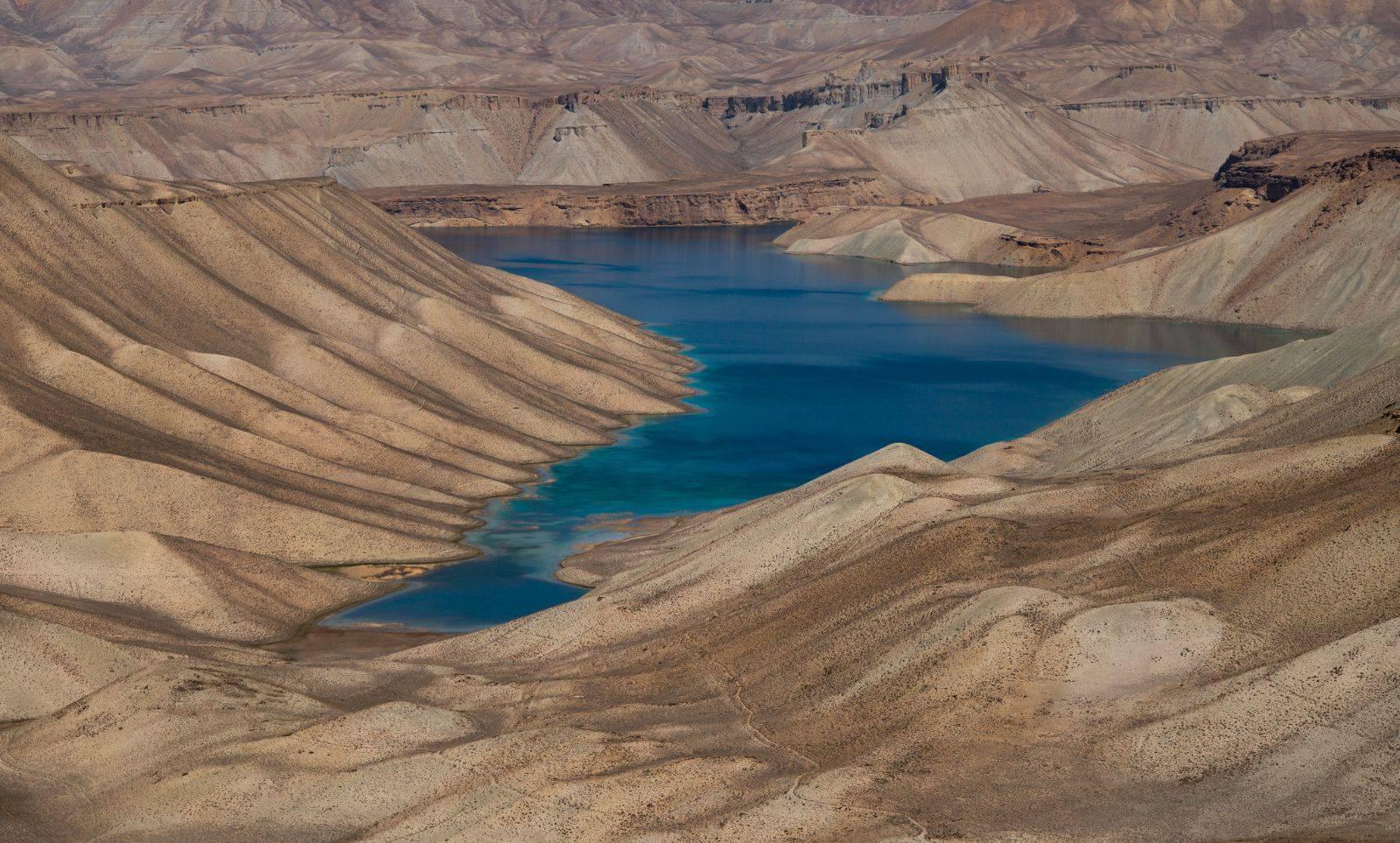 Band E Amir National Park: forbidden for women
 - March 27, 2022: Banned women from traveling abroad without a mahram (husband or guardian) and without a legitimate reason.
- January 16, 2023: Instructed travel agencies not to sell tickets to women without a mahram.