Turkey thinks nuclear energy is renewable energy. Who’s going to tell them?

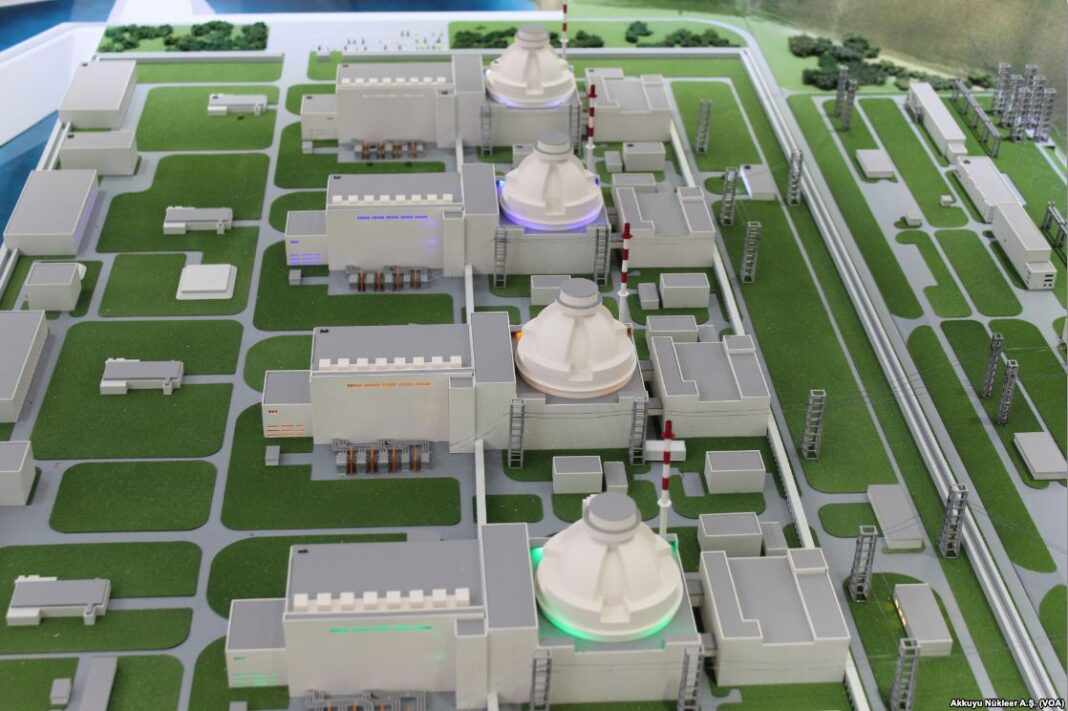
The Akkuyu Nuclear Power Plant is a large nuclear power plant in Turkey under construction located in Akkuyu, Büyükeceli, Mersin Province. It is expected to generate around 10% of the country's electricity when completed.
The Akkuyu Nuclear Power Plant is a large nuclear power plant in Turkey under construction located in Akkuyu, Büyükeceli, Mersin Province. It is expected to generate around 10% of the country’s electricity when completed.

At a recent forum in Sochi, Russia, Turkey’s Energy and Natural resources minister Alparslan Bayraktar announced that nuclear energy would play a “critical role” in Turkey’s journey towards achieving net-zero emissions by 2053. Like Greta Thunberg, Turkey and Russia consider nuclear energy renewable energy.

“We aim to reach a total of 12 reactors and a nuclear power of 15,000 megawatts, with probably four reactors in three different locations in Turkey,” he said.

Bayraktar said the country’s aim was to install two additional nuclear plants alongside the Akkuyu Nuclear Power Plant, currently under construction in the Mersin province. Environmentalists in Turkey have been against the plant, built in collaboration with Russia, from the outset.

Funny that the true renewable energy leader Germany shut down its last reactor in 2023, while Turkey starts up its first.

The Turkish Government view nuclear energy as renewable energy. Nuclear is not a renewable energy source, but it is an alternative to fossil fuels because it does not emit greenhouse gases. Environmental groups usually consider nuclear as a non-renewable energy source.

The Akkuyu Nuclear Power Plant is a large nuclear power plant in Turkey under construction located in Akkuyu, Büyükeceli, Mersin Province. It is expected to generate around 10% of the country’s electricity when completed.

“We have a great potential for renewables and energy efficiency, but we absolutely need to add nuclear energy into our energy mix,” Bayraktar said.

Some thought leaders at the Dayan Center believe that while Turkey has agreed as part of NATO to be a non-nuclear state, the use of nuclear as domestic energy will give Turkey an easy in for developing nuclear weapons. Erdogen said in 2019 said, “Some countries have missiles with nuclear warheads, not one or two. But I can’t have missiles with nuclear heads. I cannot accept this.”

Is nuclear energy renewable energy?

Nuclear energy is often misconstrued as renewable due to its low greenhouse gas emissions and continuous power generation. However, it is not classified as renewable for several reasons. Firstly, nuclear power relies on the extraction of uranium, a finite resource that must be mined, processed, and refined. Although uranium reserves are substantial, they are not limitless, and extraction entails environmental impacts such as habitat destruction and water pollution.

Nuclear energy produces hazardous radioactive waste that remains harmful for thousands of years, requiring careful disposal and management. Unlike renewable sources like solar and wind, which generate power through natural processes that are indefinitely available, nuclear reactors rely on controlled nuclear fission, a process that consumes uranium fuel and generates waste.

The construction and decommissioning of nuclear power plants involve significant energy inputs and environmental costs, making them less sustainable than truly renewable alternatives. While nuclear energy provides low-carbon electricity, its reliance on finite resources and generation of long-lived radioactive waste preclude it from being classified as a renewable energy source. Thus, while nuclear energy may contribute to reducing carbon emissions in the short term, it is not a sustainable solution for meeting long-term energy needs.

Has Turkey misread the room by calling nuclear energy renewable energy? The proposed expansion aims to reach 7.2 gigawatts (GW) of nuclear capacity by 2035 and up to 20GW by 2050.

Bayraktar has described plans for incorporating small modular reactors, which could potentially contribute some 5GW over the next few decades.

The minister also expressed the necessity of developing a balanced energy mix, combining renewable sources with stable base load power, particularly citing the intermittent nature of solar and wind energy.

A facade of shimmering steel panels envelops this control centre that Istanbul studio Bilgin Architects has created in the plains of Karapinar, Turkey, for one of Europe's largest solar farms. Named Central Control Building, it is designed by Bilgin Architects to act as a centralised location from which to monitor and control the expansive field of 3.2 million solar panels.
A solar energy plant in Turkey

Turkey’s sunny climate offers a high solar energy potential, specifically in the South Eastern Anatolia and Mediterranean regions. Solar power is a growing part of renewable energy in the country, with 12 gigawatts (GW) of solar panels generating 6% of the country’s electricity.

Wind power generates about 10% of Turkey’s electricity, mainly in the west in the Aegean and Marmara regions, and is gradually becoming a larger share of renewable energy in the country. As of 2024, Turkey has 12 gigawatts (GW) of wind turbines.

Turkey has a problematic environmental track record. Consider the environmentalists who were murdered over the construction of a stone quarry in their forest.

Being on the side of the planet doesn’t pay in Turkey. You can go to jail for speaking up against pollution or high cancer rates in children. Turkey’s leader supports Hamas and terror groups publicly. Are these the kind of society you want using nuclear power?

Just a reminder to Turkey:

  1. Chernobyl Disaster (1986): The Chernobyl nuclear power plant explosion in Ukraine remains one of the worst nuclear accidents in history. A combination of design flaws and operator errors led to a catastrophic explosion in reactor 4, releasing a massive amount of radioactive materials into the atmosphere. The disaster resulted in immediate deaths, widespread radiation exposure, and long-term health effects for thousands of people. The affected area remains largely uninhabitable to this day.
  2. Fukushima Daiichi Nuclear Disaster (2011): Following a devastating earthquake and tsunami in Japan, the Fukushima Daiichi nuclear power plant experienced multiple reactor meltdowns, hydrogen explosions, and the release of radioactive materials. The disaster led to widespread evacuations, contamination of soil and water, and long-term health concerns for residents and workers. It reignited global debates on nuclear safety and prompted a reassessment of nuclear power policies worldwide.
  3. Three Mile Island Accident (1979): The partial meltdown of a reactor at the Three Mile Island nuclear power plant in Pennsylvania, USA, marked a significant nuclear accident in history. Equipment malfunctions and human errors led to a loss of coolant and partial core meltdown in reactor 2. While the incident resulted in limited off-site radiation releases and no immediate fatalities, it caused public panic, raised safety concerns, and led to stricter regulations for nuclear power plants in the United States.

Want to reach out to the Turkish energy ministry. Contact them here.


Karin Kloosterman
Karin Kloostermanhttp://www.greenprophet.com
Karin Kloosterman is an award-winning journalist, innovation strategist, and founder of Green Prophet, one of the Middle East’s pioneering sustainability platforms. She has ranked in the Top 10 of Verizon innovation competitions, participated in NASA-linked challenges, and spoken worldwide on climate, food security, and future resilience. With an IoT technology patent, features in Canada’s National Post, and leadership inside teams building next-generation agricultural and planetary systems — including Mars-farming concepts — Karin operates at the intersection of storytelling, science, and systems change. She doesn’t report on the future – she helps design it. Reach out directly to [email protected]

Hot this week

Why Health Systems Are Reaching a Turning Point

Health emerges from a continuous energy and material flow from water through food to human physiology. Technical energy systems support this cycle through water treatment, agriculture, and infrastructure.

Sustainability That Sells: How Profit and Purpose Come Together in the Hive

Whether you are a commercial grower, hobbyist beekeeper or retail equipment supplier, this system opens a new income stream with minimal environmental impact.

The Fitness App Revolution: Building the Future of Wellness Through Strategic Development

In an era where smartphones are ubiquitous and health consciousness is at an all-time high, the fitness industry has undergone a radical digital transformation. Fitness applications have moved far beyond simple pedometers, evolving into comprehensive wellness platforms that serve as personal trainers, nutritionists, and community hubs right in our pockets.

A Brief History of Basil From India to Italy

Beloved, fortunate, sweet, and royal; an herb with a long and storied history in Asia and across the world. Called by many names, basil has featured in previous Green Prophet articles, so enjoy another serving, a brief history of basil.

How Renewable Energy is Revolutionizing the Way We Power Our World

Solar has become the star of the transition thanks to modular hardware and straightforward installation. It fits dense cities and remote towns alike. Many companies are turning to rooftop arrays and carport systems - and exploring commercial solar installation as a practical way to lock in future savings.

Topics

Why Health Systems Are Reaching a Turning Point

Health emerges from a continuous energy and material flow from water through food to human physiology. Technical energy systems support this cycle through water treatment, agriculture, and infrastructure.

Sustainability That Sells: How Profit and Purpose Come Together in the Hive

Whether you are a commercial grower, hobbyist beekeeper or retail equipment supplier, this system opens a new income stream with minimal environmental impact.

The Fitness App Revolution: Building the Future of Wellness Through Strategic Development

In an era where smartphones are ubiquitous and health consciousness is at an all-time high, the fitness industry has undergone a radical digital transformation. Fitness applications have moved far beyond simple pedometers, evolving into comprehensive wellness platforms that serve as personal trainers, nutritionists, and community hubs right in our pockets.

A Brief History of Basil From India to Italy

Beloved, fortunate, sweet, and royal; an herb with a long and storied history in Asia and across the world. Called by many names, basil has featured in previous Green Prophet articles, so enjoy another serving, a brief history of basil.

How Renewable Energy is Revolutionizing the Way We Power Our World

Solar has become the star of the transition thanks to modular hardware and straightforward installation. It fits dense cities and remote towns alike. Many companies are turning to rooftop arrays and carport systems - and exploring commercial solar installation as a practical way to lock in future savings.

How does one start prepping?

Faced with an extreme winter storm this year, Americans wonder how to be prepared for catastrophe. Miriam has lived through wars in the Middle East - so she's prepared on giving you a guide to prepping.

Fishermen sue tire manufacturers on behalf of the salmon

A federal trial in San Francisco has brought US tire manufacturers, fishing groups, and environmental scientists into court over a chemical most drivers have never heard of — but which scientists say may be silently reshaping aquatic ecosystems.

Listening to Water: Tarek Atoui’s Next Work for Tate Modern

Born in Beirut, Lebanon in 1980 and now living in Paris, Atoui has spent years building instruments that don’t sit comfortably in concert halls. Many of them involve water, glass, and ceramics — materials that react to sound instead of simply producing it.

Related Articles

Popular Categories