



Hydrogen is the most abundant element in the universe. It is also a powerful zero-carbon fuel with an energy density of 5.5 kilowatt-hours per kilogram (kWh/kg). This is more than two and a half times the energy density of gasoline and eighteen times the energy density of the 0.296 kWh/kg 4680 battery used in the Tesla Model S.
Hydrogen is used for space travel and other specialized applications but it has not yet replaced fossil fuels in electricity generation, consumer or freight transportation. That may be about to change thanks to these breakthroughs in hydrogen technology.
1. Green Hydrogen
When hydrogen is burned in the presence of Oxygen, it doesn’t produce carbon dioxide (CO2) it only produces water (H2O) and small amounts of the chemicals produced by heating air. But the processes for generating hydrogen consumes energy and that energy can come from sources which produce CO2. Hydrogen is a colorless gas but engineers developed a nine color code to track environmental factors in the production of hydrogen. For example, when coal is used to produce hydrogen, it is known as Black or Brown hydrogen. Natural gas is used to produce Gray hydrogen with the steam-methane reformation process which released CO2 into the atmosphere. Burning black, brown or gray hydrogen appears to be carbon neutral but the overall process contributes to air pollution and climate change.
Blue hydrogen also uses natural gas (mostly methane) but the process is designed to capture and sequester the CO2 byproduct for storage or industrial purposes.
Green hydrogen goes one step further by producing hydrogen from solar, wind and other energy technologies which do not contribute to climate change.
Who is working with green hydrogen?
With abundant gas reserves and good climate for solar electrolysis, mideast countries are particularly well-placed for cost-effective green hydrogen production and job creation. Saudia Arabia’s NEOM development is working to produce the world’s largest green hydrogen production utility.
Oman is also competing in this market with signed contracts for six green projects and a production target of more than one million tons of green hydrogen per year. The war in Ukraine has also forced the European Union to rethink energy dependency as part of regional defence and security. Hydrogen terminals and pipelines are being built and expanded to take advantage of imports from the Mideast and Canada. As Canada’s Prime Minister Justin Trudeau puts it: “The enhanced action plan on hydrogen will mobilize investment, support businesses, share expertise and get clean Canadian hydrogen to Europe… Fundamentally, it’s about good middle-class jobs, economic growth and clean energy.”
2. Hydrogen for mimicking photosynthesis
Photovoltaic (PV) electrolysis is not particularly efficient in using sunlight to extract hydrogen from water. The best PV cells are only about 15% efficient and electrolysis is only about 70% efficient. And when the panels are dusty, knock that down even more. Together their total efficiency is only about 10.5%.
Plants do much better but their process is complicated. Reading over my daughter’s shoulder while she was studying biology, I learned something about light-harvesting complex, dyads, ATP, antenna proteins. In my day it was simple, chlorophyll made plants green and turned sunlight, CO2 and water into vegetables our mom made us eat!
On a very high level, light is a form of electromagnetic energy like radio waves. For efficient capture of that energy we need antennas that are a small integer ratio to the wavelength. You may have noticed that the antenna in your 1980s mobile phone was shorter than the ones in your walkie talkie. CB and HAM radio buffs used to tune antenna lengths with a Standing Wave Ratio (SWR) meter. In the early days of television people did something similar with bits of aluminum foil wrapped around TV antennas.
But light has a very short wavelength. The sunlight that filters through our atmosphere has a wavelength of about 400-700 billionths of a meter (nanometer). Because this is a wide range of wavelengths, we need a range of different antenna sizes. Not to worry (says whoever invented photosynthesis) layers of different pigments capture different parts of the spectrum.
No one will ever know this little secret until autumn when the green chlorophyll fades and some of the the other colors are revealed. My explanation may be an oversimplification but our best PV solar cells are not nearly as complex or efficient as the photosynthesis in the broccoli mom made us eat. It’s like comparing a stone tool to the International Space Station.
But we have to start somewhere and scientists at the University of Michigan took a step in the right direction by mimicking photosynthesis. They used a window-sized lens to focus sunlight onto a panel containing an indium gallium nitride nanostructure catalyst covered with water that was soon bubbling with hydrogen and oxygen gasses with an efficiency of 6.1% indoors and 9% outdoors. This doesn’t beat the efficiency of our best PV electrolysis systems, but it’s a start.
3. Geologic Hydrogen

We discussed this in a recent Green Prophet article about natural hydrogen. The idea is that instead of trying to find green energy to extract hydrogen from water, we search for deposits of hydrogen gas in the same way we search for fossil fuels. Geologic hydrogen is a hot topic in recent weeks because if we find large deposits of hydrogen, it really could be a game changer. At the very least it could serve as a transition fuel to help us phase out fossil fuels before their environmental damage overwhelms us.
4. Hydrogen Fusion
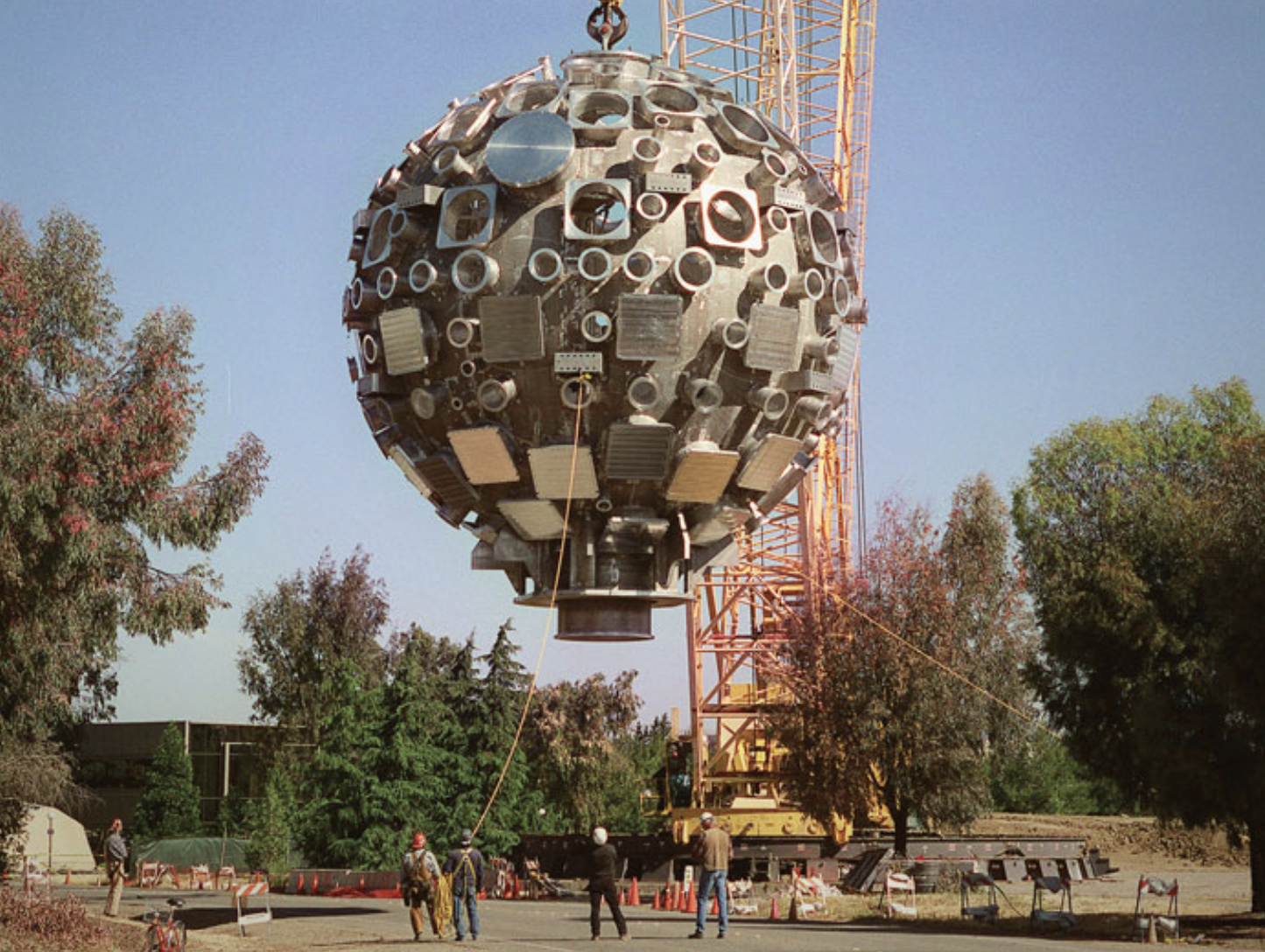
Two isotopes of hydrogen are used in the most common fusion reaction. These are Deuterium and Tritium. Chemically each of these behave very much like ordinary hydrogen which has one proton and one electron but Deuterium also has one neutron and Tritium has two neutrons. These isotopes are relatively rare but the energy released by a fusion reaction is hard to ignore. We already mentioned that the energy density of hydrogen when it is chemically burned in air is about 5.5 kilowatt-hours per kilogram.
But the nuclear fusion reaction between Deuterium and Tritium isotopes can produce 94 trillion kilowatt-hours per kilogram. This is 17 trillion times the energy density of gasoline. The catch is that fusion is difficult. Harnessing this energy isn’t as easy as dumping some rubbish into a device like “Mr. Fusion” in the film “Back to the Future.”
It’s even more difficult than trying to harness the energy in a bolt of lightning. But scientists are working on this from two different angles, magnetic confinement and laser confinement. Both have demonstrated net energy gain but not yet at a level that is commercially practical.
5. Hydrogen Airships
It must have seemed the perfect form of transportation. Dirigibles were luxurious and majestic. School teachers told us what it was like to watch these massive inventions cast shadows across midwestern cornfields. They took the comforts of a passenger cruise ship and sailed among the clouds. The Hindenberg even had a piano lounge.
No form of transportation is perfectly safe and these airships were no exception. Seventy-three people died when the USS Akron crashed into the ocean and 48 died on the R-101. But the Hindenberg exploded on land in daylight with thousands of spectators, photographers and NBC radio broadcaster Herbert Morrison whose famous words “Oh the humanity!” would signal the end of this airship era..

This too may change as we face the true costs of jet aircraft travel. A round-trip transatlantic flight releases about two tons of CO2 per passenger, comparable to the annual carbon footprint of an average person living in Jordan.
One of the disadvantages of airships was that they flew low and slow in a part of the atmosphere prone to gusty winds, turbulence and lightning. When Hughs and other companies took jet aircraft into the stratosphere above the weather, modern flight was transformed. There is no reason why an airship should be confined to the turbulent lower atmosphere. The spy balloons that were in US news in recent weeks launched from China over Canada and the US flew at 60,000 feet, almost twice the cruising altitude of commercial aircraft.
But hydrogen isn’t just for spy balloons. The developers of an airship called the h2 clipper plan to take advantage of the economic advantages of hydrogen airships in cargo transport. Hydrogen will be used for both lift and power and if it is green hydrogen, it will truly be a zero carbon aircraft. Loz Blain explains in New Atlas:
“We’re talking cargo loads up to 340,000 lb (150,000 kg – or the equivalent of about 115 Toyota Corollas), distances up to 6,000 miles (9,650 km, or roughly the distance between Los Angeles and Barcelona), at cruising speeds over 175 mph (280 km/h, or a little under one-third the speed of a Dreamliner passenger plane – but 7-10 times faster than a cargo ship can go).”
On paper it sounds good, jet aircraft are expensive, carbon-heavy energy hogs and these airships are beautiful. H2-Clipper won the prestigious hydrogen transport innovation awards in 2023. The company has tested models in wind-tunnels and has plans for a prototype by 2025 and a full-size production airship by 2028.
Oceansky’s airship is smaller but it may be perfect for the luxury class. Who wouldn’t want to fly over the north pole on something like this?


These are just five recent breakthroughs in hydrogen technology. However you look at it, it seems that the future is bright for Hydrogen!


