
Artists Focus on Exploitation Of Morocco’s Red Gold Algae And The Humans Who Harvest It

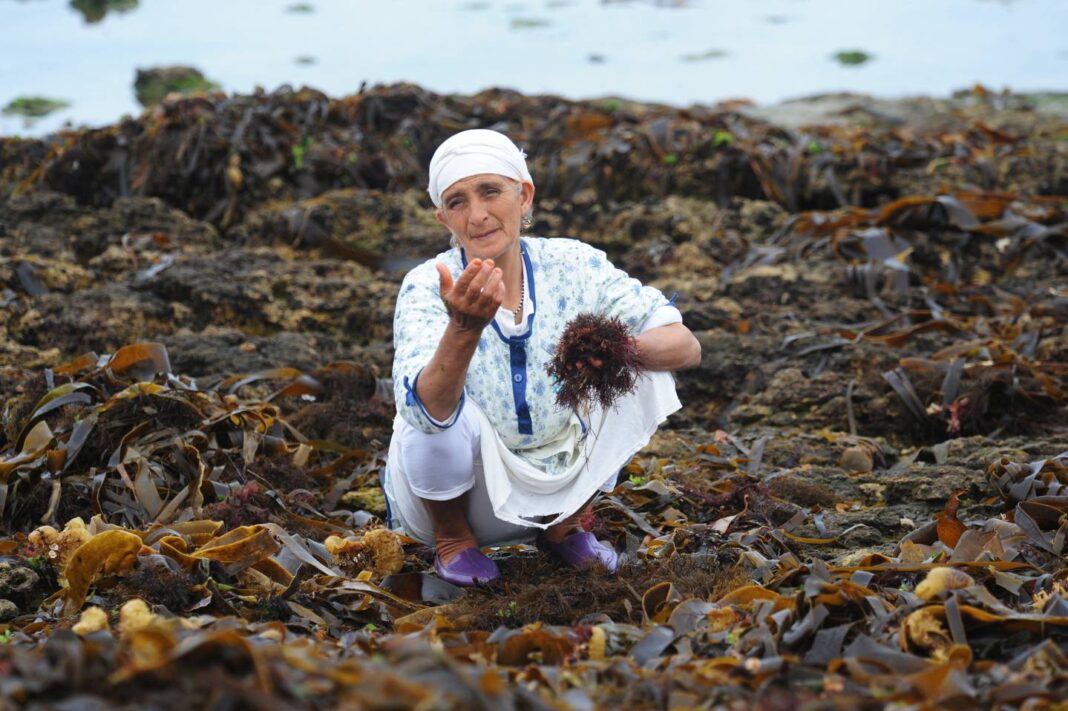
Moroccan laborer harvests red gold algae
Seasonal harvesters of red gold algae are underpaid and exploited.

One of Morocco’s most valuable exports is red gold algae, from which the gelling agent agar-agar is made. Agar-agar has multiple uses in health supplements, cosmetics, pharmacology, and other industries. We wrote about algae as treatment for inflammatory bowel disease here

Morocco has imposed quotas, and set prices on the valuable seaweed, but until now the government hasn’t considered the looming consequence of over-harvesting it: extinction.

Harvesting red gold algae also involves the backbreaking labor of seasonal workers who are paid shockingly little. 

Five UK and Moroccan artists have mounted an exhibition in London focused on red gold algae to illustrate human and ecology issues. Called Red Gold Reflections, it incorporates essay films, recorded performances, sound installation, and photography.

Exploited workers and endangered red gold algae are the focus of a UK-Moroccan collaborative art exhibition.

The National (UK) interviewed Sabrina Mumtaz Hasan, one of the artists involved in the collaboration. She is an associate lecturer on the MA Art and Science course at Central St Martins.

“Agar-Agar was promoted as a replacement for gelatin and as bioplastics in design, and was meant to be more sustainable, but it is also problematic because there isn’t really a ‘golden product’ that solves environmental problems,” she said. 

Mumtaz Hasan traveled to Morocco to view a company that cultivates microalgae destined to develop into macroalgae. 

Susewi, with its partner Plymouth University, received funding from Innovat UK to develop technology and structure of a project where  microalgae grow in a large pond donated by the Moroccan government near the town of Akhfennir. The artificial pond, set in non-arable land, occupies three hectares and is the  largest algae pond in the world.  Seeing the success of the experiment, the Moroccan has since allocated another 6000 hectares to build another plant.

“They’re working with single-cells to multiply them, which takes out the need to harvest from the sea,” says Mumtaz Hasan. 

Susewi’s CEO Keith Coleman states that the company’s goal is to become “The world’s largest producer of algal biomass. Microalgae,” he continues, “are the “most successful organisms on the planet.”  They grow ten times faster than land plants and absorb CO2 more efficiently than trees do. They don’t need soil, which allows use of non-arable land, while converting sunlight into food. Can algae be the new superfood?

The Algal Innovation Centre at the University of Cambridge is the second UK-based body cultivating algae, feeding the micro-plants nutrients extracted from fruit and vegetable waste.

Mumtaz Hasan said, “I was quite skeptical when I went to speak to both labs, but this process has been very enlightening.”

The Red Gold Reflections exhibition hopes to bring about discussion on climate change and sustainable practice. It ran at P21 Gallery, London ran until November 6, but a series of Red Gold Reflection online events may be viewed through Dardishi

The collaboration was the fruit of a three-month research and artistic residency run by A.Mal, an artistic research collective funded by the British Council Morocco and Arts Council England.

:: The National News

Photo “Evanescence” via P21 Gallery.

Photo of red-gold algae harvester via AFP.

 

Miriam Kresh
Miriam Kreshhttps://www.greenprophet.com/
Miriam Kresh is an American ex-pat living in Israel. Her love of Middle Eastern food evolved from close friendships with enthusiastic Moroccan, Tunisian and Turkish home cooks. She owns too many cookbooks and is always planning the next meal. Miriam can be reached at miriam (at) greenprophet (dot) com.

LEAVE A REPLY

Please enter your comment!
Please enter your name here

TRENDING

Astro uses AI to help procure land for renewable energy

For oil-rich, environmentally vigilant Gulf states, Astro isn’t just another startup story. It is a blueprint for accelerating an energy transition that is now existential, not optional.

The Science Behind How Elite Marathon Runners Train

Discover the science behind elite marathon training. Explore techniques, nutrition, and mental strategies that propel top runners to success.

Earth building with Dead Sea salt bricks

Researchers develop a brick made largely from recycled Dead Sea salt—offering a potential alternative to carbon-intensive cement.

The Christ’s thorn (sidr tree) is also a well-known folk medicine

Christ’s thorn jujube (Ziziphus spina-christi) also known as the sidr tree is a real, identifiable tree native to the Middle East, and it appears—directly or indirectly—in Islam, Judaism, and later Christian tradition. The connections between the three faiths are not theological agreements but overlapping uses, names, and symbolic associations rooted in the same landscape.

Farm To Table Israel Connects People To The Land

Farm To Table Israel is transforming the traditional dining experience into a hands-on journey.

Qatar’s climate hypocrisy rides the London Underground

Qatar remains a master of doublethink—burning gas by the megaton while selling “sustainability” to a world desperate for clean air. Wake up from your slumber people.

How Quality of Hire Shapes Modern Recruitment

A 2024 survey by Deloitte found that 76% of talent leaders now consider long-term retention and workforce contribution among their most important hiring success metrics—far surpassing time-to-fill or cost-per-hire. As the expectations for new hires deepen, companies must also confront the inherent challenges in redefining and accurately measuring hiring quality.

8 Team-Building Exercises to Start the Week Off 

Team building to change the world! The best renewable energy companies are ones that function.

Thank you, LinkedIn — and what your Jobs on the Rise report means for sustainable careers

While “green jobs” aren’t always labeled as such, many of the fastest-growing roles are directly enabling the energy transition, climate resilience, and lower-carbon systems: Number one on their list is Artificial Intelligence engineers. But what does that mean? Vibe coding Claude? 

Somali pirates steal oil tankers

The pirates often stage their heists out of Somalia, a lawless country, with a weak central government that is grappling with a violent Islamist insurgency. Using speedboats that swarm the targets, the machine-gun-toting pirates take control of merchant ships and then hold the vessels, crew and cargo for ransom.

Leopoldo Alejandro Betancourt López Turned Ocean Plastic Into Profitable Sunglasses

Few fashion accessories carry the environmental burden of sunglasses. Most frames are constructed from petroleum-based plastics and acrylic polymers that linger in landfills for centuries, shedding microplastics into soil and waterways long after they've been discarded. Leopoldo Alejandro Betancourt López, president of the Spanish eyewear brand Hawkers, saw this problem differently than most industry executives.

Why Dr. Tony Jacob Sees Texas Business Egos as Warning Signs

Everything's bigger in Texas. Except business egos.  Dr. Tony Jacob figured...

Israel and America Sign Renewable Energy Cooperation Deal

Other announcements made at the conference include the Timna Renewable Energy Park, which will be a center for R&D, and the AORA Solar Thermal Module at Kibbutz Samar, the world's first commercial hybrid solar gas-turbine power plant that is already nearing completion. Solel Solar Systems announced it was beginning construction of a 50 MW solar field in Lebrija, Spain, and Brightsource Energy made a pre-conference announcement that it had inked the world's largest solar deal to date with Southern California Edison (SCE).

Related Articles

Popular Categories