How your home garden helps the bees

home garden bees

Home gardens are by far the biggest source of food for pollinating insects, including bees and wasps, in cities and towns, according to new research.

The study, led by the University of Bristol and published today in the Journal of Ecology, measured for the first time how much nectar is produced in urban areas and discovered residential gardens accounted for the vast majority – some 85 per cent on average.

Results showed three gardens generated daily on average around a teaspoon of Nature’s ambrosia, the unique sugar-rich liquid found in flowers which pollinators drink for energy. While a teaspoon may not sound much to humans, it’s the equivalent to more than a tonne to an adult human and enough to fuel thousands of flying bees. The more bees and fellow pollinators can fly, the greater diversity of flora and fauna will be maintained.

gardening for health

Ecologist Nicholas Tew, lead author of the study, said: “Although the quantity and diversity of nectar has been measured in the countryside, this wasn’t the case in urban areas, so we decided to investigate.

“We expected private gardens in towns and cities to be a plentiful source of nectar, but didn’t anticipate the scale of production would be to such an overwhelming extent. Our findings highlight the pivotal role they play in supporting pollinators and promoting biodiversity in urban areas across the country.”

The research, carried out in partnership with the universities of Edinburgh and Reading and the Royal Horticultural Society, examined the nectar production in four major UK towns and cities: Bristol, Edinburgh, Leeds, and Reading. Nectar production was measured in nearly 200 species of plant by extracting nectar from more than 3,000 individual flowers.

The extraction process involves using a fine glass tube. The sugar concentration of the nectar was quantified with a refractometer, a device which measures how much light refracts when passing through a solution.

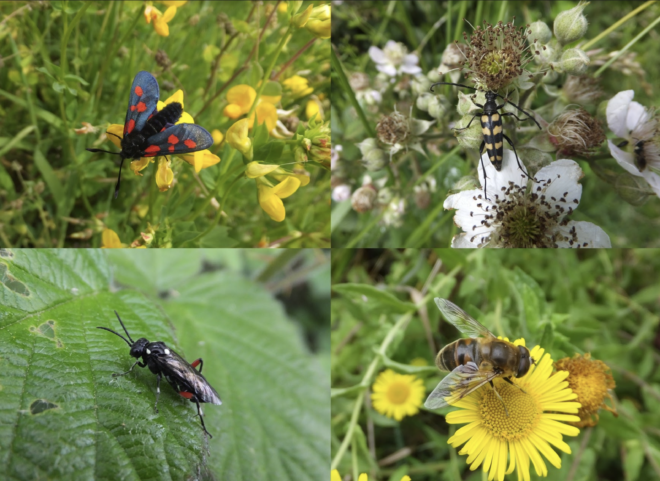
Pollinators are not just bees, but wasps, sawflies and even beetles
variety of garden polinators

“We found the nectar supply in urban landscapes is more diverse, in other words comes from more plant species, than in farmland and nature reserves, and this urban nectar supply is critically underpinned by private gardens,” said Nicholas Tew, who is studying for a PhD in Ecology.

urban beehive young couple city roof new york

“Gardens are so important because they produce the most nectar per unit area of land and they cover the largest area of land in the cities we studied.”

Nearly a third (29 per cent) of the land in urban areas comprised domestic gardens, which is six times the area of parks, and 40 times the area of allotments.

“The research illustrates the huge role gardeners play in pollinator conservation, as without gardens there would be far less food for pollinators, which include bees, wasps, butterflies, moths, flies, and beetles in towns and cities. It is vital that new housing developments include gardens and also important for gardeners to try to make sure their gardens are as good as possible for pollinators,” Nicholas Tew explained.

What kinds of flowers produce nectar?

“Ways to do this include planting nectar-rich flowers, ensuring there is always something in flower from early spring to late autumn, mowing the lawn less often to let dandelions, clovers, daisies and other plant flowers flourish, avoiding spraying pesticides which can harm pollinators, and avoiding covering garden in paving, decking or artificial turf.”

Dr Stephanie Bird, an entomologist at the Royal Horticultural Society, which helped fund the research, said: “This research highlights the importance of gardens in supporting our pollinating insects and how gardeners can have a positive impact through their planting decisions. Gardens should not be seen in isolation – instead they are a network of resources offering valuable habitats and provisions when maintained with pollinators in mind.”

Karin Kloosterman
Karin Kloostermanhttp://www.greenprophet.com
Karin Kloosterman is an award-winning journalist, innovation strategist, and founder of Green Prophet, one of the Middle East’s pioneering sustainability platforms. She has ranked in the Top 10 of Verizon innovation competitions, participated in NASA-linked challenges, and spoken worldwide on climate, food security, and future resilience. With an IoT technology patent, features in Canada’s National Post, and leadership inside teams building next-generation agricultural and planetary systems — including Mars-farming concepts — Karin operates at the intersection of storytelling, science, and systems change. She doesn’t report on the future – she helps design it. Reach out directly to [email protected]

TRENDING

Sustainability That Sells: How Profit and Purpose Come Together in the Hive

Whether you are a commercial grower, hobbyist beekeeper or retail equipment supplier, this system opens a new income stream with minimal environmental impact.

How to grow an olive tree in a container

Don't have a garden? You can still own a fruiting olive tree, grown in a container. A sunny balcony and the right climate are the essential things; that, and time.

Make moss graffiti

Express your green views for all to see - right on the walls of your house, restaurant or office. Moss grafitti is the hottest trend in urban agriculture, after hydroponics and vertical farming.

Going green with Saint Patrick’s Day iconography

? BEER:  Spirulina, a blue-green algae superfood packed with protein, copper, and B vitamins, is growing in popularity among international brewers. RedDot Brewhouse, located next to the Singapore Botanical Gardens, offers a spirulina-infused lager.

City garden project pays you to compost and earn coupons for food

Tel Chubez is an urban agricultural farm located in the Shapira operating on principles of a circular economy. This vacant city land was transformed three years ago into a farm, providing residents with a green, productive space within the City, increasing wellness and access to fresh and healthy food while strengthening community resilience and increasing biodiversity.

Should You Invest in the Private Market?

startustartup Unlike public stock exchanges, which offer daily trading, strict...

How to build a 100-year-company

Kongō Gumi is a Japanese construction company, purportedly founded in 578 A.D., making it the world's oldest documented company. What can we learn about building sustainable businesses from them?

From Pilot Plant to Global Stage: How Aduro Clean Technologies’ 2026 Expansion Signals a Turning Point for Chemical Recycling Investors Like Yazan Al Homsi

The company's Next Generation Process (NGP) Pilot Plant in London, Ontario, has officially moved into initial operating campaigns, generating the kind of structured, repeatable data that separates laboratory promise from commercial viability.

How AI Helps SaaS Companies Reduce Repetitive Customer Support Work

SaaS products are designed for large numbers of users with different levels of experience, and also in renewable energy.

Pulling Water from the Air

Faced with water shortage in Amman, Laurie digs up...

Turning Your Energy Consultancy into an LLC: 4 Legal Steps for Founders in Texas

If you are starting a renewable energy business in Texas, learn how to start an LLC by the books.

Tracking the Impacts of a Hydroelectric Dam Along the Tigris River

For the next two months, I'll be taking a break from my usual Green Prophet posts to report on a transnational environmental issue: the Ilısu Dam currently under construction in Turkey, and the ways it will transform life along the Tigris River.

6 Payment Processors With the Fastest Onboarding for SMBs

Get your SMB up and running fast with these 6 payment processors. Compare the quickest onboarding options to start accepting customer payments without delay.

Related Articles

Popular Categories