

Renewable energy is something we all want. Churches in the US are putting their faith and investments in them, and governments –– Germany, Australia, Israel on a smaller scale, the United Arab Emirates, Canada and even Saudi Arabia have set goals for attaining 100% renewables one day. How fast countries support businesses and award tenders for solar power plants and wind turbines depends not only on governments but the corporate funding mechanisms in place and the people who want to support green energy.
Consider that 90% of the world’s electricity companies are blocking investment in renewables (Oxford study), so sometimes we need to take matters into own own hands.
Bonds, or more specifically, green bonds, are just one way that institutional investors – but also individuals – can fulfil client demands to be more green. Colleges investing an endowment, even unions that represent teachers, cities, labourers and artists, can consider green bonds as a carbon-forward structure that puts your clients’ money where their values are.
Today we speak with Peter Leighton, Chief Operating Officer and Co-founder, RE Royalties in Canada to learn more about how green bonds work, and what they can do for us.
Green Prophet: A wind energy farm in British Columbia. A solar park in Texas. What metrics do you look for when financing a deal? Are you looking for more companies to invest in? Tell us about a “dream” deal you would love to see.
Peter Leighton: When we examine an opportunity, we first ensure that the opportunity meets our corporate objective of acquiring a portfolio of long term, stable, and diversified royalty streams that will provide our investors with sustainable long term cash flows.
Specifically, we are looking for the following:
- Renewable or sustainable energy projects;
- Commercially viable technologies;
- Operating projects or those that will reach operation in the very near term – we like near term cash flow;
- Projects that have a strong ability to offset GHG emissions;
- Global diversification but limited to OECD countries in the near term; and
- Targeted returns in the mid-teens.
Yes, we are always looking for new clients and new opportunities!
Our dream opportunity is a developer/owner/operator who has a portfolio of operating renewable energy projects and has an opportunity to develop a new renewable energy project and/or projects but needs financing to realize on that opportunity. We love it when the opportunity has a tight time line because we firmly believe that our speed to close a transaction is unmatched in the industry and we think this give us a competitive edge in the market place and helps our clients do what they want to do – build more renewable energy projects more quickly.
What has been the perception of renewables since Covid-19, before and after.
A2: When I first started working in the renewable energy space some 25 years ago, there was a broad perception that renewable energy was expensive and a bit of a science experiment. What we have seen in the last 10 years, however, is an order of magnitude decrease in the cost of renewables, specifically wind and solar, combined with an order of magnitude increase in the efficiency of both generation technologies.
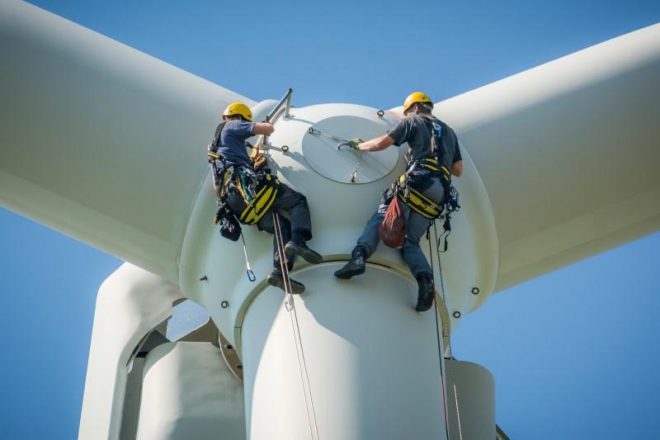
Immediately prior to Covid-19, I would say that most people still saw renewables as being a bit of a fad, even though in 2018 over $200 billion was invested in renewables across the globe, more money than was invested in either the Mining Industry or the Oil and Gas Industry during the same time.
I do not think that any of us can predict the long-term impact of Covid-19 on energy intensive industries such as transportation, home and office heating, and industry in general. We do know that right now, solar and wind are the cheapest sources of new electricity in more than 2/3 of the world and are expected to be the cheapest everywhere by 2030.
One thing that Covid-19 has proven is that renewables are really quite resilient. In Q2 2020 there was a total investment in renewables of $69.9B compared to Q2 2019 investment of $70.1B, a decline of less than 1%. Even despite the economic impact of Covid-19, the investment in renewables remains robust.
Covid-19 has, and will continue to change the way our society consumes energy and the form of energy we utilise but I do not think it will reduce our overall demand for energy
What do you think is driving up the price of Tesla stock?
A3: If I knew the answer to this question, I would be living off of my capital gains instead of taking part in this interview! I do follow Tesla and I do believe that the age of the electrical vehicle has finally arrived. Economically and environmentally it just makes sense. Carbon and other emissions alone almost make the business case. Then when you add in the fuel cost savings, and the reduction in operating expenses, (approximately 30,000 moving parts in an internal combustion engine versus approximately 20 moving parts in an electric engine), not to mention the reduction in noise pollution, the case for EV’s is pretty solid.
The other thing that Tesla has done very well, is to bring some of the best innovative aspects of the technology sector to what has been a static automotive sector. Tesla is pushing the boundaries on materials, manufacturing, distribution, and pricing, and their shareholders are getting rewarded based on tech valuations instead of traditional automotive manufacturing valuations.
What kind of risks are your investors looking to avert?
A4: Our shareholders and our green bond investors have told us that they like the fact that investing in either our shares or our green bonds provide them with capital protection, immediate cash flow and attractive risk adjusted returns. We believe that we deliver on the trifecta of growth and yield while helping the planet. Our approach is much like a lead-off hitter in baseball; we are aiming for doubles while targeting a very high on base percentage.
Q5: The Middle East is opening up channels to renewable energy to mitigate carbon emissions and to diversify away from oil. What country or two in the Middle East would be an ideal partner for growing your firm’s values? How would you give them value?
A5: We have spent some time looking at renewable diesel opportunities in Canada with groups refining waste products into transportation fuels and we have also been looking at a few renewable natural gas opportunities in both Europe and Ontario.
To date, we have not been exposed to any opportunities in the Middle East. Our values are aligned with the United Nations Sustainable Development Goals as set out in 2015 and we would be open to exploring any opportunity that allows us to meet our corporate objective of acquiring a portfolio of long term, stable, and diversified royalty streams that will provide our investors with sustainable long term cash flows while helping to reduce global carbon emissions.
Who should invest in green bonds?
A6: We think our green bonds are an ideal investment for anyone who wants to earn a solid, safe return while helping the planet. These bonds will offer a strong fixed income return of 6% per annum, and the proceeds will be used to invest in renewable energy projects that will help reduce global carbon emissions and help mitigate climate change. One unique aspect of our green bond offering is that the ability to invest in these bonds is truly democratic; the minimum investment size is only $5,000, and the bonds are eligible for registered accounts. This means that investors can purchase the green bonds in their RSP, RESP, TFSA, or RIF accounts.
Are companies/institutions using your investment as part of their CSR Corporate Social Responsibility plan? Can they use it as carbon credits, for the media? What are you seeing interest in there?
A7: Yes, companies/institutions could use an investment in either our green bonds or our shares as part of their Corporate Social Responsibility plan. The projects we invest in currently offset 321,667 tonnes of CO2 equivalent emission, and any investor would be able to point to their support of that emission reduction.
Any advantages with you being Canadian for US/foreign investors? Explain.
A8: The Canadian securities regulations require a high degree of disclosure and transparency so that fact that we are traded on the Canadian exchange may be an advantage for some foreign investors. The fact that we trade in Canadian dollars may also be some advantage to either US/foreign investors who are looking to increase their exposure to the Canadian dollar. Some investors in very low interest rate environments such as Europe or Japan may also find the 6% yield on our green bonds very attractive. Even in the United States, a 6% yield on the bonds look attractive.
About RE Royalties
RE Royalties Ltd. is a specialty finance company created in 2016 that creates stable long-term cash flow streams by utilizing a royalty financing model to provide loans to, and acquires revenue-based royalties from, renewable and clean energy projects and companies globally. The company’s mission is to provide innovative financing for climate change solutions. RE Royalties is a publicly traded company on the TSX Venture Exchange under the symbol “RE”, and the first to pioneer the royalty-financing model for renewable energy projects.
Bio – Peter Leighton, Chief Operating Officer and Co-founder, RE Royalties
Peter Leighton is an experienced renewable energy executive with over 20 years of experience in project development and mergers and acquisitions in the energy sector. He is the Co-Founder and Chief Operating Officer of RE Royalties, an innovative finance company specializing in renewable energy. With climate change a pressing issue globally, RE Royalties has become an important source of capital for renewable energy projects. In 2016, RE Royalties officially launched as the first company to take the royalty-financing model, well proven in other industries, and apply it to the renewable energy sector. RE Royalties is a publicly traded company on the TSX Venture Exchange under the symbol “RE”.
Peter is the former President and Chief Operating Officer of Finavera, where he delivered $750 million worth of wind energy projects from the embryonic stages of development through to the ready to build stage. He also worked as the Chief Operating Officer of Accenture’s Business Services for Utilities, the Director of Clean Energy B.C. from 2010 to 2016, and Health Shared Services B.C. from 2009 to 2018. This year Peter was named as an Honouree to Canada’s Clean50 for 2020. Peter holds a Bachelor of Science Degree (BSc) in Geography/ Geology from Queen’s University and a Master, Business Administration (MBA) from the University of British Columbia.