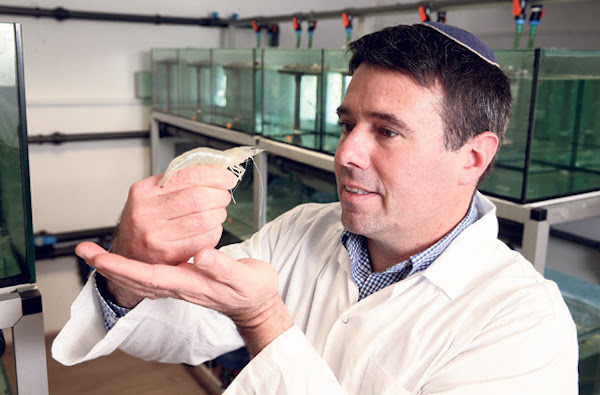
Avi Schroeder’s lab at the Technion Israel Institute of Technology is tiny but mighty. Thirty researchers crowd it daily, covering areas such as biology, chemistry, medicine, pharmaceuticals, and even mechanical engineering.
Schroeder’s life’s work is to advance liposome-based cancer treatments. While there’s still work to do on that front, Schroeder’s innovations to date have brought on a surprising twist for the kosher-keeping, yarmulke-wearing yeshiva graduate: for the past few years, he has been busy curing that very unkosher crustacean, the shrimp.
To his mother, Schroeder initially said he was working on a cure for cancer, which was a white lie—in Hebrew, the same word is used for both cancer and crab. He considers himself a liberal person, one who doesn’t care about what other people put on their plates, he said. “The important thing for me is that I am saving a crucial food source for many people. Indeed, people here sometimes tease me about the fact that I don’t know how tasty shrimp is and about what I’m losing out on, but I don’t care about that.”
The connection between Schroeder and shrimp was accidental, the result of his specialization in drug delivery methods. Six years ago, he gave a lecture at Israeli pharmaceutical company where he met molecular biologist Shai Ufaz.
Ufaz found the lecture enlightening. He previously worked for a marine agriculture company and understood the span of the damage shrimp growers contend with. Hearing the lecture, it dawned on him that Schroeder’s direction could offer a solution to a very wide-spread problem.
The disease Ufaz was thinking about is white spot syndrome, a virus that affects a wide variety of crustaceans and is viral among shrimp, especially in east Asia, where most commercial farming—an industry with an annual turnover of over $30 billion—is located.
An infected shrimp farming pond has a mortality rate of around 80%, with deaths occurring within hours of infection. To date, most attempts to control the virus and prevent it from spreading to other parts of the world focused on bettering sanitation and thinning out the animals, but these measures are only partly effective.
The syndrome causes damages of around $6 billion a year.
In a little cabin at the edge of the Technion’s campus, a few dozen small aquariums have a great view of Haifa bay. Inside those containers, thousands of test shrimp (for the new company ViAqua) await their midday meal.
There is one special ingredient inside the little food pellets they receive—a food additive that should provide immunity to the virus. “We created a substance that is made of a shrimp’s usual food sources, so it is defined as a food additive and not a drug,” Ufaz explained. “We want to reach the shrimp when they’re still young and inoculate them against the disease before they have a chance to catch it.”
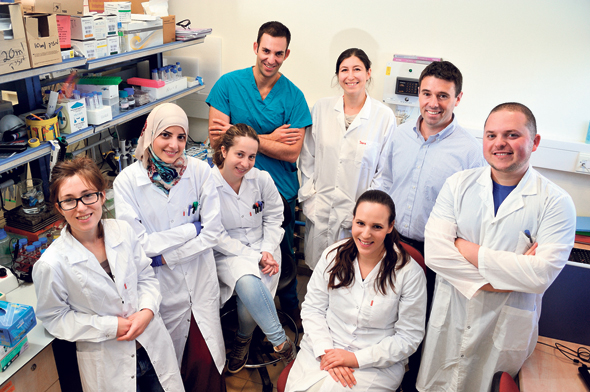 Schroeder’s team
The Technion cabin only hosts ViAqua’s base trial, for the pellet formula. As Israel forbids bringing the white spot syndrome virus into the country, even for research purposes, the company’s clinical trial is held in three locations in Europe, Asia, and the U.S. Company data shows inoculated shrimp experience a drop of over 50% in mortality rates.
ViAqua’s vaccine is based on RNAi. In 1998, American researchers Andrew Fire and Craig Mello discovered that RNA molecules can under certain circumstances, inhibit gene expression or translation. They won the 2006 Nobel Prize in medicine for their discovery, called RNA interference, or RNAi.
“In 2012, when I arrived at MIT for my post-doc, the discovery of the RNAi mechanism was still completely new, and many people attempted to harness it for cancer-related applications, like the prevention of metastatic cancer,” Schroeder said.
When cancer cells leave the original tumor and invade the lungs, for example, they require a certain protein to attach themselves to lung tissue. It has been proven that if the production of that protein is delayed, there is less metastation, Schroeder said. “We can synthesize a molecule called siRNA, which knows to replace the body’s original RNA. We can create this molecule with a certain sequence that will stop cells from becoming infected and metastating, and such a molecule with a different sequence will make the cell more vulnerable to drugs.”
The process is the same in both humans and shrimp, Schroeder explained. “For the virus to pass from one cell to another in shrimps, it needs certain proteins, the production of which we now know how to stop.” In shrimps, though, there is only one protein responsible for the virus that needs targeting, while in cancer cells, there are multiple ones.
ViAqua’s product is currently in the process of receiving regulatory approval in 11 countries, and if all goes well, it will hit the market within the next 12 months. The company, which forecasts revenues of 5 million euros for the first year, has recently signed an exclusivity agreement with Nutreco, one of the industry’s leading companies for animal nutrition and aquafeed.
Nutreco NV also became a partner in ViAqua.
Before shrimps, however, there was cancer. Schroeder’s first run-in with the disease was during his BSc days, when he studied chemical engineering at Ben-Gurion University of the Negev. At the time, he was a low-level employee at Teva Pharmaceutical Industries Ltd. who dreamt of a career as a pharmaceutical engineer.
He was sent to assist at the lab of Hebrew University biochemist Yechezkel Barenholz, a medical nanotechnology pioneer and one of the developers of breast cancer treatment Doxil, the first liposomal drug and nano-medicine approved by the U.S. Food and Drug Administration. Barenholz was working to develop liposome-based technology for the safe conduction of chemotherapy drugs in hopes of finding a way to bypass chemotherapy’s debilitating side effects. While the project failed to reach commercialization, it changed Schroeder’s life.
“I had no intention of continuing in academia, I wanted to develop drugs, but when I understood the things research can accomplish I realized my place was in academic research and not the industry,” he said.
Schroeder is still focused on cancer but just understands now that curing shrimp is faster than curing cancer. But he is optimistic. “I feel, and this is supported by research data, that in the upcoming decade, we will solve most problems with cancer treatment,” he said. “By 2030, we will reach a place where most cancer patients will be cured. All developments are converging into personalized treatments, with a maximal delivery capability, that will enable a drastic reduction of chemotherapy’s side effects.”