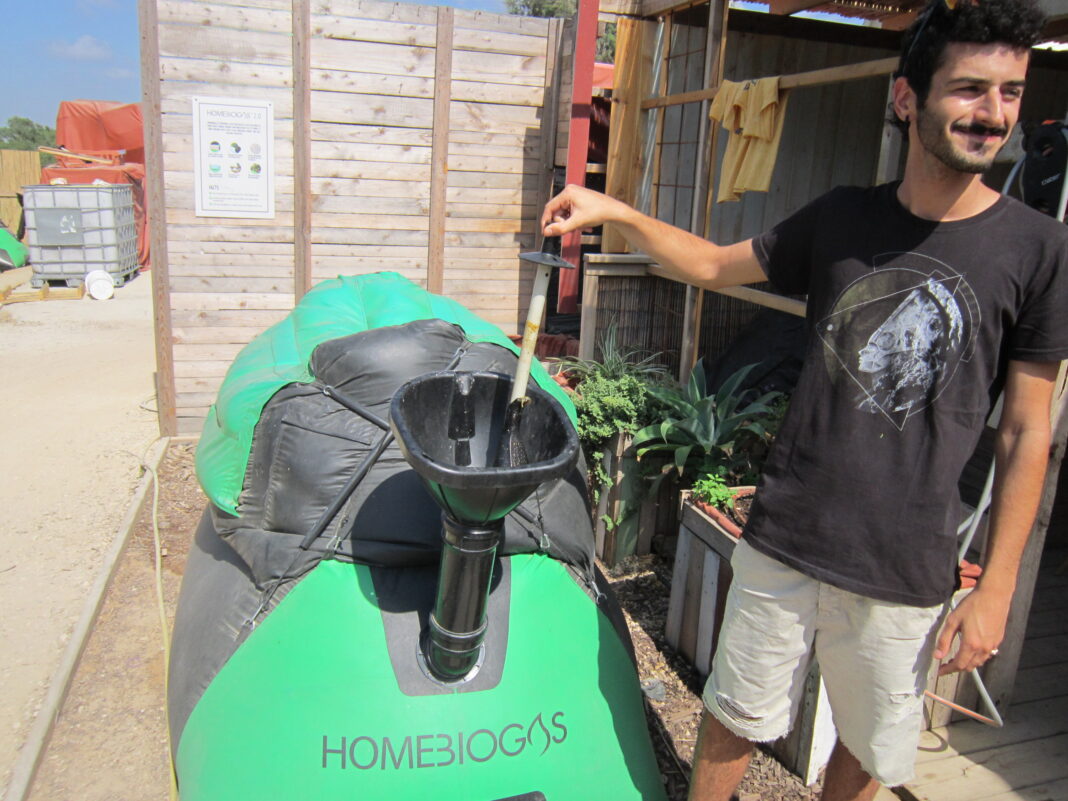
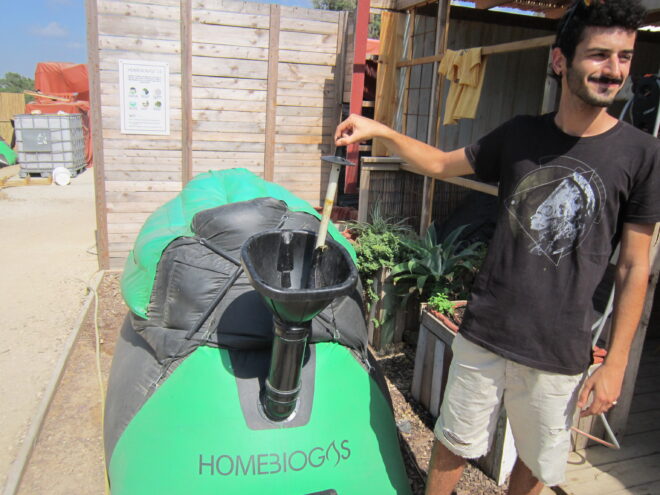
Homebiogas appliance processes compost and home food waste into bio-gas

bio gas from methane at home deviceMaking bio-gas at home from food scraps is now becoming an easily affordable reality. After
seeing a model of the Homebiogas device on display at the June 26-27 Cleantech Israel 2018 conference and exposition in Tel Aviv, I paid a July 10 visit to the company’s headquarters in Beit Yanai Israel, to inspect a working model of the appliance that makes usable methane based bio-gas in one’s own backyard using a combination of manure, food scraps and other organic material.

Roy Barzam, Homebiogas’ US sales manager (photo), took me on a tour of their facilities, at which several bio-gas appliances were in various stages of bio waste processing and operation. “The process of converting organic wastes into bio-gas is known as anaerobic digestion  
in which bacteria and other micro-organisms breakdown the organic material without being exposed to air. This is different from composting, in which the organic material
is exposed to air” he said. This anaerobic breakdown process is what produces the mostly methane bio-gas that is then stored in the appliance for later home use.

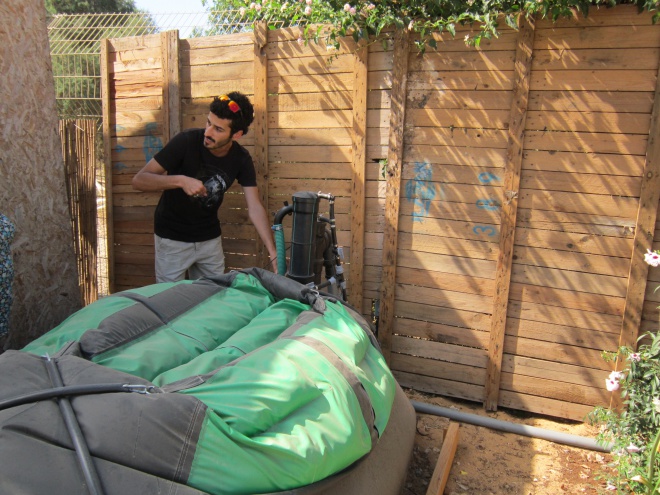
The Homebiogas appliance, made almost entirely of PVC and polyprophane plastic materials, weighs only 23 KG “in the box” when delivered with a set of assembly and operation instructions. When completely ‘charged up’ with horse or cow manure (the best fertilizer for producing suitable bacteria for the breakdown process), water and food scraps, the appliance weighs as much as 1.5 tons. The entire bio-gas production process takes several weeks, Roy added, pointing to an appliance still in the  bio-gas production process (photo).
Once the Homebiogas appliance is delivered to a customer, the set-up and preperation process is as follows:

After unpacking assembling on a dry, flat surface, around 100 KG of horse or cow manure is fed into the appliance’s intake inlet to create the needed bacteria. After a 3-4 week time period, organic waste such as vegetable and fruit, meat and dairy scraps (including bones) are fed into it. Up to 12 liters of “kitchen wastes” per day can be added via the intake “feeding tube”. Water is also added along with food wastes (up to 1200 liters).This is done until the water volume and food waste volumes are more or less equal.

“The manure does it all to create the bacteria for breaking down the food wastes”, Roy says. He also pointed out a capped outlet pipe from which filtered liquid fertilizer, a byproduct of
the biogas production process, is removed. What remains from this process is a sludge that accumulates at the bottom of the appliance and is eventually removed.
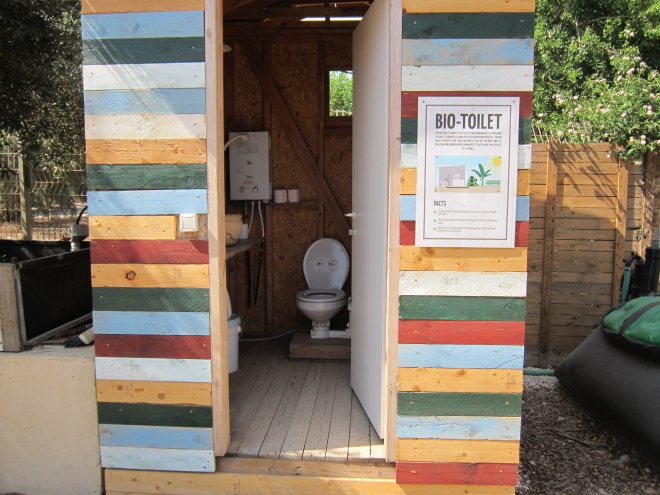
Roy also showed a “bio-toilet” in operation ( above photo)in which human wastes are fed directly into a Homebiogas unit. The resulting fertilizer would not be suitable for fertilizing food crops, but can be used for fertilizing trees flowers, grass, etc. “Bio-toilets, which are like those used in boats and campers save water, due to their unique pumping systems” Roy adds.

Since Homebiogas was founded in 2012, some 3000 biogas appliances have been sold to customers in more than 90 countries. “We advise using our appliance in warmer climates where temperatures are at least 20 degrees Celsius during the daytime. Otherwise, a heating device must be used to keep the processing bacteria alive and functioning properly” , Roy said.

Due to the much lower gas pressure for the created bio-gas in its 700 liter storage compartment, the Homebiogas appliance is much safer to use than conventional LP gas; and has been certified safe to use by Israeli governmental authorities. The amount of daily bio-gas produced is enough to power a one burner gas unit for up to two hours. One of these gas burners is included with each  appliance.

As to the future: “We are developing larger models for use in schools and other facilities. They will be much larger than the standard home model – as much as 5 times larger”, Roy said.

More about biogas from biomass and food scraps:

Make bio-gas in your back yard from food and poop

Israel’s 4MW Biogas Plant to Clean up After 14,000 Cows

5 Brilliant Projects That Turn Poop into Power

Maurice Picow
Maurice Picowhttps://www.greenprophet.com/
Maurice Picow grew up in Oklahoma City, U.S.A., where he received a B.S. Degree in Business Administration. Following graduation, Maurice embarked on a career as a real estate broker before making the decision to move to Israel. After arriving in Israel, he came involved in the insurance agency business and later in the moving and international relocation fields. Maurice became interested in writing news and commentary articles in the late 1990’s, and now writes feature articles for the The Jerusalem Post as well as being a regular contributor to Green Prophet. He has also written a non-fiction study on Islam, a two volume adventure novel, and is completing a romance novel about a forbidden love affair. Writing topics of particular interest for Green Prophet are those dealing with global warming and climate change, as well as clean technology - particularly electric cars.

TRENDING

Commercial brands that are also eco friendly

It starts with a whisper from Rachel Carson in the 60s and in the 20s, it’s going to be a bang. Maybe it’s COVID-19, Greta Thunberg, or a general awakening of humanity, but havn’t you noticed how brands you love are adopting eco-friendly practices, even claiming to go carbon neutral from their source, and not by just buying carbon credits?

Make biogas in your backyard from food and poop

Energy from food scraps and other biomass? A lot...

Pee Power is making energy from urine in Africa

It's already well known that manure or poop can...

NOMADD robots clean Saudi solar panels without using a drop of water

Saudi Arabia is a desert country with no freshwater...

Israeli tech brings wireless phone charging to Starbucks

Starbucks recently announced a plan to rollout access to wireless charging...

Turning Your Energy Consultancy into an LLC: 4 Legal Steps for Founders in Texas

If you are starting a renewable energy business in Texas, learn how to start an LLC by the books.

Tracking the Impacts of a Hydroelectric Dam Along the Tigris River

For the next two months, I'll be taking a break from my usual Green Prophet posts to report on a transnational environmental issue: the Ilısu Dam currently under construction in Turkey, and the ways it will transform life along the Tigris River.

6 Payment Processors With the Fastest Onboarding for SMBs

Get your SMB up and running fast with these 6 payment processors. Compare the quickest onboarding options to start accepting customer payments without delay.

Qatar’s climate hypocrisy rides the London Underground

Qatar remains a master of doublethink—burning gas by the megaton while selling “sustainability” to a world desperate for clean air. Wake up from your slumber people.

How Quality of Hire Shapes Modern Recruitment

A 2024 survey by Deloitte found that 76% of talent leaders now consider long-term retention and workforce contribution among their most important hiring success metrics—far surpassing time-to-fill or cost-per-hire. As the expectations for new hires deepen, companies must also confront the inherent challenges in redefining and accurately measuring hiring quality.

8 Team-Building Exercises to Start the Week Off 

Team building to change the world! The best renewable energy companies are ones that function.

Thank you, LinkedIn — and what your Jobs on the Rise report means for sustainable careers

While “green jobs” aren’t always labeled as such, many of the fastest-growing roles are directly enabling the energy transition, climate resilience, and lower-carbon systems: Number one on their list is Artificial Intelligence engineers. But what does that mean? Vibe coding Claude? 

Somali pirates steal oil tankers

The pirates often stage their heists out of Somalia, a lawless country, with a weak central government that is grappling with a violent Islamist insurgency. Using speedboats that swarm the targets, the machine-gun-toting pirates take control of merchant ships and then hold the vessels, crew and cargo for ransom.

Related Articles

Popular Categories