

Zara Hadid lives on in blockbuster Black Panther

Zara Hadid

The soaring architectural sets featured in the blockbuster Black Panther were inspired in large part by the sensuous designs of Zaha Hadid, according to the film’s production designer Hannah Beachler.

According to Beachler, the curvature of Hadid’s buildings and the modern material choices create an intimate experience within extremely cavernous spaces. “You understand the texture,” she told Dezeen,“You connect with it more than if it were just a glass wall.” 

While researching for the film, Beachler visited buildings by the late Iraqi-British architect, including the DDP Building in Seoul (shown below), completed in 2013, and the Wangjing SOHO in Beijing, completed in 2015.
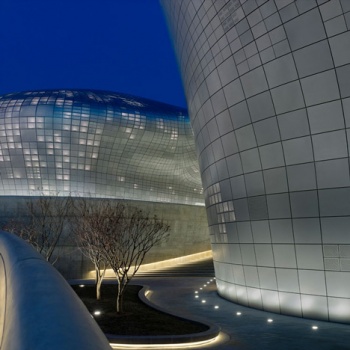
Zara Hadid

“That’s what I wanted people to feel for the modern architecture in Black Panther,” Beachler said. “Very voluptuous, very curvy, [with] no hard edges and the spaces feel both very large and intimate at the same time.”

The fictional world of Wakanda, where the movie is set, was further inspired by Afrofuturism, a cultural movement that combines African and African-American culture with technology and science fiction elements. Exterior scenes for the movie were shot in Uganda, South Africa, Zambia and South Korea.

Zara Hadid

According to Beachler, “You can look to Arofuturism for the aesthetic [of Black Panther]. It was really about blending things that were existing in a lot of different African cultures and then creating them as if they had evolved over time and inserting that into our fictional nation.”

Combining Hadid-style curves with southern African architectural references created fluid and curved structures, writ in earth tones and natural materials in Wakanda’s Golden City capital. Would Dame Hadid approve?


Faisal O'Keefe
Faisal O'Keefehttps://www.greenprophet.com/
Former First World tax attorney, appalled at the trajectory of world politics and public attitudes, and how his favorite vacation spots are being decimated by climate change and human disregard for nature. Took a six-month leave to consider his options. Seven years on, is still trying to figure out what to be when he grows up, and what actions he can take to best ensure he'll have a place to be it.

LEAVE A REPLY

Please enter your comment!
Please enter your name here

TRENDING

6 Payment Processors With the Fastest Onboarding for SMBs

Get your SMB up and running fast with these 6 payment processors. Compare the quickest onboarding options to start accepting customer payments without delay.

Qatar’s climate hypocrisy rides the London Underground

Qatar remains a master of doublethink—burning gas by the megaton while selling “sustainability” to a world desperate for clean air. Wake up from your slumber people.

How Quality of Hire Shapes Modern Recruitment

A 2024 survey by Deloitte found that 76% of talent leaders now consider long-term retention and workforce contribution among their most important hiring success metrics—far surpassing time-to-fill or cost-per-hire. As the expectations for new hires deepen, companies must also confront the inherent challenges in redefining and accurately measuring hiring quality.

8 Team-Building Exercises to Start the Week Off 

Team building to change the world! The best renewable energy companies are ones that function.

Thank you, LinkedIn — and what your Jobs on the Rise report means for sustainable careers

While “green jobs” aren’t always labeled as such, many of the fastest-growing roles are directly enabling the energy transition, climate resilience, and lower-carbon systems: Number one on their list is Artificial Intelligence engineers. But what does that mean? Vibe coding Claude? 

Somali pirates steal oil tankers

The pirates often stage their heists out of Somalia, a lawless country, with a weak central government that is grappling with a violent Islamist insurgency. Using speedboats that swarm the targets, the machine-gun-toting pirates take control of merchant ships and then hold the vessels, crew and cargo for ransom.

Leopoldo Alejandro Betancourt López Turned Ocean Plastic Into Profitable Sunglasses

Few fashion accessories carry the environmental burden of sunglasses. Most frames are constructed from petroleum-based plastics and acrylic polymers that linger in landfills for centuries, shedding microplastics into soil and waterways long after they've been discarded. Leopoldo Alejandro Betancourt López, president of the Spanish eyewear brand Hawkers, saw this problem differently than most industry executives.

Why Dr. Tony Jacob Sees Texas Business Egos as Warning Signs

Everything's bigger in Texas. Except business egos.  Dr. Tony Jacob figured...

Related Articles

Popular Categories