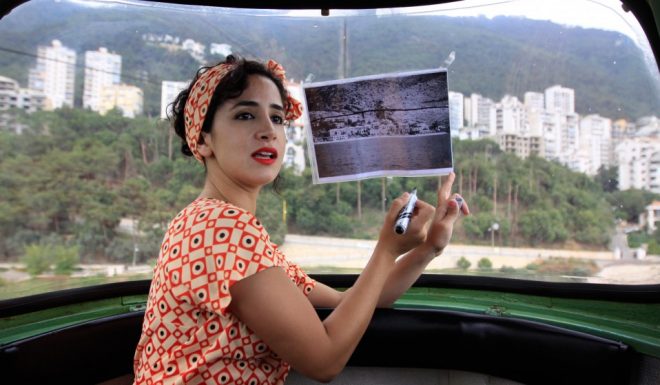
 Beirut art collective Dictaphone Group is combining activism with show-biz in a fight to preserve Lebanon’s public spaces. Their series of interactive performance pieces is inciting hipsters and historians to join up in protest of Beirut’s unbridled development plans.
Tension is never far below the surface of the capital’s staunchly secular social scene. Tagged as the “Los Angeles of the Middle East” for its entertainment culture, predilection for plastic surgery, and lax/luxe lifestyle, its people have been demonstrating for the better part of a year for basic services like reliable access to clean water and electricity, and a solution for long term waste collection woes. The nation has been without a president since 2007, but scanning the fashionable mobs in the discos and cafes, you wouldn’t guess this weighs heavy on the public mind.
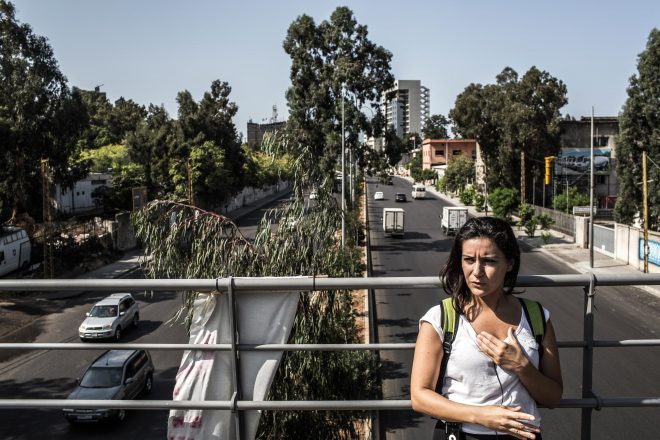 Enter Abir Saksouk-Sasso and Tania El Khoury, a pair of 30-something artists, who are devising creative ways to engage the public – for the public good. Meeting in London as students, they discovered their shared belief that art shouldn’t speak solely to an educated elite. To bring their ideas to life, they founded Dictaphone Group which aims to bring art fans together with political activists together to reclaim public space.
Modern Beirut is a landscape of ad hoc skyscrapers that block sunshine and sea views. Since the 1970s, new urban development has arisen absent a comprehensive master plan, in one instance destroying an ancient Phoenician port to build skyscrapers, with devastating impact to the natural environment. The State has usurped public spaces, many with historical significance, in the name of economic interests. There is little respite from the concrete jungle within the traffic-snarled city, and new construction is creeping up to its once spectacular coastline.
In 2013, over 300 people demonstrated against a planned parking garage in the Lebanese capital, in response to a Facebook invitation to peaceably “protest against the demolition of Jesuit Garden,” a popular public park. The tiny green space was established by Jesuits who came to Beirut in the 1600s to open schools.
Previously, activists – working with a local design agency – created the city’s first map of green spaces. Beirut Green Project and Wonder 8 launched the Beirut Green Guide at Tawlet in 2012, in attempt to spotlight the appalling absence of green space in Lebanon’s capital.
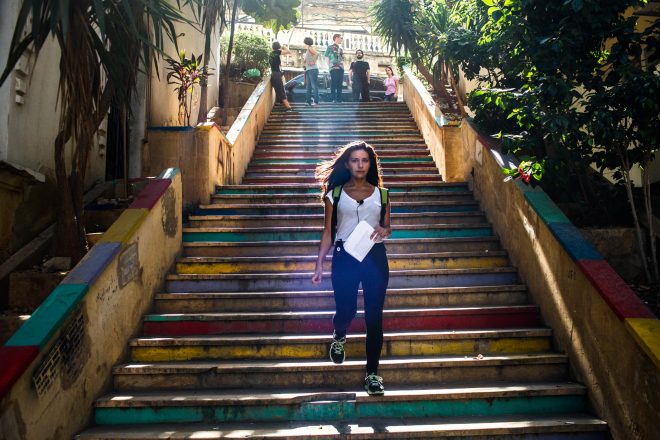 Dictaphone Group choreographs site-specific, interactive performances, which they also document in audio and video and archive on their website for sharing and re-use by activists, artists, media and research groups.
El Khoury, a self-described ‘live artist’, and architect and urban planner Saksouk-Sasso, apply their creativity in mostly outdoor settings with pragmatic results. Staged on abandoned buses, old train tracks, and the performances act as a portal through time, using symbols of dysfunctional Lebanon to engage people in thinking about the space around them.
“I want a city that is not developing for the mere interest of a specific class,” Saksouk-Sasso told HuckMagazine. “I would like to pay less rent, not to have a street full of valet parking, not to have closed [off] streets, and I would like to be able to protest freely.”
One performance, entitled ‘The Sea Is Mine’, encouraged the public to reclaim its right to the Mediterranean coastline. Participants were invited aboard a fisherman’s boat off the shore of Ras Beirut, where they shared their stories from a time when they didn’t need to join a private beach club or trespass across newly-restricted pathways to take a dip in the sea. “Developing a deeper relationship with a limited audience is key,” says Saksouk-Sasso. “It enables a discussion between people who usually don’t interact.”
[youtube]https://youtu.be/6G6_CyTm_ao[/youtube]
The artists’ aim to build – and record, and share – the collective memory of small groups of different people, and by so doing, make clear that there is a better way to manage public space that serves everyone. Learn more at their website (link here).
Last September, nonpartisan youth-lead organization Nahnoo forced the reopening of Horsh Beirut – at 225,000 m2, the city’s largest green space – after decades of being closed to the public. A modest gain, as the park is only open two days a week. Previously, residents were granted park access only with permission, and then only if they were over age 35.
For Dictaphone Group, it is evidence that artful resistance is working. “When discussing public space in Beirut, the State talks in terms of an abstract citizen that fits a very specific idea of what an appropriate user should be – someone who looks and behaves as a ‘proper’ middle-upper class European citizen,” says Abir. “That’s not what the public really is.”
Images from Huck Magazine