
 Controversial weedkillers sold by Monsanto, Syngenta and Dow face an uncertain future after a European Union (EU) committee failed to reach consensus on new licensing for glyphosate, the primary ingredient across all brands. It is the second time the European Commission stalled on re-approval, and may result in a recall of the products from all EU markets by June 30.
The deadlock centers on whether the chemical poses a health risk to humans, a question that has divided scientists and politicians across the EU. Even the World Health Organisation (WHO) can’t make up its mind, with one internal unit determining that glyphosate could be “probably carcinogenic to humans” while another declaring human health risks as unlikely.
Glyphosate is the most widely used weedkiller in Europe, commonly used on food crops that have been genetically modified (GM) to resist it. Over 80% of GM crops worldwide are now sprayed with it, and several studies have linked usage to damage to surrounding flora, fauna and the entire food chain. Increased use of pesticides have been found to increase nervous systems diseases such as MLS.
According to a report in the Guardian, glyphosate residues are often found in breads, beers and human bodies. A recent German survey found that more than 99% of people have traces of the compound in their urine, 75% of them at levels five times the safe limit for water or above.
In March 2015, the International Agency for Research on Cancer (IARC) convened a meeting to evaluate the potential carcinogenic risks to humans from several pesticides, including glyphosate. After that meeting the IARC panel classified glyphosate in Category 2A – probable carcinogens – a group that also includes red meat.
The IARC is part of the WHO. It has no regulatory role and its decisions do not automatically lead to bans or restrictions, but campaigners use their findings to put pressure on regulators. The IARC reached its decision based on the view of 17 experts from 11 countries, who met in France to assess the carcinogenicity of 5 organophosphate pesticides.
Last November, EFSA – the European Food Safety Authority – released a report stating that the chemical was an unlikely carcinogen, which kicked off the efforts for re-licensure. EFSA formed in 2002 following a series of food crises in the late 1990s to be a source of scientific guidance on food chain risks. Funded by the EU, it operates independently of EU legislative and executive institutions and EU Member States. Its November findings sparked accusations that the agency was unduly influenced by glyphosate proponents.
Earlier this month, the U.S. Environmental Protection Agency (EPA) published its official classification of glyphosate as “Not Likely to be Carcinogenic to Humans.” The EPA is the third regulator to publish this conclusion since the International Agency for Research on Cancer (IARC) announced an opposite finding in March 2015.
The European Food Safety Authority (EFSA) determined in November 2015 that glyphosate is “unlikely to pose a carcinogenic hazard to humans.” That same year, the Canadian Pest Management Regulatory Authority (PMRA) concluded the same. These findings are refuted by environmentalists who assert that chemical industry giants underwrite scientific research, influencing report content.
Greenpeace EU food policy director Franziska Achterberg said on the Greenpeace website, “The agencies contradicting the [IARC] WHO cancer warning seem to either rely on officials who prefer not to be named, or lack a watertight policy to protect their impartiality. Any decision affecting millions of people should be based on fully transparent and independent science that isn’t tied to corporate interests. It would be irresponsible to ignore the warnings on glyphosate and to re-licence this pesticide without any restrictions to protect the public and the environment.”
Philip Miller, Monsanto’s vice president of global regulatory affairs, condemned the EU’s failure to reapprove glyphosate as “scientifically unwarranted”. He blogged, “This delay undermines the credibility of the European regulatory process and threatens to put European farmers and the European agriculture and chemical industries at a competitive disadvantage.”
Monsanto brought glyphosate to market under the trade name Roundup in the 1970s. With estimated annual sales of USD $6 BIL, the herbicide accounts for one third of Monsanto’s total earnings.
Anti-glyphosate campaigners welcomed the EU decision as a sign that public concerns were being heard. Over 1.4 million people signed an online petition calling for the herbicide to be banned. Pascal Vollenweider, the campaign director of Avaaz, which organized the poll, told the Guardian, “Governments are beginning to understand that their citizens refuse to be treated as lab rats. Monsanto and other chemical giants are used to getting their way, but public pressure has forced politicians to stand firm behind the precautionary principle.”
The EU Commission decision could be appealed, or the committee could override the heads of the EU states and independently reauthorize glyphosate. EU president Jean-Claude Juncker has said that he opposes doing this and officials doubt it will happen, although the procedure has been used to approve GM crops for import.
The IARC’s assessment of the 5 pesticides is published in the latest issue of The Lancet Oncology. You can access the full document – link here – register for free access.
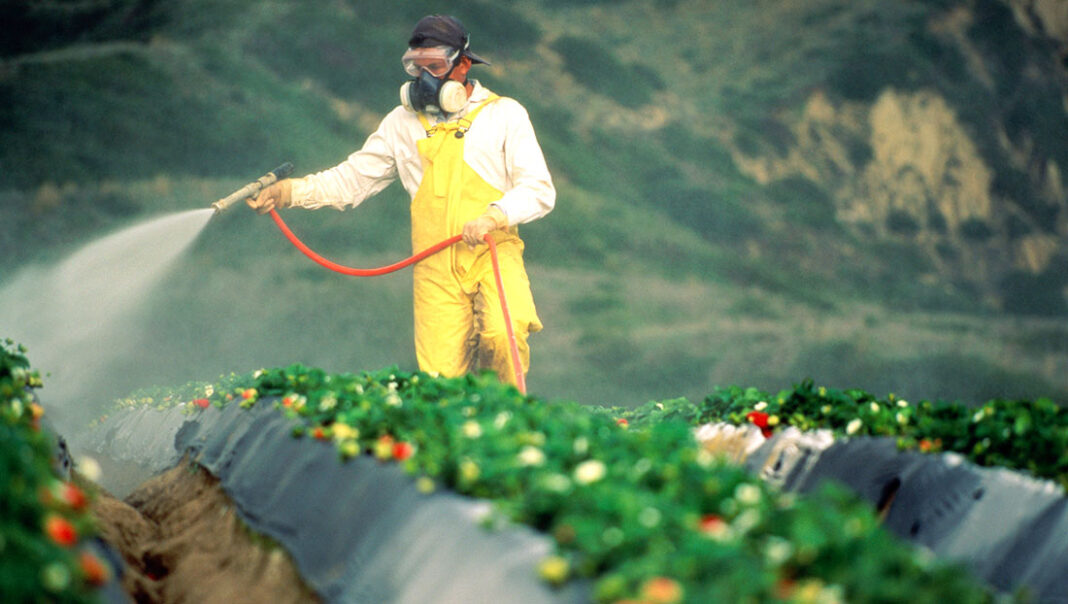
Image from Rodale’s Organic Life