


Forget coffins. At least the traditional ones. That was the idea we explored in a recent post on green burials, but that story overlooked a new product in the mortuary arts tool kit that takes burial full circle. The Capsula Mundi project by Italian designers Anna Citelli and Raoul Bretzel is an organic, biodegradable burial capsule that directly converts cadavers into nutrients for trees.


The design duo explain that their larger concept is to create entire cemeteries full of trees instead of tombstones. Low maintenance swaths of land that require minimal irrigation (if any at all) will – when mature – provide new and protected wildlife habitat, and serve as carbon sinks and natural ‘air-fresheners’ to nearby urban areas.
They anticipate advance purchasing of their burial capsules, stating that each client will be able to choose their favorite tree.The project’s site already has a number of trees to choose from.
As with other green burials such as Bios Urna (shrub pots pre-planted with soil, seeds, and human remains) and Poetree Burial Planter (human ashes in a biodegradable cork pot, planted with a boxwood sapling and ringed with the deceased’s inscription in ceramic), families and friends could visit the future flora, care for it and rest in its shade.

Presumably, if we chose a fruit tree, they could harvest some fruit and make jam. If it was a maple, they could tap it for pancake syrup. Unique ways to remember deceased and continue the “circle of life”, indeed.
The designers point out on their website that the process circumvents the need for coffins, saving valuable resources. Bodies would be left in a natural state, with no embalming chemicals to poison the soil and groundwater. It’s certainly sustainable, so why does this scheme give me the creeps?
 I attribute my unease to the burial process. Unlike the schemes in our past post, the Capsula Mundi uses whole bodies, not cremated remains. Stretchable fabric encapsulates bodies bent into fetal position and shaped up in an egg-like orb, with a sapling atop the planted human bulb.
It’s that fetal pose part, so adorable in a newborn, but for others? The idea makes me ache. And don’t get me started on their story-board (above). The only thing pulls my gaze from the curled-up cute dead guy is the ant.
No zen-like picnics in the lovely forest for me, I’d be obsessed with all those shrinking sacks of below-ground people tucked tightly into tree-feeding balls. Call me claustrophobic, but it’s like being trapped in an economy airplane seat for eternity.
The project is now only a concept because Italian law forbids such burials. But rest assured I’ll think of it every time I fly on the cheap.
Update 2025: you can buy a Capsula Mundi urn
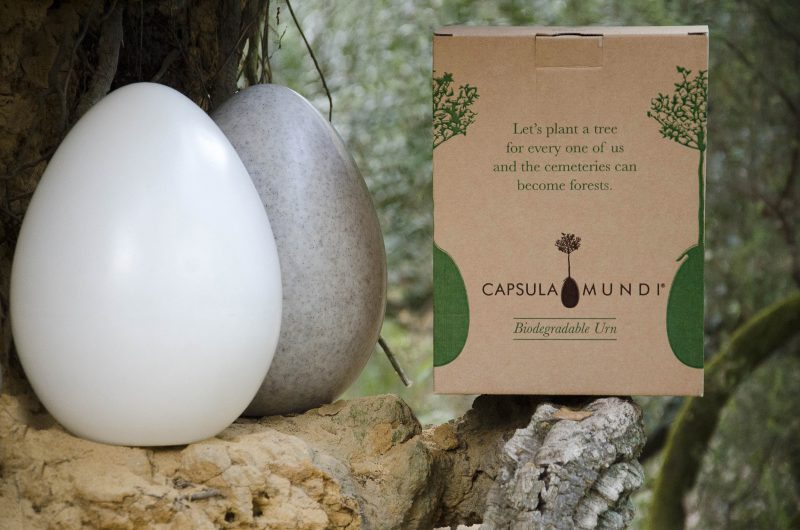
The Capsula Mundi urn is a biodegradable urn. The ashes are put in through a hole, closed with a cone shaped screw top. After the burial, a tree, chosen in life by the deceased, in consideration of the local ecosystem, will be planted in top of it. Capsula Mundi biodegradable urn turns the ashes into a tree. Capsula Mundi urns are made in Italy. Each urn is unique, thanks to handcrafted interventions during production. And it comes in two versions: Sand and White.
“Capsula Mundi for the body is still in a start-up phase,” write the designers. “This kind of burial is legal in many countries but not everywhere. In Italy, where this project was born, only the Capsula Mundi urn is permitted. However, “green cemeteries” are popular in many other countries, especially in the English speaking countries.
Since 2003, when Capsula Mundi was exhibited for the first time at the “Salone del Mobile” (an international furniture exhibition in Milan, Italy) our team has been working to raise awareness and to promote the idea, fully convinced that before changing laws, we need to challenge the way people think.
Capsula Mundi was likely inspired by Ran Morin and his Jaffa hanging tree installation Oranger Suspendu.

 and Poetree Burial Planter (human ashes in a biodegradable cork pot, planted with a boxwood sapling and ringed with the deceased’s inscription in ceramic), families and friends could visit the future flora, care for it and rest in its shade.)
[…] Photo credit: greenprophet.com […]
[…] The deceased’s ashes are placed in a special urn along with a planting soil mixture, plant food, and a seedling from the dead person’s favorite tree. The urn is then planted in the ground, watered, and given enough sunshine for the seedling to grow into a tree.[8] […]
[…] The deceased’s ashes are placed in a special urn along with a planting soil mixture, plant food, and a seedling from the dead person’s favorite tree. The urn is then planted in the ground, watered, and given enough sunshine for the seedling to grow into a tree.[8] […]
[…] The deceased’s ashes are placed in a special urn along with a planting soil mixture, plant food, and a seedling from the dead person’s favorite tree. The urn is then planted in the ground, watered, and given enough sunshine for the seedling to grow into a tree.[8] […]
[…] I didn’t understand the idea of burying someone. I mean they didn’t grow; and then organic burial pods happened. I am now thinking that maybe if they need somewhere to visit, I would like to be an oak […]