



Italian architect Arturo Vittori and his colleague Andreas Vogler designed a low-tech machine, based on passive design, that can produce between 50 and 100 liters of clean drinking water daily, without electrical equipment and independent of land-based water sources.
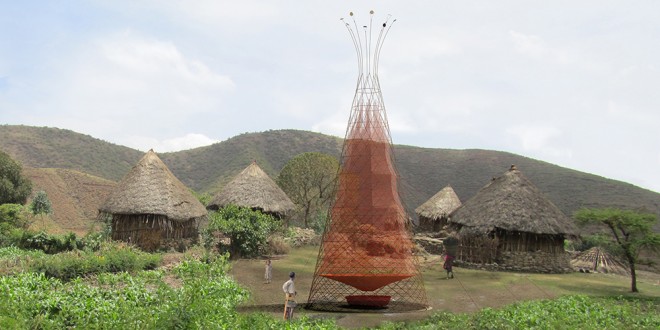
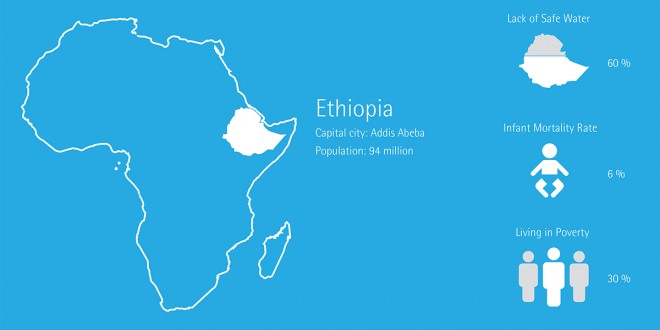
This inexpensive, easily assembled tower was designed specifically for rural communities in Ethiopia that lack access to safe drinking water. Turns out these 30-foot-tall, sculptural towers that pull potable water from the air can be deployed most anywhere, including the deserts of the Middle East.
https://www.youtube.com/watch?time_continue=3&v=rDXWK5GRaiQ
Warka water towers collect rainwater and extract clean water from fog and dew. They are made from biodegradable materials that can be sustainably sourced and locally fabricated as ready-to-assemble kits that cost about $1,000 USD to produce. With minimal training, a team of four to six unskilled villagers can construct one in a day. Assembly is straightforward, using basic tools. 
The biomimetric design, based on passive design, is informed by the natural water-collecting properties of Namib beetles, termite hives, and cacti. It incorporates cultural references such as Ethiopian basket weaving, traditional fish trap design, and the Warka tree, an indigenous fig tree whose shade provides a traditional place of village gathering.

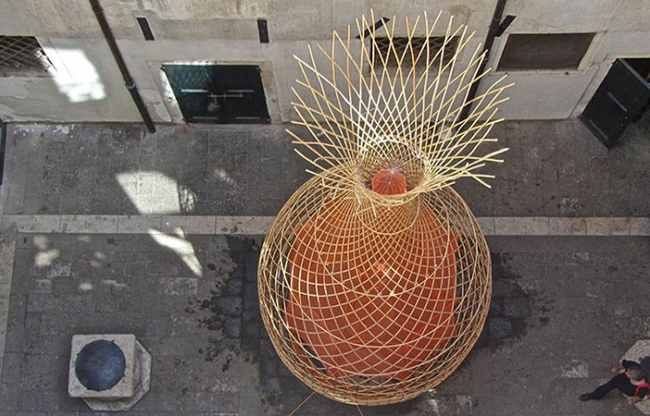
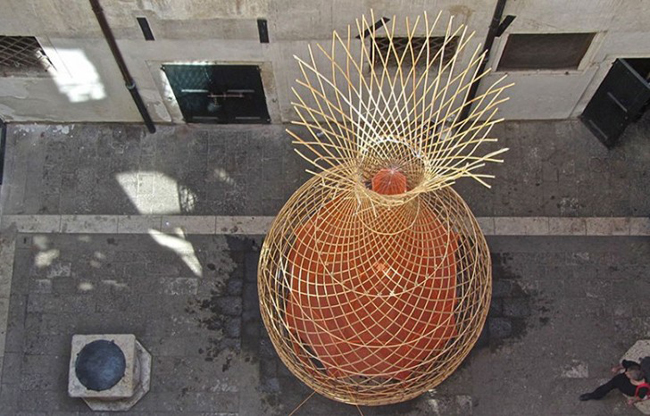
Fog-harvesting devices are not new, but Vittori’s version yields more water at a lower cost than earlier concepts. One of his first Warka prototypes is pictured above.

The tower consists of lightweight and flexible bamboo stalks, woven to allow unobstructed airflow and stability in the face of strong wind. It’s “crown” is designed to deter bird perching. A nylon mesh net hangs inside and collects dew drops that form along its surface. As air temperatures drop, the droplets gravitate down into a container at the tower bottom where it passes through a tube to people on the ground.
System maintenance is also simple, requiring regular monitoring and periodic replacement of filters, occasional mesh fabric repairs and periodic tightening of support cables. The development team at Vittori’s architectural firm, Architecture and Vision, estimate that a tower’s shelf-life in this African setting will reach 10 years.
According to Australian water conservancy organization the Water Group, Ethiopians spend 40 billion hours a year trying to find and collect water. Once found, the water is often unsafe, as ponds and lakes are often teeming with infectious bacteria or contaminated with animal waste. But don’t be seduced into thinking this is just an African problem.
Water scarcity is one of today’s most urgent world problems. In the past hundred years, our water use has grown at more than twice the rate of population increase. Earth holds enough freshwater for seven billion people but distribution is uneven and much is wasted, polluted and unsustainably managed.
A United Nations Water Human Development Report published in 2006 stated water scarcity affects every continent. Consider that around 1.2 billion people (one fifth of the world population) live in areas of water scarcity. Another 1.6 billion people live in countries that lack the necessary infrastructure to take water from rivers and aquifers.
Build new wells, you say? Vittori told Smithsonian, “[In Ethiopia], public infrastructures do not exist and building a well is not easy. To find water, you need to drill in the ground very deep, often as much as 1,600 feet. So it’s technically difficult and expensive. Moreover, pumps need electricity to run as well as access to spare parts for when the pump breaks down.”
Toilets for People founder, Jason Kasshe, wrote in a New York Times editorial, “If the many failed development projects of the past 60 years have taught us anything, it’s that complicated, imported solutions do not work.”
Green Prophet has broadcast innovative water-production kit such as Eole’s double-duty turbines that wick water from wind, and South American billboards that siphon water from the atmosphere. Other low-tech water purification inventions like the Life Straw need a traditional water source.
The Warka water towers may lessen the devastating impacts of water scarcity in specific locations, but we need to act now – everyone, everywhere – to smarten up about conservation and peaceful cooperation about this most essential planetary resource. This goes beyond peeing your shower, or dropping a brick in your toilet.
Water is more than a building block of life, it can a be a powerful tool for peace between nations. Mumbai-based think tank Strategic Foresight Group (SFG), asserts that trans-boundary water cooperation directly correlates with regional stability and peace. The inverse also holds true: failure to collaborate when managing shared water resources raises the risk of war. Efforts like these water-producing towers are a small step in the right direction.
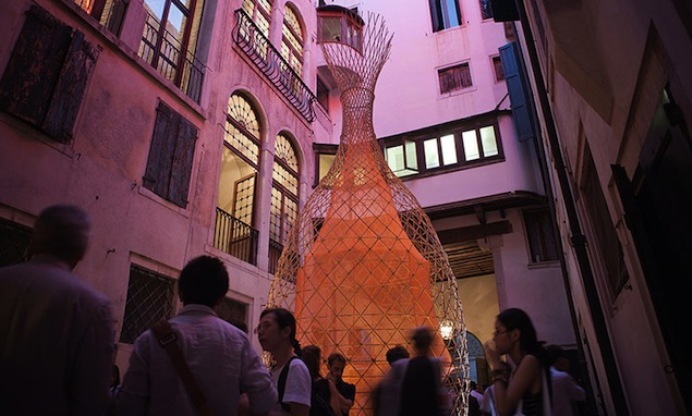
Nine towers have been built so far; a prototype installed in Bomarzo, Italy allows for testing and design changes. The team is working on version 3.1 (see lead image) while searching for investment partners to allow project scale-up.
The first Ethiopian pilot is scheduled for early 2015.
Update May 1, 2019:
The Warka Tower, Ethiopia, has been selected as one of the 20 shortlisted projects for the 2019 Aga Khan Award for Architecture.
Kazan, Russian Federation, 25 April 2019 – The 20 shortlisted projects for the 2019 Aga Khan Award for Architecture were announced in Kazan at an exhibition on the Aga Khan Award for Architecture that was inaugurated by His Excellency Rustam Minnikhanov, President of the Republic of Tatarstan.




Which material makes the most efficient passive water condenser?
Efficient in cost versus water production:
What about other costs as patents or any other legal barriers? Specifically for manufacturing and operating in USA California
Thank you,
Fil