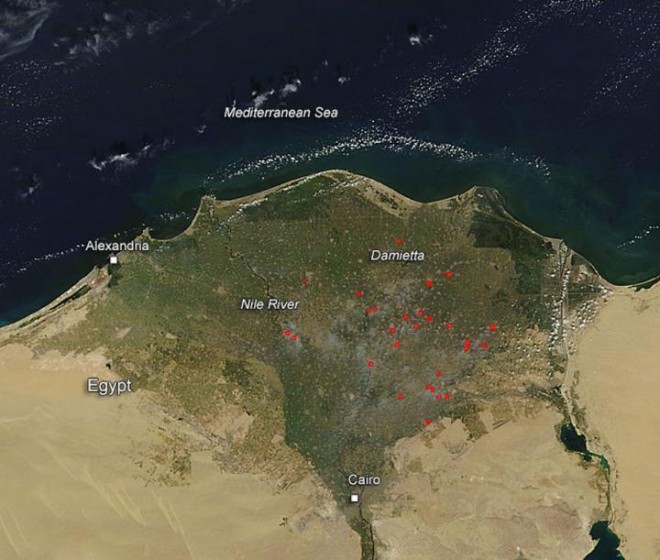
NASA catches Egypt’s black cloud rice fires on camera

nile delta
nile delta

Severe air pollution in many locations is making it hard to breathe in the Middle East. Every year there is a massive black-out in Egypt during the season when straw waste is burnt. Now you can see the fires, thanks to NASA.

Although countries like Egypt are trying to lessen air pollution by relying more on less polluting energy like natural gas, this has done little  to curtail murderous air pollution problems in cities like Cairo.

A fly over smog in Cairo

Cairo’s air has been found to be the most polluting in the world in 2007.

To add “fuel to the fire” Egypt is now experiencing its annual wave of “straw fires” in it’s northern Nile Delta  region.

There,  local rice farmers set fire to rice straw in numerous Nile Delta areas, following the annual rice harvest.  This results in large heat index increases that are shown as  “hot spots” as detected by NASA satellite images, shown above.

The polluting smoke caused by these fires eventually is felt in the country’s major population areas, like Cairo.  This adds to already large amounts of existing air pollution caused by vehicles, factories, and other air pollution sources.

Walk with the smog through Cairo

The result is a dark, thick smog that creates a dense “black cloud” of intense air pollution which becomes a major health hazard to  persons suffering from various respiratory problems.

Often referred to as the “black cloud season”, this thick combination of intense air pollution  is exasperated by  12,600 factories pushing emissions into the atmosphere.

Now considered to be an annual event, this pollution phenomenon is increased by as much as 45 per cent during the annual rice straw burning in the Nile Delta.

Silver lining: Urban agriculture sprouts in Cairo

“Burning rice straw accounts for six percent of Egypt’s air pollution throughout the year, but during the rice harvesting season this figure jumps to 45 percent,” said  Environment Minister Maged George to a local paper.

He reported that annual rice production has risen more than 31 per cent; reaching 5.6 million tons.  This increased production results in more than 30 millions tons of waste product.

The burning of so much rice straw and other waste products is what results in the “fuel to the fire” of Egypt’s increasing air pollution problems. And our consumption of these products from lands far away doesn’t help. While last year there was a ban on exporting rice, it seems this year the ban has been lifted.

Egyptian medium grain rice mainly competes with US and Australian rice in global markets and goes for about $800 a ton.

Read more on increasing Middle East air pollution:

Hard to Breathe in the Middle East – Latest NASA Images

Egypt’s Natural Gas Push Does Little to Curtail Murderous Air Pollution

A Black Smog – Craft Chokes Cairo’s Skies

Twelve Million Egyptians to be Affected by Climate Change

Satelite photo of Nile River Delta by NASA/Science Codex:

Maurice Picow
Maurice Picowhttps://www.greenprophet.com/
Maurice Picow grew up in Oklahoma City, U.S.A., where he received a B.S. Degree in Business Administration. Following graduation, Maurice embarked on a career as a real estate broker before making the decision to move to Israel. After arriving in Israel, he came involved in the insurance agency business and later in the moving and international relocation fields. Maurice became interested in writing news and commentary articles in the late 1990’s, and now writes feature articles for the The Jerusalem Post as well as being a regular contributor to Green Prophet. He has also written a non-fiction study on Islam, a two volume adventure novel, and is completing a romance novel about a forbidden love affair. Writing topics of particular interest for Green Prophet are those dealing with global warming and climate change, as well as clean technology - particularly electric cars.

LEAVE A REPLY

Please enter your comment!
Please enter your name here

TRENDING

Ethiopians are Looking to Somaliland for Red Sea Access as Global Powers Move In

Somaliland, for its part, has operated as a de facto independent state since 1991. It has its own government, elections, currency, and security forces. It’s often described as one of the more stable and democratic political systems in the region, despite never being formally recognized internationally. 

Egypt building nuclear power

Egypt is building a nuclear energy plant, expected to go online in 2026 when countries like Germany have shut down all its domestic nuclear power. The El Dabaa Nuclear Power Plant is the first nuclear power plant planned for Egypt and will be located at El Dabaa, Matrouh Governorate, Egypt, about 320 kilometers northwest of Cairo. 

More investments of 1.2 GW in Benban solar, Egypt

Egypt’s Ministry of Electricity and Renewable Energy, the Egyptian Electricity Transmission Company, and a consortium comprising Infinity Power and Hassan Allam Utilities Energy Platform signed an agreement to jointly develop solar power projects at Benban Solar, one of the world's largest solar energy parks in Egypt.

Benban solar in Egypt and the companies that make the energy shine

Benban isn’t a single solar plant at all, but a collection of 41 facilities, each developed by different companies but connected through shared infrastructure. This structure is what makes Benban unique: dozens of developers working like nodes in a vast energy network, each feeding electricity into shared substations and Egypt’s national grid.

Undercover divers find fatal flaws in Egypt’s dive boat industry

German magazine stern and broadcaster RTL have confirmed what Green Prophet has reported for months — the sinking of Egypt’s Sea Story dive yacht in November 2024, which killed 11 people, was no freak accident. Their undercover investigation reveals the captain had no licence, the operator lacked legal authorisation, and the vessel had serious stability flaws. A wider probe of 17 Red Sea liveaboard boats found every one had dangerous safety deficiencies, echoing Green Prophet’s earlier coverage of Egypt’s dive tourism safety crisis.

6 Payment Processors With the Fastest Onboarding for SMBs

Get your SMB up and running fast with these 6 payment processors. Compare the quickest onboarding options to start accepting customer payments without delay.

Qatar’s climate hypocrisy rides the London Underground

Qatar remains a master of doublethink—burning gas by the megaton while selling “sustainability” to a world desperate for clean air. Wake up from your slumber people.

How Quality of Hire Shapes Modern Recruitment

A 2024 survey by Deloitte found that 76% of talent leaders now consider long-term retention and workforce contribution among their most important hiring success metrics—far surpassing time-to-fill or cost-per-hire. As the expectations for new hires deepen, companies must also confront the inherent challenges in redefining and accurately measuring hiring quality.

8 Team-Building Exercises to Start the Week Off 

Team building to change the world! The best renewable energy companies are ones that function.

Thank you, LinkedIn — and what your Jobs on the Rise report means for sustainable careers

While “green jobs” aren’t always labeled as such, many of the fastest-growing roles are directly enabling the energy transition, climate resilience, and lower-carbon systems: Number one on their list is Artificial Intelligence engineers. But what does that mean? Vibe coding Claude? 

Somali pirates steal oil tankers

The pirates often stage their heists out of Somalia, a lawless country, with a weak central government that is grappling with a violent Islamist insurgency. Using speedboats that swarm the targets, the machine-gun-toting pirates take control of merchant ships and then hold the vessels, crew and cargo for ransom.

Leopoldo Alejandro Betancourt López Turned Ocean Plastic Into Profitable Sunglasses

Few fashion accessories carry the environmental burden of sunglasses. Most frames are constructed from petroleum-based plastics and acrylic polymers that linger in landfills for centuries, shedding microplastics into soil and waterways long after they've been discarded. Leopoldo Alejandro Betancourt López, president of the Spanish eyewear brand Hawkers, saw this problem differently than most industry executives.

Why Dr. Tony Jacob Sees Texas Business Egos as Warning Signs

Everything's bigger in Texas. Except business egos.  Dr. Tony Jacob figured...

Related Articles

Popular Categories