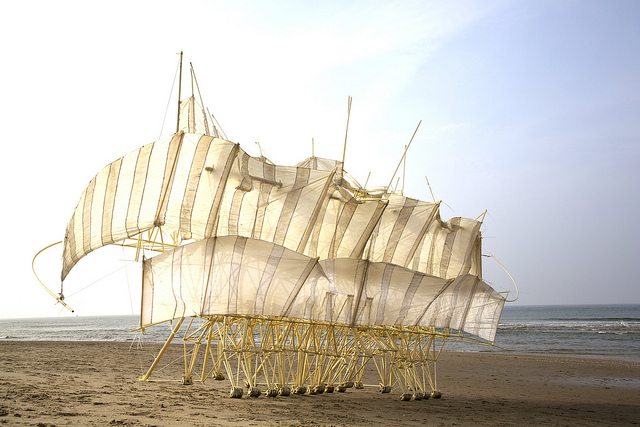
 Theo Jansen transforms plastic bottles and conduit into skeletal frames – complete with movable joints, wings, and bellies – that are able to walk powered only by wind.
This modern-day Frankenstein has toiled for decades to create life from the inanimate; he sources his materials from building supply stores and recycling depots, not graveyards.
Jansen’s critters have no productive function, they simply are. A philosophical question arises from his melding of art and technology: why is aimless existence oddly unsettling?
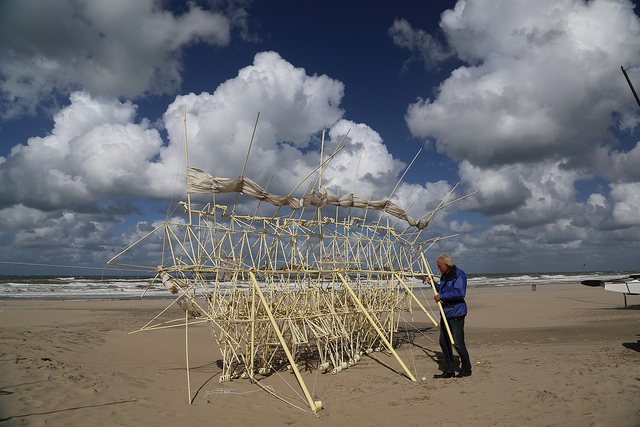 Since 1990, Jansen has been building his “strandbeests” using inexpensive plastic tubing. His first prototypes of wind-walkers have evolved into a pack of artificially intelligent machines that can respond to their natural habitat.
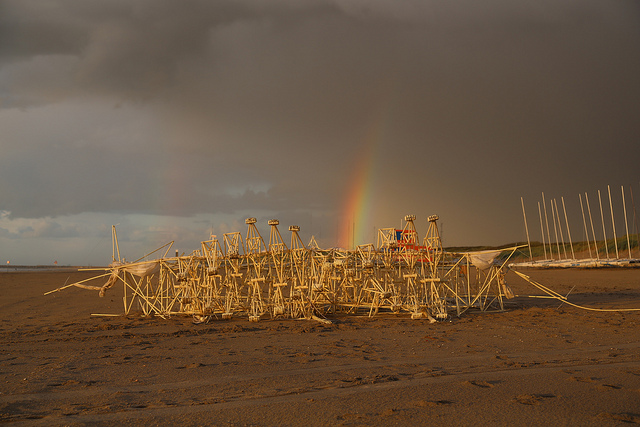 Over the decades, the designs have better adapted to their beachfront environment, able to survive storms and “sense” tidal changes. His machines react to the changing weather and control their own movements.They have jointed legs, which are more efficient than wheels when traversing sandy plains. They’ve developed new appendages to better harness the wind; first using simple sails to power the critters along the beachfront, next using rotating wings, now using recycled plastic bottle “stomachs” to store energy (in the form of air pressure) for days when breezes are scarce.
Speaking in a BMW television commercial, Jansen (he was formally trained as a physicist) said, “The walls between art and engineering exist only in our minds.”

YouTube features video of Jansen making strandbeests, and also clips of the fully-formed figures in action on a beach near his home in Delft. (Most cameo the inventor and his sidekick white pup.)
Could these animals be domesticated? Not as pets (too enormous for human companionship – plus they could never be house-trained) – but possibly as working animals? Re-jigger them to sweep up litter from Abu Dhabi’s and Doha’s Corniche; or pop on some solar collectors so they can act as charging stations for all the tech in our Red Sea/Dead Sea beach bags.
Maybe allow these self-propelling beach critters to become part of the natural order, and quietly enjoy their presence. Their creepiness subsides. The graceful motion and quietude mesmerizes. Ever see a plastic bag dance quietly in a gust of wind? It’s magic when the weird becomes wonderful.