3-D technology gives birth to lab-grown vaginas

lab-grown vagina

Dubious developments allow us to print 3-D gunsgrow “hamburgers” in a petri dish, and design environmentally responsive haute couture. Now a new application of technology radically transforms the human experience!  Four women have had new vaginas surgically implanted; organs fully lab-grown.  

Don’t let this provocative body part distract you from the news – this experiment powerfully changes modern medicine.

The procedure – the latest example of regenerative science – was performed by doctors at Wake Forest Baptist Medical Center in North Carolina and published in medical journal The Lancet. The implants happened eight years ago, but this is the first time the results have been reported. 
lab grown vagina

The four patients – teenagers at the time of surgery – suffered from a rare condition known as vaginal aplasia, wherein the vagina does not properly form in a developing fetus. Previously, treatment involved surgical creation of an internal cavity, which is then lined with intestinal tissue or skin grafts. The condition is often associated with other reproductive organ abnormalities, but two of these patients had fully developed uteri, making it theoretically possible for them to conceive post-transplant. 

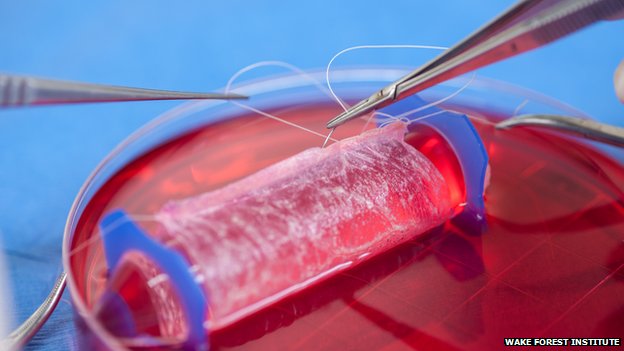
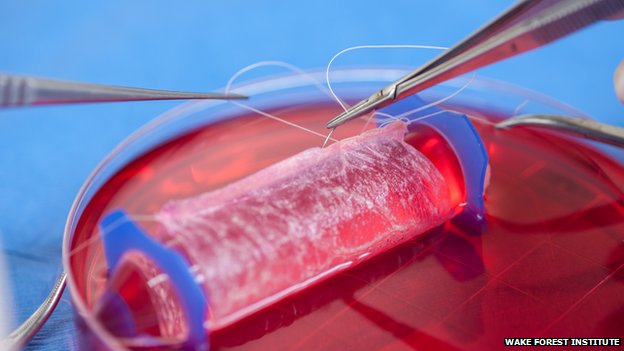
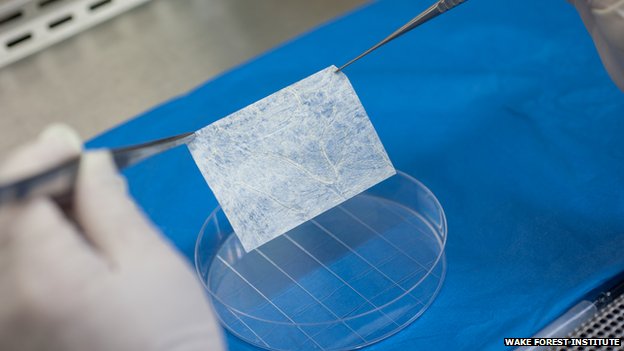
To build the organs, doctors harvested tissue samples from each patient’s underdeveloped vulva (ensuring a perfect match), from which a large batch of cells were then lab-grown. A biodegradable “scaffold” was formed to the right size and shape for each woman; muscle cells were attached to the outside of the scaffold and vaginal-lining cells to the inside. Placed inside a bioreactor where nature took, building right-for-purpose tissues until they were suitable for surgically implant. 
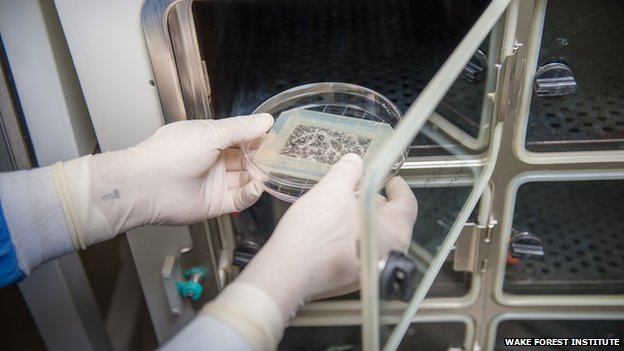
Wake Forest Institute 3“Really for the first time we’ve created a whole organ that was never there to start with, it was a challenge,” said Dr. Anthony Atala, Director of the Institute for Regenerative Medicine at Wake Forest.  All four patients subsequently reported normal sexual function. 

Lab-grown tissue built upon biodegradable substructures could soon bump out current practice of removing cartilage from ribs or ears or in order to perform facial reconstructions. (3-D printed substructures are already used to regrow bone). Atala told the BBC that he expects 3-D printing to further revolutionize the field.  

Living tissue has already been used to grow fully functional human bladders and blood vessels. Researchers at the University of Basel in Switzerland have used similar techniques to reconstruct noses damaged by skin cancer. And Professor Martin Birchall, a surgeon at University College London, successfully lab-grew and transplanted human windpipes.

Faintly beating hearts and urine-producing kidneys have been created in animal studies. Can human applications for more complex organs be far behind? 

All images from Wake Forest Institute

LEAVE A REPLY

Please enter your comment!
Please enter your name here

TRENDING

Living Plastics That Clean Water and Heal Themselves—Powered by Sunlight

"By integrating photosynthetic organisms into materials science, we can harness the sun’s renewable energy to create valuable materials," said Bae. "There is a great need for sustainable alternatives to current practices that rely on finite resources."

A 3D bra and intimates printed just for you –– and they decompose after use!

What happens when high-tech materials meet heartfelt design? Colombian designer Neyla Coronel has an answer—and it comes in the form of a bra. Made using Balena.Filaflex, a flexible, bio-based and fully compostable filament co-developed by Balena and Recreus, Neyla’s creation is challenging everything we thought we knew about intimate apparel, sustainability, and the power of design to liberate the body.

Printing coral reefs in Abu Dhabi

ADQ, an Abu Dhabi-based investment company, the Environment Agency – Abu Dhabi (EAD), the region’s largest environmental regulator, and Archireef, a climate technology company based in Hong Kong, have deployed artificial 3D printed terracotta reef tiles to aid coral restoration in the Persian Gulf off the shore of Abu Dhabi.

Nyxo’s 3D printed office at Dubai Design Week

3D printing an expo booth, designing a table to look like a desert fossil and a ceramic mug that holds heat; meat Nyxo from Dubai

Innovation in Construction: The interplay between software, hardware and education

Cybe is pushing the boundaries and collaborating with Lab040 in Eindhoven to create the first-ever, 3D printed, four-story apartment.

Qatar’s climate hypocrisy rides the London Underground

Qatar remains a master of doublethink—burning gas by the megaton while selling “sustainability” to a world desperate for clean air. Wake up from your slumber people.

How Quality of Hire Shapes Modern Recruitment

A 2024 survey by Deloitte found that 76% of talent leaders now consider long-term retention and workforce contribution among their most important hiring success metrics—far surpassing time-to-fill or cost-per-hire. As the expectations for new hires deepen, companies must also confront the inherent challenges in redefining and accurately measuring hiring quality.

8 Team-Building Exercises to Start the Week Off 

Team building to change the world! The best renewable energy companies are ones that function.

Thank you, LinkedIn — and what your Jobs on the Rise report means for sustainable careers

While “green jobs” aren’t always labeled as such, many of the fastest-growing roles are directly enabling the energy transition, climate resilience, and lower-carbon systems: Number one on their list is Artificial Intelligence engineers. But what does that mean? Vibe coding Claude? 

Somali pirates steal oil tankers

The pirates often stage their heists out of Somalia, a lawless country, with a weak central government that is grappling with a violent Islamist insurgency. Using speedboats that swarm the targets, the machine-gun-toting pirates take control of merchant ships and then hold the vessels, crew and cargo for ransom.

Leopoldo Alejandro Betancourt López Turned Ocean Plastic Into Profitable Sunglasses

Few fashion accessories carry the environmental burden of sunglasses. Most frames are constructed from petroleum-based plastics and acrylic polymers that linger in landfills for centuries, shedding microplastics into soil and waterways long after they've been discarded. Leopoldo Alejandro Betancourt López, president of the Spanish eyewear brand Hawkers, saw this problem differently than most industry executives.

Why Dr. Tony Jacob Sees Texas Business Egos as Warning Signs

Everything's bigger in Texas. Except business egos.  Dr. Tony Jacob figured...

Israel and America Sign Renewable Energy Cooperation Deal

Other announcements made at the conference include the Timna Renewable Energy Park, which will be a center for R&D, and the AORA Solar Thermal Module at Kibbutz Samar, the world's first commercial hybrid solar gas-turbine power plant that is already nearing completion. Solel Solar Systems announced it was beginning construction of a 50 MW solar field in Lebrija, Spain, and Brightsource Energy made a pre-conference announcement that it had inked the world's largest solar deal to date with Southern California Edison (SCE).

Related Articles

Popular Categories