

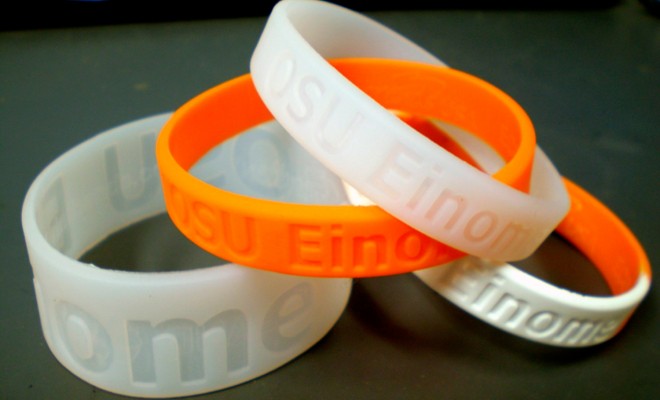
 Pack away the clunky radon-detectors and carbon monoxide alarms! Silicone wristbands have emerged as the simplest of environmental warning devices – cheap to manufacture and damn stylin’ too. Not quite Fitbit –– Pop on some plastic bling and know what exactly you’re breathing!
Blame Lance Armstrong for the gel bracelet craze; his LIVESTRONG logos started a movement that turned wrists into billboards for everything from gay rights to school sports teams. At least until his doping admission – when his yellow loops were fast shoved into sock drawers – (probably to emerge as hot eBay collectibles far in the future!).
Researchers have just demonstrated that those squishy wristbands can work as easy-to-wear devices to track our chemical exposure over any timespan. Ordinarily, to monitor the array of compounds you inhale in any given place, you’d strap on a bulky “personal exposure monitor” and lug the backpack-sized kit around to record exposure levels, carefully checking equipment battery life.
Researcher Kim Anderson noticed fans at a of Oregon State University football game waving bracelet-clad arms in the air. Understanding the sponge-like qualities of silicone, which can absorb a variety of airborne chemicals, she hatched the idea to use silicone wristbands to test environmental condition.
Anderson’s team recruited 30 volunteers to wear special silicone bracelets continuously for 30 days. Afterwards they collected them and, using solvents, extracted all compounds that the silicone absorbed. Finally, using gas chromatography and mass spectrometry, they identified each chemical compound.
They discovered traces of 49 compounds from a menu of 1,200 possibilities, including polyaromatic hydrocarbons (PAHs), flame retardants, other industrial chemicals, pesticides and personal care products.
Eight construction workers were convinced to don bracelets – combinations of three types of silicone monitoring devices – for work periods spanning 40 hours. As expected, the team observed different compound combinations and levels for each person depending on how they spent their day.
Julie Herbstman, an epidemiologist at Columbia University, says the backpack monitors are optimal as they also track particulate matter which the bracelets would miss. The wristbands are so unobtrusive that the wearers “sort of forget about it.”
Herbstman is now working with Anderson’s team to test the bands with pregnant women to track their exposure to PAHs (polycyclic aromatic hydrocarbons) created by burning fossil fuels and smoking, and to compare the performance of wristbands with backpack monitors.
Increase your awareness of the environment you live in via jewelry – a concept made possible by Lance Armstrong, but one Elizabeth Taylor could’ve really endorsed.
Image of silicon bracelets from American Chemical Society




[…] Stylin'. Gel wristbands sniff out chemicals killing your body silicon-environmental-health-wristband Pack away the clunky radon-detectors and carbon monoxide alarms! Silicone wristbands have emerged as the simplest of environmental warning devices – cheap to manufacture and damn stylin'. Too. Not quite Fitbit … Read more on Green Prophet […]
[…] Stylin'. Gel wristbands sniff out chemicals killing your body silicon-environmental-health-wristband Pack away the clunky radon-detectors and carbon monoxide alarms! Silicone wristbands have emerged as the simplest of environmental warning devices – cheap to manufacture and damn stylin'. Too. Not quite Fitbit … Read more on Green Prophet […]