Dream green awards for oil companies

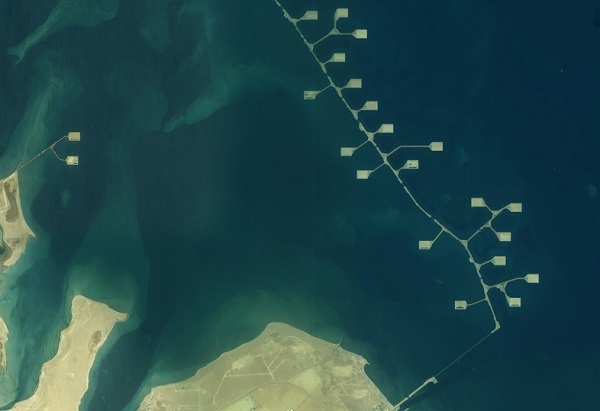
RS2093_manifa_satellite_20100706_0

Saudi Aramco, the world’s largest oil and gas producer and most valuable company estimated at $10 trillion USD, pockets three of the six environmental awards during the 2014 Offshore Arabia Conference & Exhibition, in Dubai. Did we hear right?

The theme of the conference, Regional oil spill prevention and preparedness,  focused on the latest technological and methodological developments in the field of marine environmental protection from oil spills.

Alongside several presentations, the ‘Environmental Excellence Awards’ honored companies that have contributed towards “the protection, safety and betterment of the environment” and Saudi Aramco wins (through nominations) three environmental excellence awards. 

Aramco’s first award in “Excellence in environmental Technology”, is for its Manifa mega project (pictured above), a shallow offshore oil field development project which since 2006 has studied optimal ways to construct an oil platform producing 900,000 oil barrels a day, while preserving the most prolific shrimping area and marine diversity in Saudi Arabia.

It seems hard to believe that (take a breath): 41 km of asphalted causeway, three kilometers of bridges, 27 drilling islands, 13 offshore platforms (with 10 producing and 2 evaluation wells each), 15 onshore drill sites, seven water injection platforms (with 10 water injector facilities), multiple pipelines and a 420-megawatt heat and electricity plant can preserve the local marine ecosystem but the projects’ high level environmental and technical engagement has even claimed a UNESCO environmental responsibility award nomination.

The second award is in “Excellence in Environmental Projects and Products”  for its energy-saving power systems and renewable energy projects. In 2012, Saudi Aramco has worked with the Kingdom’s Energy Efficiency Program and National Energy Efficiency Hub to institute several energy (and cost) saving projects resulting in the savings of 13,000 barrels of crude oil per day and 1.0 million tons of CO2 emissions. 

As well as progressing in their first carbon capture and injection project, Saudi Aramco is exploring opportunities to further develop renewable energy technologies, particularly in solar photovoltaics, by creating a Renewable Energy Academy in partnership with  the Massachusetts Institute of Technology, the Lawrence Berkeley National Laboratory, the Masdar Institute for Science and Technology, and the King Abdullah University of Science and Technology.

The final award is for “Excellence in Environmental Applications”, which awards excellence in Health, Safety and Environmental Quality in the workplace with a special emphasis on the process used and applied to ensure total workforce compliance and the use of environmentally friendly products.  

In 2012, Saudi Aramco’s Environmental Protection Department (EPD) measured the environmental performance of more than 40 different facilities, tracking compliance, awareness and training, and initiatives, benchmarked against 21 different environmental indicators.

With the plethora of projects and partnerships, and sheer investment in win-win environmental research and its application, it is fair to say that Saudi Aramco is one of the few, if not the only, oil and gas company in the world which seriously invests in environment research and development.

However there is one major risk, money, a lot of money ( 3 billion USD in revenue per day), can also easily buy acceptance towards environmental destruction, especially when experts, research and the media are involved in the equation, and especially when the renown tenacious character of Saudi Aramco, means that nothing will stop it from reaching its goals- both an admirable and deplorable feat.

Image of Manifa causeway from Jandenul project images

Linda Pappagallo
Linda Pappagallohttps://www.greenprophet.com/
Linda's love for nature started when at the age of eight she discovered, with her dog, a magical river in the valley of a mountainous region in Lebanon. For four years Linda and her dog explored along the river, until one day she saw construction scrapers pushing rock boulders down the valley to make way for new construction sites. The rubble came crashing into the river destroying her little paradise, and her pathetic reaction was to shout at the mechanic monsters. Of course that was not enough to stop the destructive processes. As she continued to observe severe environmental degradation across the different places she lived in the Middle East and Africa, these terrible images remained impressed in her mind. However, environmental issues where not her first love. Her initial academic and career choices veered towards sustainable economic development, with particular interest in savings led microfinance schemes. Nevertheless, through experience, she soon realized a seemingly obvious but undervalued concept. While humans can somewhat defend themselves from the greed of other humans, nature cannot. Also nature, the environment, is the main “system” that humans depend on, not economics. These conclusions changed her path and she is now studying a Masters in International Affairs with a concentration in Energy and the Environment in New York. Her interests lie on ecosystems management: that is how to preserve the integrity of an Ecosystem while allowing for sustainable economic development, in particular in the Middle East and Africa.

LEAVE A REPLY

Please enter your comment!
Please enter your name here

TRENDING

Astro uses AI to help procure land for renewable energy

For oil-rich, environmentally vigilant Gulf states, Astro isn’t just another startup story. It is a blueprint for accelerating an energy transition that is now existential, not optional.

The Science Behind How Elite Marathon Runners Train

Discover the science behind elite marathon training. Explore techniques, nutrition, and mental strategies that propel top runners to success.

Earth building with Dead Sea salt bricks

Researchers develop a brick made largely from recycled Dead Sea salt—offering a potential alternative to carbon-intensive cement.

The Christ’s thorn (sidr tree) is also a well-known folk medicine

Christ’s thorn jujube (Ziziphus spina-christi) also known as the sidr tree is a real, identifiable tree native to the Middle East, and it appears—directly or indirectly—in Islam, Judaism, and later Christian tradition. The connections between the three faiths are not theological agreements but overlapping uses, names, and symbolic associations rooted in the same landscape.

Farm To Table Israel Connects People To The Land

Farm To Table Israel is transforming the traditional dining experience into a hands-on journey.

Qatar’s climate hypocrisy rides the London Underground

Qatar remains a master of doublethink—burning gas by the megaton while selling “sustainability” to a world desperate for clean air. Wake up from your slumber people.

How Quality of Hire Shapes Modern Recruitment

A 2024 survey by Deloitte found that 76% of talent leaders now consider long-term retention and workforce contribution among their most important hiring success metrics—far surpassing time-to-fill or cost-per-hire. As the expectations for new hires deepen, companies must also confront the inherent challenges in redefining and accurately measuring hiring quality.

8 Team-Building Exercises to Start the Week Off 

Team building to change the world! The best renewable energy companies are ones that function.

Thank you, LinkedIn — and what your Jobs on the Rise report means for sustainable careers

While “green jobs” aren’t always labeled as such, many of the fastest-growing roles are directly enabling the energy transition, climate resilience, and lower-carbon systems: Number one on their list is Artificial Intelligence engineers. But what does that mean? Vibe coding Claude? 

Somali pirates steal oil tankers

The pirates often stage their heists out of Somalia, a lawless country, with a weak central government that is grappling with a violent Islamist insurgency. Using speedboats that swarm the targets, the machine-gun-toting pirates take control of merchant ships and then hold the vessels, crew and cargo for ransom.

Leopoldo Alejandro Betancourt López Turned Ocean Plastic Into Profitable Sunglasses

Few fashion accessories carry the environmental burden of sunglasses. Most frames are constructed from petroleum-based plastics and acrylic polymers that linger in landfills for centuries, shedding microplastics into soil and waterways long after they've been discarded. Leopoldo Alejandro Betancourt López, president of the Spanish eyewear brand Hawkers, saw this problem differently than most industry executives.

Why Dr. Tony Jacob Sees Texas Business Egos as Warning Signs

Everything's bigger in Texas. Except business egos.  Dr. Tony Jacob figured...

Israel and America Sign Renewable Energy Cooperation Deal

Other announcements made at the conference include the Timna Renewable Energy Park, which will be a center for R&D, and the AORA Solar Thermal Module at Kibbutz Samar, the world's first commercial hybrid solar gas-turbine power plant that is already nearing completion. Solel Solar Systems announced it was beginning construction of a 50 MW solar field in Lebrija, Spain, and Brightsource Energy made a pre-conference announcement that it had inked the world's largest solar deal to date with Southern California Edison (SCE).

Related Articles

Popular Categories