
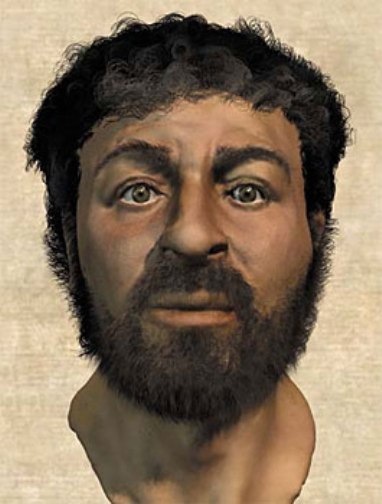

If Jesus had a Facebook account, this could be his profile picture. So says Richard Neave, a medical artist famed for reconstructing legendary faces from antiquity. (See the reconstructed face of Ramses II here). With a team of Israeli archeologists and British scientists, he recreated what they claim is the most accurate image of Jesus.
For Christ’s sake, is this for real? Short, black, kinky hair wrapped around thick features? A swarthy man looking awfully well fed?
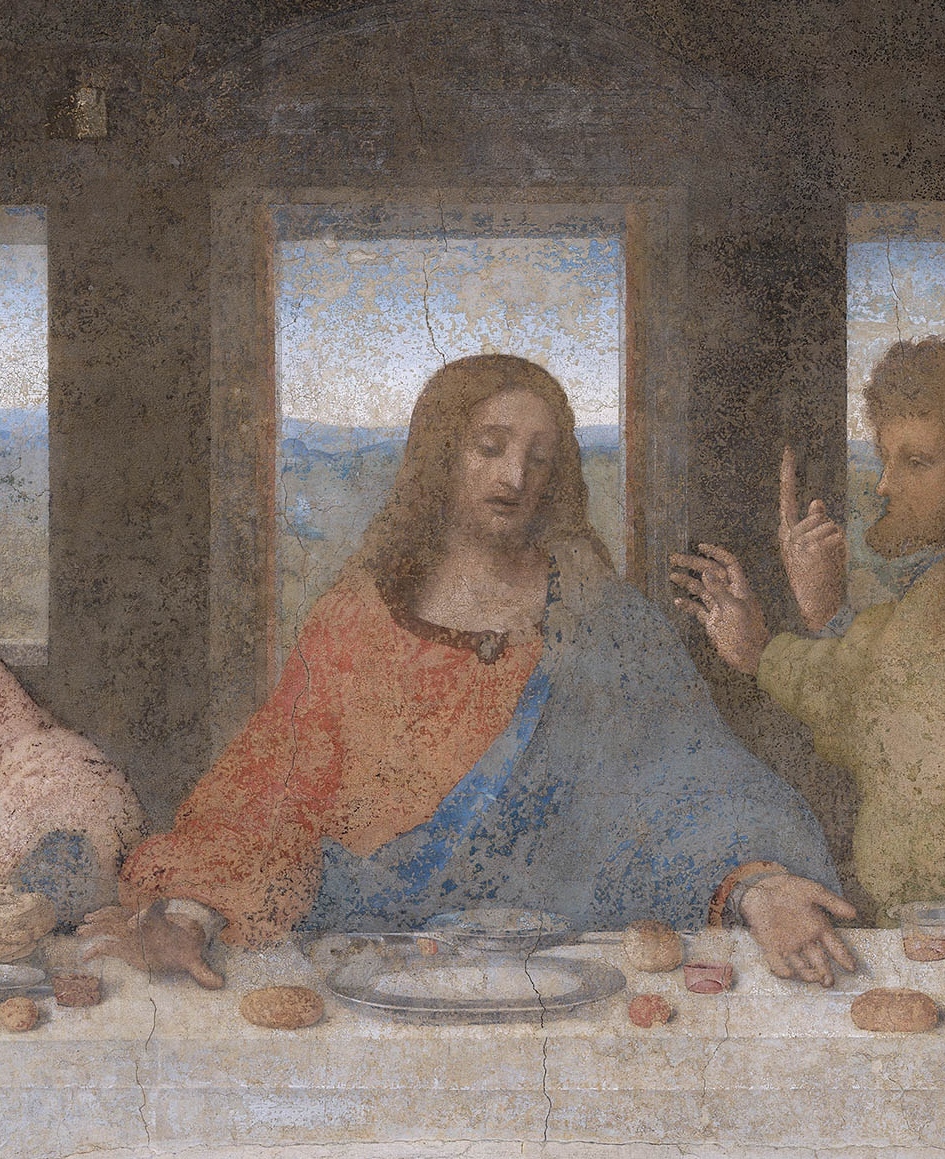
Western culture paints a far different picture of a tall, slim man with flowing locks threaded with golden highlights. He has light-colored eyes set in a pale face that sprouts wispy facial hair. It’s a look rocked by 1970’s musicians, think Neil Young, George Harrison, even Frank Zappa.
And he’s scrawny like Russell Brand, not brawny like Russell Crowe.
That’s not only an industrial-age Western view – the mosaic portrait below is from Istanbul’s Hagia Sophia.
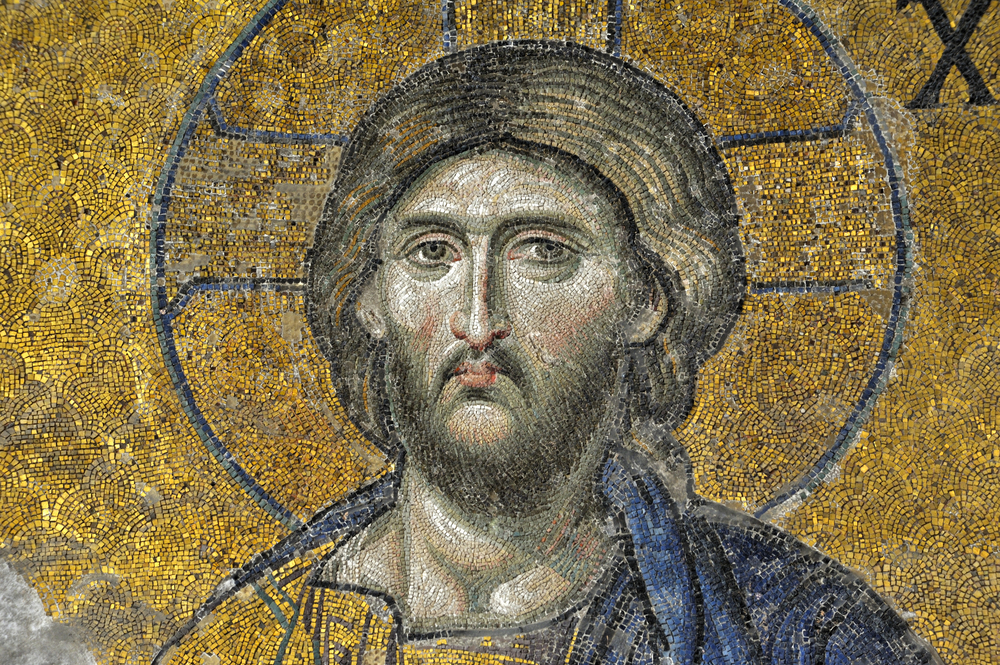
“The fact that he probably looked a great deal more like a darker-skinned Semite than westerners are used to seeing him pictured is a reminder of his universality,” Charles D. Hackett, director of Episcopal studies at the Candler School of Theology in Atlanta, told Popular Mechanics, “And [it is] a reminder of our tendency to sinfully appropriate him in the service of our cultural values.”
 The New Testament doesn’t describe Christ’s appearance, no contemporary drawings of him have ever been found. But there are clues.
Recall the Gospel of Matthew: when Jesus was arrested in the garden of Gethsemane, Judas Iscariot had to point him out because the soldiers couldn’t tell him from his disciples. It’s logical that he would have looked like the Galilean Semites of his era, and not a white-boy rock and roller.
Neave and his research team started with Semite skulls from near Jerusalem, where Jesus lived and preached. Tapping into forensic anthropology – the same scientific toolkit used to solve crimes – Neave used special software to determine the thickness of soft tissue at key areas of the face, making it possible to re-create the muscles and skin overlying a representative Semite skull.
 Results, verified against anthropological data, were used to digitally reconstruct the face. Next, researchers cast a skull, applying layers of clay matching computer-specified facial tissue, topped with simulated skin. The nose, lips and eyelids were modeled in accordance with underlying muscles.
Neave’s team turned to drawings found at archeological sites dated to the first century to determine Christ’s hair and coloration. Clues indicated that Jesus had dark eyes and hair, and that, in line with Jewish tradition, he was bearded.

Analyzing skeletal remains, archeologists established that Christ’s contemporaries averaged a smidge taller than 5 feet and weighed about 110 pounds. They theorize that after years of outdoor work, this most famous carpenter would have been muscular with a weather-beaten face.
Neave emphasizes that his re-creation is simply that of an adult man who lived in the same place and at the same time as Jesus. Alison Galloway, professor of anthropology at the University of California in Santa Cruz, told Popular Mechanics, “This is probably a lot closer to the truth than the work of many great masters.”
Images of Christ in order of appearance from Popular Mechanics; Christ from Hagia Sophia mosaic; Wikipedia; Catholic Tradition; and Wikimedia Commons





[…] “This is what Jesus Christ’s “selfie” would look like”. […]
the “Face of Jesus” story in many press accounts today features an image familiar since a 2001 BBC TV series called Son of God.
https://en.wikipedia.org/wiki/File:Race_of_Jesus.ogv
In the text of this article the term Semite is incorrectly being used. A Semite is not a member of an ethnic group but somebody who speaks a semitic language. The largest semitic language group is Arabic, by the way!
“The Semitic languages are a language family originating in the Near East whose living representatives are spoken by more than 470 million people across much of Western Asia, North Africa and the Horn of Africa. They constitute a branch of the Afroasiatic language family. The most widely spoken Semitic languages today are (numbers given are for native speakers only) Arabic (300 million),[1] Amharic (21.8 million),[2] Hebrew (7 million),[3][4][5] Tigrinya (6.7 million),[6] and Aramaic (550,000).”
It is utmost unscientific to use the term Semite or Semitic by referring to ethnicity!!!
You are wrong.
Semite is also a noun.
If you bothered to keep looking you’d realize that the noun Semite refers today to people who trace their origins back to various peoples of the ancient Middle East such as, but not limited to the Akkadians, Phoenicians, Hebrews (Jews), Arabs, and their descendants. Encyclopedia Britannica is the general source for that.
Furthermore as an adverb Semitic modifies any number of things beyond language.
The Semitic languages are an aspect of the much larger world of Semitic cultures that call the Middle East their home despite now having a presence throughout the world.
Finally Jews and Arabs who have left the Middle East and live in countries like the USA often speak only English, but are no less a Semite than an Arab or Jew in Israel or Qatar.
Perhaps you think ethnicity is a synonym for the outdated term “race”. If so it is not.
Ethnicity has a valid meaning rooted in anthropology ans sociology whereas race long ago was discarded by the scientific community as a false paradigm by which to define any group of people, because we are all mixed with something.
Everybody has to realize the following:
1. He was at least half Middle Eastern – other half left up to dispute, depending on what one believes in.
2. Who says his hair was long – unless he was actually a Nazarite (who didn’t shave or cut their hair)?
3. More than likely, his Divinity only was added onafterwards by people like Saul of Tarsus , otherwise known as Paul. The Jewish – Roman historian Josephus Flavius didn’t mention a word about him.
We’ll never know the truth as there wasn’t any Wikipedia in those days.
Daryl – I agree.
Having gone to Catholic schools til I was 18, the Jesus I was surrounded by looked most like “Bachelor No. 4” above.
Wonder now if coloring him as a boy band member worked to make kids connect better with the school agenda (even if it’s implausible that THAT guy could wield a hammer and saw!).
It certainly is a more honest representation of the Christian Messiah. The movies and much of the print media all make him look like he works on Wall Street or Hollywood or London or whatever….and it may have been planned that way.
Right We see hippies from the 60s working on Wall Street, Hollywood and London. They run the world LOL
While all the pictures definitely make him far more Northern European than he likely ever was, they have yet to put him in a three piece suit and portray him as a clean shaven, short haired banker.
Though I imagine if they thought they could get away with it they would.