5 Steps to a Carbon Neutral World Cup in Qatar

Qatar 2022, Al-Wakrah Region, Zaha Hadid, AECOM, carbon neutral world cup, carbon neutral building standards, renewable energy, Qatar, Doha, public transportation

Qatar has promised a carbon neutral 2022 World Cup, but we know from the Masdar City experiment how hard that is to achieve. Still, here are five dubious steps AECOM and Zaha Hadid Architects are reported to be taking to support that goal with their joint design – Al-Wakrah Stadium.

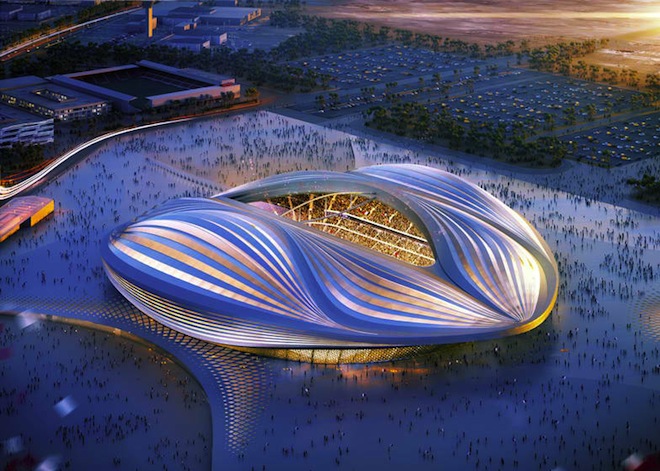
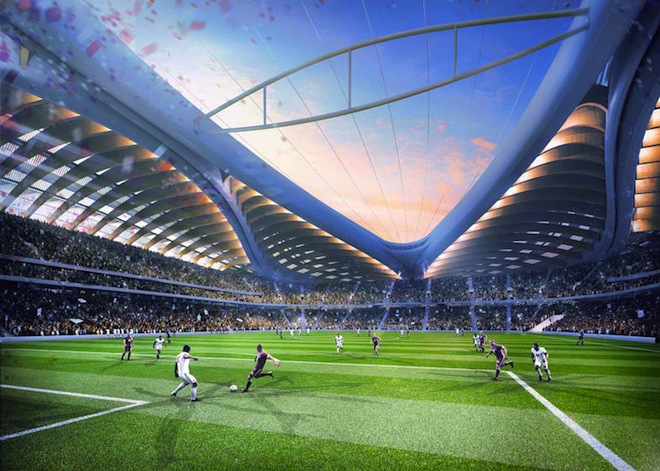
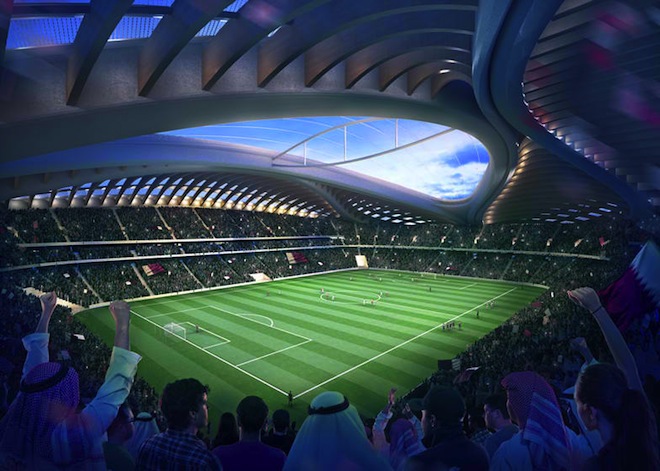
Shaped like a dhow out of deference to Qatar’s long fishing history, the Al-Wakrah stadium will incorporate shading,  along with aerodynamic and mechanical cooling components to ensure that the spectator stands and the grass pitch never rise above 30 degrees Celsius (86 degrees Fahrenheit.)

Slated for construction in Al-Wakrah, the southernmost host city for the 2022 World Cup less than 10 miles outside of the capital Doha, the stadium will seat up to 40,000 spectators; half of those modular seats will be removed and shipped to developing countries at the tournament’s close.
Qatar 2022, Al-Wakrah Region, Zaha Hadid, AECOM, carbon neutral world cup, carbon neutral building standards, renewable energy, Qatar, Doha, public transportation

But how – pray tell – does the Qatar 2022 Supreme Committee imagine that they will achieve a carbon neutral sporting event? Well, that depends. It turns out that there are varying degrees of carbon neutrality.

Some carbon neutral standards require only that a building produces no greenhouse gas emissions while operating, but this fails to consider the energy required to produce materials (such as concrete, which has a high embodied energy footprint), transport materials, and construct the building.

Other standards are more rigorous and take into account the entire cycle of a building, along with the surrounding transportation infrastructure. In order to be truly carbon neutral, according to the Stern Review published by the British government in 2006, a building must generate 80 percent less greenhouse gas emissions than a conventional one. 
Qatar 2022, Al-Wakrah Region, Zaha Hadid, AECOM, carbon neutral world cup, carbon neutral building standards, renewable energy, Qatar, Doha, public transportation

Based on the following five steps that the design team will take to edge towards carbon neutrality with the Al-Wakrah stadium,  as outlined by Trade Arabia, we suspect that if Qatar can come even close to carbon neutrality, they will do so by observing the most lenient standards.

1. 15 percent of the tournament’s energy will be generated by on-site renewable energy sources.
2. Water use will be reduced by 60 percent.
3. 15 percent of the permanent structures will be built using reused or recycled material.
4. A full 90 percent of construction waste will be diverted through smart design and waste management. 
5. Structural timber will be sourced sustainably.

Admittedly, these will be admirable achievements if attained, and with AECOM on board they may well be.

But Qatar has a very immature supply chain of green building materials, which means the majority required to build nine stadiums, along with $140 billion in additional infrastructure such as a new airport, rail system, roads, and a new seaport, will have to be shipped in. This greatly increases the embodied energy footprint.

Construction is expected to break ground in early 2014.

:: Trade Arabia

Tafline Laylin
Tafline Laylinhttp://www.greenprophet.com
As a tour leader who led “eco-friendly” camping trips throughout North America, Tafline soon realized that she was instead leaving behind a trail of gas fumes, plastic bottles and Pringles. In fact, wherever she traveled – whether it was Viet Nam or South Africa or England – it became clear how inefficiently the mandate to re-think our consumer culture is reaching the general public. Born in Iran, raised in South Africa and the United States, she currently splits her time between Africa and the Middle East. Tafline can be reached at tafline (at) greenprophet (dot) com.

Read More

TRENDING

Collecting kinetic energy from roads; REPS turns traffic into a power plant

REPS announced a $23.6M equity financing round to scale...

AI data centers are triggering panic, instead of cleantech opportunities

AI may unintentionally become the economic engine that finally modernizes America’s aging grid. California is experiencing a massive AI data center boom, ranking 3rd in the U.S. with 227 operating centers and 54 more in development as of April 2026, according to Stanford.

Korean researchers create battery from greenhouse gases

Professor Ji-Soo Jang, in collaboration with Professor Taekwang Yoon of Ajou University and Professor Hansel Kim of Chungbuk National University, has developed a novel energy device that generates electricity during the process of capturing greenhouse gases.

EU startup aiming to generate energy on moon villages

Stepping up to democratize the moon is an EU-funded company, Deep Space Energy, which has just raised more than $1 million USD as a seed fund to help it create energy generators on the moon.

BM Studios is designing systems, not just buildings in the UAE

Balsam Madi is an architect and systems thinker whose work bridges culture, sustainability, and design intelligence across the Middle East and Europe.

Yerukim Forms a New Green Economy Where the Money is Really Green

The Yerukim members who pick up the recyclables get to keep the monetary reward, the public earns "green" bills that can be used in shops, and business owners get to be associated with environmentalism.

Choosing Riyadh over Dubai? What Investors Should Know

Saudi Arabia is deploying capital at unmatched scale to catalyze tourism and advanced industry while rewiring its power-and-water backbone. The investable frontier is widening—especially in renewables, grid storage, water efficiency/desal retrofits, and hospitality operating platforms. Prudent investors will insist on phased delivery, enforceable KPIs (energy, water, biodiversity), and RHQ/zone compliance—while pricing political-economy and reputational risks alongside growth upside.

Sell your cooking oil for biodiesel money

Want to make money on old french fry oil? Sell it.

Qatar Alternative Energy Summit Pairs Investors And Innovators

Alternative energy investors and innovators can meet n' greet in Doha, Qatar March 16 and 17.

Here’s How To Implement The Four Pillars Of Employee Engagement

If you throw a party for your work team and they are vegans, don't make it a barbecue. Know the sustainability values of your team to boost moral and retain good people.

Locals From Rishon Fight IKEA

Big Box stores are a pretty new concept in Israel, and thank God that not every Israeli city wants them in their backyard. A word from someone who has see the beautiful farmland around her hometown Newmarket, Ontario stripped and converted into vulgar strip malls of big box shops: they have no place in a healthy and sustainable town or city.

The Jewish National Fund Meets An Inconvenient Truth

According to the JNF, it has transformed thousands of acres of barren land into green forests in Israel. They state that each person emits about 23 tons of carbon per year, estimating that each tree planted can absorb one ton of carbon in its lifetime. That's a whole lot of trees you'd need to be planting. Could so many fit in Israel?

How to quiet noise from construction in your office

Streets need to be resurfaced in New York but the humming and grinding noise is unsettling. Noise is environmental pollution. 

Popular Categories