Turkey Opens World’s Deepest Subsea Tunnel, the Marmaray, Connecting Asia to Europe

marmaray undersea tunnel tube turkey istanbul

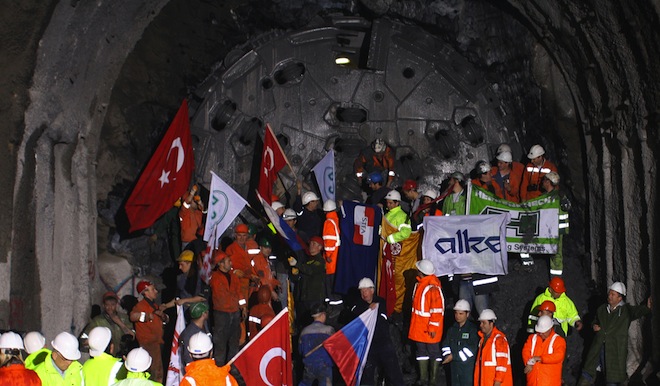
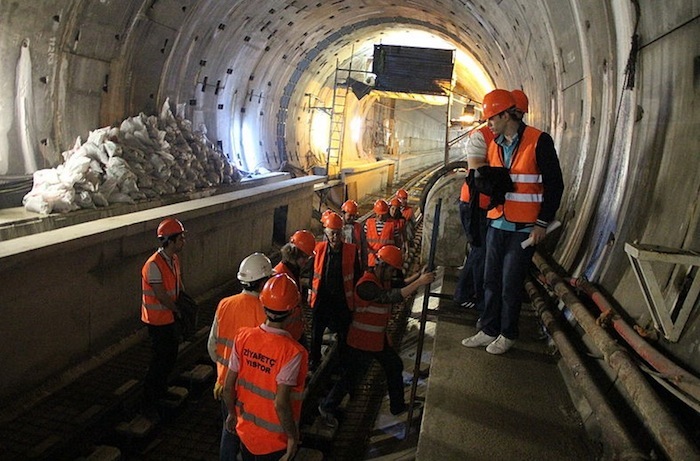
Turkey inaugurated the Marmaray undersea railway tunnel on Tuesday, linking Europe and Asia. It is the Marmaray, the world’s deepest immersed tube tunnel at 60.46 metres (198.4 ft). 

An Ottoman sultan’s dream finally realized, the project has sparked criticism in part because it was built just 11 miles from one of the most seismically active earthquake zones on earth – the North Anatolian fault.

Prime Minister Recep Tayyip Erdoğan first conceived the Marmaray project, which includes an 8.5 mile Bosporus crossing, 39 miles of suburban train lines and a 47.4 mile high-capacity line between Gebze and Halkalı, during his tenure as Mayor of Istanbul.

It is just one of several major infrastructure projects he has initiated to bring the city up to speed with the rest of the western world, but critics claim that these “Pharaonic” ambitions destroy valuable green space and ruin the city’s former character.

Supporters and city officials say the $4 billion Marmaray project will reduce congestion and improve public transportation for at least some of Istanbul’s 16 million residents.

Construction of the tubular tunnel beneath the Bosporus Strait broke ground in 2004 and should have been completed in  2009, but a series of archaeological discoveries delayed the first phase’s inauguration by just over four years.

Erdoğan was impatient with these discoveries. “First (they said) there was archaeological stuff, then it was clay pots, then this, then that. Is any of this stuff more important than people?” Phys.org quoted him as saying in an earlier statement.

While the railway tunnel can transport as many as 75,000 passengers every hour in either direction, easing terrible traffic on existing bridges, its proximity to the North Anatolian fault is worrisome.

In 2007, Wired Magazine wrote about Eurasia’s equivalent of the San Andreas Fault.

“Since AD 342, it [the North Anatolian Fault] has seen more than a dozen huge quakes that each claimed more than 10,000 lives,” they reported. “Two in 1999 together killed 18,000 people. Worse, over the last century the tremors have marched steadily west, toward Istanbul and the strait.”

While Wired detailed a variety of measures that have been taken to ensure that the tunnel can withstand a massive earthquake, local city planners and architects are far from confident that they are sufficient or that the project was ready to be inaugurated.
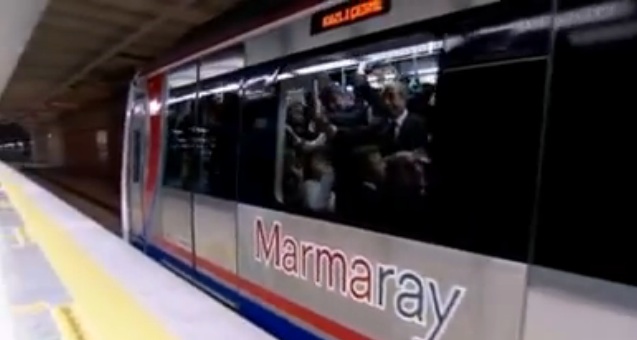
marmaray tunnel istanbul

“It would be murder to open it under these conditions,” Suleyman Solmaz, a senior figure at the Chamber of Architects and Engineers, told the New York Times. He also that “a project engineer told him he would not dare ride through the tunnel until those issues were addressed.”

Despite these concerns, the transport minister, Binali Yildirim, insists that the tunnel is designed to withstand a magnitude 9 earthquake, and that – in such an event – it will be the “safest place in Istanbul.”

Top image of Istanbul tunnel under construction via Wikipedia
Tafline Laylin
Tafline Laylinhttp://www.greenprophet.com
As a tour leader who led “eco-friendly” camping trips throughout North America, Tafline soon realized that she was instead leaving behind a trail of gas fumes, plastic bottles and Pringles. In fact, wherever she traveled – whether it was Viet Nam or South Africa or England – it became clear how inefficiently the mandate to re-think our consumer culture is reaching the general public. Born in Iran, raised in South Africa and the United States, she currently splits her time between Africa and the Middle East. Tafline can be reached at tafline (at) greenprophet (dot) com.
5 COMMENTS
  1. I find the project innovative applause that it has been finished, however I am curious about the safety and security of this project now that it’s operational. I would like to see and hear more about the security of using the marmaray. Perhaps it’s one find piece of public transportation to the graveyard.

  2. The picture you’ve presented displays the tunnel under Bosphorous for water supply to the Thracian (West) side of Istanbul, and has no relation at all with Marmaray but some 40 km North of it. This water tunnel is operated successfully by The State Directorate of Water Works since about 2 years now.

  3. Unfortunately, İstanbul is too crowded. People seem to think it’s streets are paved with gold – maybe they are but it’s impossible to see them due to the number of vehicles using them. Having lived for two years and (thankfully) worked on the same side of the Bosporus, I have personally experienced the traffic which clogs the bridges during the rush hour.

    This tunnel is a long-awaited artery which will hopefully ease the commute for many residents. All such projects will have critics, as I’m sure the first tube tunnels driven under the Thames in London did in those days.

    The only thing I can say to Mr Solmaz in reply to his promise not to use the tunnels until certain issues are addressed: “Thank you, I will be able to sit in your place while you tackle the traffic on the bridge. Have a safe journey!” 🙂

Comments are closed.

Hot this week

How Renewable Energy is Revolutionizing the Way We Power Our World

Solar has become the star of the transition thanks to modular hardware and straightforward installation. It fits dense cities and remote towns alike. Many companies are turning to rooftop arrays and carport systems - and exploring commercial solar installation as a practical way to lock in future savings.

How does one start prepping?

Faced with an extreme winter storm this year, Americans wonder how to be prepared for catastrophe. Miriam has lived through wars in the Middle East - so she's prepared on giving you a guide to prepping.

Fishermen sue tire manufacturers on behalf of the salmon

A federal trial in San Francisco has brought US tire manufacturers, fishing groups, and environmental scientists into court over a chemical most drivers have never heard of — but which scientists say may be silently reshaping aquatic ecosystems.

Listening to Water: Tarek Atoui’s Next Work for Tate Modern

Born in Beirut, Lebanon in 1980 and now living in Paris, Atoui has spent years building instruments that don’t sit comfortably in concert halls. Many of them involve water, glass, and ceramics — materials that react to sound instead of simply producing it.

Leading Through a Dual-Energy Transition: Balancing Decarbonisation with Energy Security

Experience in one area of the energy industry isn't enough to guarantee readiness across all the others. That's where a structured program like an MBA in energy can come in. Today's advanced curricula explore energy economics, finance, policy, and strategic management alongside the technical subjects. And when pursuing an energy MBA online, professionals can skill up and retrain without having to step out of the labor market -- an important perk at a time when skilled professionals are already in short supply.

Topics

How Renewable Energy is Revolutionizing the Way We Power Our World

Solar has become the star of the transition thanks to modular hardware and straightforward installation. It fits dense cities and remote towns alike. Many companies are turning to rooftop arrays and carport systems - and exploring commercial solar installation as a practical way to lock in future savings.

How does one start prepping?

Faced with an extreme winter storm this year, Americans wonder how to be prepared for catastrophe. Miriam has lived through wars in the Middle East - so she's prepared on giving you a guide to prepping.

Fishermen sue tire manufacturers on behalf of the salmon

A federal trial in San Francisco has brought US tire manufacturers, fishing groups, and environmental scientists into court over a chemical most drivers have never heard of — but which scientists say may be silently reshaping aquatic ecosystems.

Listening to Water: Tarek Atoui’s Next Work for Tate Modern

Born in Beirut, Lebanon in 1980 and now living in Paris, Atoui has spent years building instruments that don’t sit comfortably in concert halls. Many of them involve water, glass, and ceramics — materials that react to sound instead of simply producing it.

Leading Through a Dual-Energy Transition: Balancing Decarbonisation with Energy Security

Experience in one area of the energy industry isn't enough to guarantee readiness across all the others. That's where a structured program like an MBA in energy can come in. Today's advanced curricula explore energy economics, finance, policy, and strategic management alongside the technical subjects. And when pursuing an energy MBA online, professionals can skill up and retrain without having to step out of the labor market -- an important perk at a time when skilled professionals are already in short supply.

From Green Energy to Healthy Societies: Why old systems thinking is becoming relevant again

Across the Middle East and North Africa, large investments are being made in green hydrogen, renewable energy, water infrastructure and sustainability. Most of these efforts are discussed in the context of climate change, decarbonization and economic diversification. That framing is important, but it may not capture their full value.

We saw peace – an interreligious encounter deep in our eyes

They came from Israel, Palestine, Jordan, Iraq, Yemen, Morocco, Tunisia, Lebanon, Egypt… There are Sunni Muslims, Shiite Muslims, Jews (Orthodox and Reform), Orthodox Christians, Coptic Christians, Protestant Christians, Druze, Baha'is, a Scientologist.

Can biochar reduce ‘Forever Chemicals’ in food if it’s used in farms?

Biochar is produced by heating organic material in a low-oxygen environment so it does not burn. This process, known as pyrolysis, transforms plant matter into a stable, carbon-rich material.

Related Articles

Popular Categories