

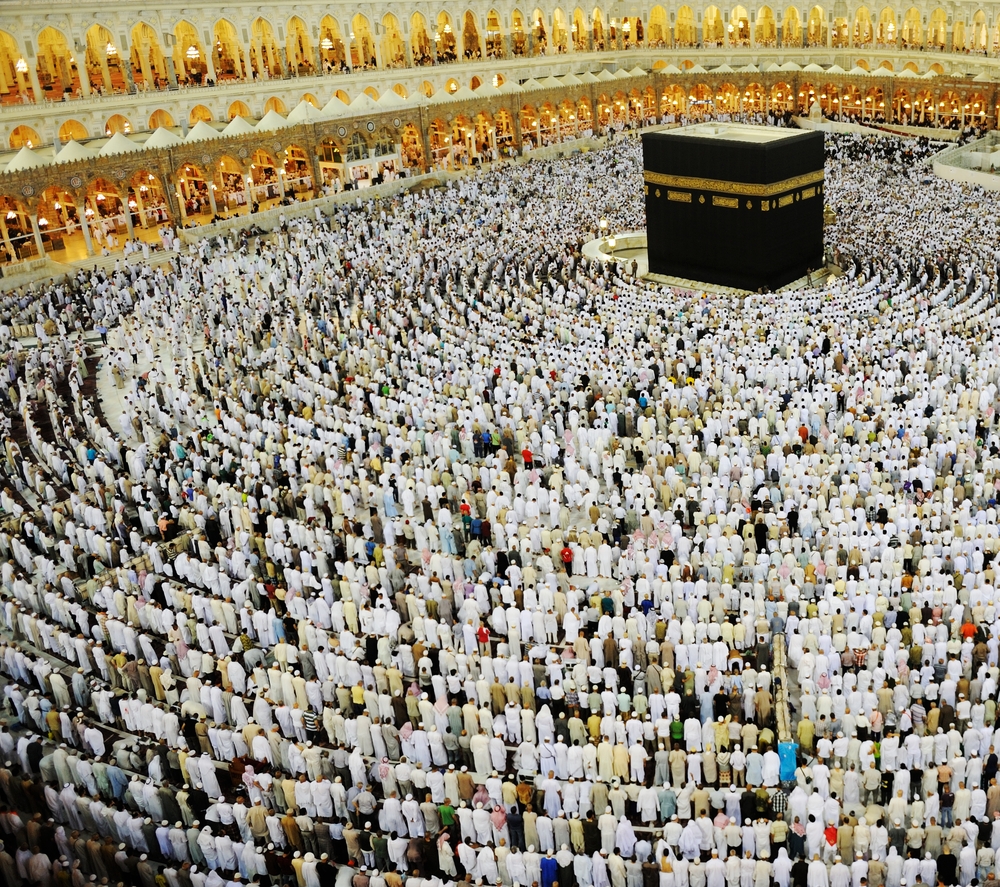
 Cleanliness may be next to godliness, but piety may prove lethal. So say global health officials as they warn travellers to take special precautions when on Hajj, where a mysterious virus knowns as MERS threatens a concentrated pilgrim population expected to exceed 3 million.
Over a year has passed since the first case emerged of Middle East Respiratory Syndrome (MERS). MERS has since infected 135 and killed 58, yet questions on the origin and transmission patterns of the disease remain.
Hajj (here’s how you can make it green) is an Islamic pilgrimage to Mecca, in the Kingdom of Saudi Arabia (KSA), and the largest annual gathering of Muslims in the world. One of the five pillars of Islam, it is a religious duty which must be performed by all able-bodied Muslims who can afford to do so at least once in their lifetime.
Medical experts are concerned that large scale international travel might accelerate virus spread.
Many opt for gruelling bus travel (drive time from Amman, Jordan to Mecca exceeds 12 hours). Once there, a strenuous series of rituals begin to symbolize the lives of the Prophet Ibrahim and his wife Hajar. Consider desert climate and rough accommodations, and see why the pilgrimage is difficult.
This year, KSA announced new limits to religious tourist visas, emphasizing ongoing construction at the Holy Mosque as the constraining factor. Belgium’s National Flu Commissioner, virologist Dr. Marc Van Ranst, advised Belgian Muslims to pass on the pilgrimage. Margaret Chan, secretary-general of the World Health Organization (WHO), pulled no punches with her proclamation that MERS posed a “threat to the entire world.”
KSA medical experts have suggested that the elderly, young children, pregnant women and people with compromised health do not make the pilgrimage. Particular caution is aimed at those with suppressed immune systems. But, regulation-wise, the bottom line is that people are free to travel to Mecca as per usual: WHO has issued no travel warnings to the Middle East relative to MERS.
While not believed to be easily transmitted in the general population, the MERS coronavirus can spread between people in prolonged close contact, hence the risk to pilgrims living and traveling in crowded conditions. The American Center for Disease Control (CDC) website offers some guidelines (link here).
Epidemiology aside, mass gatherings have always been linked with unique health risks. The Saudi Ministry of Health mitigates some by requiring all pilgrims to be vaccinated for meningococcal in order to receive Hajj visas. The CDC recommends polio boosters and vaccination against hepatitis A, B, and typhoid for travel to KSA, in addition to routine vaccines (such as measles, pertussis, and flu).
Stomach flu and diarrhea are common during Hajj, partly due to unfamiliar food prep and unreliable refrigeration. After Hajj, men are required to shave their heads: unclean blades can transmit disease, so men are urged to use officially designated centers where licensed barbers use disposable, single-use blades.
Autumn temperatures in Mecca can exceed 100°F, putting heat exhaustion, sunburn and heatstroke on the menu of maladies.
Finally, human stampede is a major risk in any gathering, exponentially worsened by the millions of assembled hajjis. Stampedes at previous Hajj events have injured or killed hundreds, inciting the KSA government to invest over $25 billion to help control crowds and minimize risk.
This year, Hajj is expected to occur from October 13 through 18; the exact duration is dependent on moon sightings. As a non-Muslim, it’s improbable I’ll ever experience it. Instead, I watch my friends glow at the prospect of participating in this mind-blowing celebration and I wish that, Insha’Allah, they return rejuvenated in spirit, mind and body.
If you want to make the Hajj more green, read our green guide to Hajj here. And here are four steps to a greener Hajj. Share these with all pilgrims everywhere.
Image of pilgrims at the Kaaba from Shutterstock



Comments are closed.