Is There a “Forest” Under the Desert Outside of Dubai?

Dubai, desert, Arabian desert, underground forest, Farmer Managed Natural Rehabilitation, FMNR, farming, Agricultural scientist Tony Rinaudo is behind one of the world’s most successful reverse desertification projects – in Niger, and now he thinks a similar underground forest might exist in the Arabian desert outside of Dubai.

The natural resources adviser for the charity World Vision Australia, Rinaudo first happened upon a land regeneration technique known as farmer managed natural regeneration (FMNR) in Niger during the 1980s.

Albeit not new, since Europeans have been using the method to grow trees for thousands of years, Permaculture News points out that it was new to Niger when it was first introduced out of sheer desperation following years of desertification, drought and then famine.

After failing at a series of misguided but well-intentioned efforts to transform a swatch of arid land in the west African country into thriving, fertile ground, costing millions of dollars in wasted money and 20 years of effort, Rinaudo one day realized that the stumps poking out of the desert might be alive.

And indeed they were. A veritable forest lay beneath the desert and – through a program managed by Rinaudo, the local farmers very carefully brought it back to life.

“The answer to the devastating desertification that was depriving countries across Africa of the food they so vitally needed was not, Mr Rinaudo concluded, the impossibly expensive and rarely successful programme of tree-planting being pursued by governments and NGOs, but ‘a two-dollar pocketknife,'” writes Permaculture News.

That pocketknife is FMNR, which involves selecting certain tree stumps (long since felled or compromised by grazing and razing forests for charcoal) and deciding how many shoots or stems should be grown on each one. This depends on the particular farmer’s dictate and needs.

Excess stems are then cut; for more on this, take a look at this wonderful PDF from Permaculture News.

Using FMNR in Niger revitalized soil quality, boosted water retention, fought off erosion and in general improved the microclimate – the trees shot up without any of the expensive interventions used in prior experiments. As a result, tree density skyrocketed from three or four trees to a hectare to 45 or more, according to The National.

But what does this have to do with Dubai?

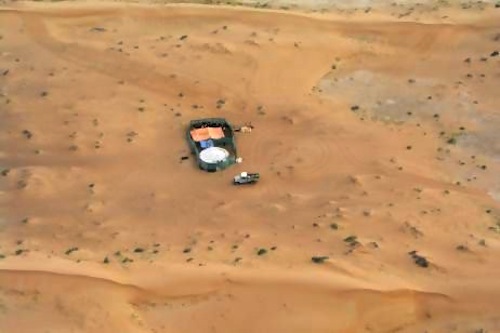
Turns out The National submitted Google images of an old goat farm outside of Dubai, where stumps jut out from the soft, sandy Arabian Desert, and without having visited the site, Rinaudo predicts that they may well be living trees that simply need a little FMNR.

“”The ‘bushes’ growing in these very arid regions look amazingly like the ‘useless’ bushes we encountered in Niger, which turned out to be tree stumps,” he told the paper.

“If you were born into a landscape with no trees, you will be very unlikely to make the link between those abused, miserable-looking bushes, and the magnificent trees that they once were.”

:: The National

Image via Mayang
Tafline Laylin
Tafline Laylinhttp://www.greenprophet.com
As a tour leader who led “eco-friendly” camping trips throughout North America, Tafline soon realized that she was instead leaving behind a trail of gas fumes, plastic bottles and Pringles. In fact, wherever she traveled – whether it was Viet Nam or South Africa or England – it became clear how inefficiently the mandate to re-think our consumer culture is reaching the general public. Born in Iran, raised in South Africa and the United States, she currently splits her time between Africa and the Middle East. Tafline can be reached at tafline (at) greenprophet (dot) com.
3 COMMENTS
  1. […] In 2012, the world’s airlines transported three billion people, emitting 689 million tonnes of CO2 into the atmosphere. To mitigate the aviation industry’s future environmental impact, Boeing, Etihad Airways and the Masdar Institute of Technology are working on a groundbreaking new jet fuel made from desert plants fed with saltwater. […]

LEAVE A REPLY

Please enter your comment!
Please enter your name here

TRENDING

Can biochar reduce ‘Forever Chemicals’ in food if it’s used in farms?

Biochar is produced by heating organic material in a low-oxygen environment so it does not burn. This process, known as pyrolysis, transforms plant matter into a stable, carbon-rich material.

EU’s CAP reform continues trend of supporting small farmers in hour of need

Despite mounting political opposition, growing scientific criticism and even the retreat of many former industrial supporters like Nestlé and Danone, certain member-states and supermarket chains continue to prop up Nutri-Score. The Commission must therefore remain vigilant to ensure these attempts do not undermine farmers, distort fair competition or compromise the integrity of the single market – particularly as other pressing threats loom on the horizon.

These glasses see microplastics on the farm

Conventional detection methods, such as sample taken and looking under a microscope to count the bits is time-consuming, labor-intensive, and often ineffective at identifying small particles, making them impractical for large-scale monitoring. 

A museum for Middle East soil

The Abu Dhabi Fund for Development (ADFD) and the International Center for Biosaline Agriculture (ICBA) will fund and develop the Middle East and North Africa’s first comprehensive guide for establishing and operating soil museums.

Bringing back the farm after a nuclear meltdown

Since the 1990’s scientists in Ukraine and overseas have been saying that the land can be safely used again despite contamination by radiocaesium and radiostrontium. But political complexities have meant that the land remains officially abandoned. That hasn’t stopped a few farmers taking matters into their own hands and beginning unofficial production in some areas. The new study has confirmed that the farmers were right – crops can be grown safely in most areas.

Qatar’s climate hypocrisy rides the London Underground

Qatar remains a master of doublethink—burning gas by the megaton while selling “sustainability” to a world desperate for clean air. Wake up from your slumber people.

How Quality of Hire Shapes Modern Recruitment

A 2024 survey by Deloitte found that 76% of talent leaders now consider long-term retention and workforce contribution among their most important hiring success metrics—far surpassing time-to-fill or cost-per-hire. As the expectations for new hires deepen, companies must also confront the inherent challenges in redefining and accurately measuring hiring quality.

8 Team-Building Exercises to Start the Week Off 

Team building to change the world! The best renewable energy companies are ones that function.

Thank you, LinkedIn — and what your Jobs on the Rise report means for sustainable careers

While “green jobs” aren’t always labeled as such, many of the fastest-growing roles are directly enabling the energy transition, climate resilience, and lower-carbon systems: Number one on their list is Artificial Intelligence engineers. But what does that mean? Vibe coding Claude? 

Somali pirates steal oil tankers

The pirates often stage their heists out of Somalia, a lawless country, with a weak central government that is grappling with a violent Islamist insurgency. Using speedboats that swarm the targets, the machine-gun-toting pirates take control of merchant ships and then hold the vessels, crew and cargo for ransom.

Leopoldo Alejandro Betancourt López Turned Ocean Plastic Into Profitable Sunglasses

Few fashion accessories carry the environmental burden of sunglasses. Most frames are constructed from petroleum-based plastics and acrylic polymers that linger in landfills for centuries, shedding microplastics into soil and waterways long after they've been discarded. Leopoldo Alejandro Betancourt López, president of the Spanish eyewear brand Hawkers, saw this problem differently than most industry executives.

Why Dr. Tony Jacob Sees Texas Business Egos as Warning Signs

Everything's bigger in Texas. Except business egos.  Dr. Tony Jacob figured...

Israel and America Sign Renewable Energy Cooperation Deal

Other announcements made at the conference include the Timna Renewable Energy Park, which will be a center for R&D, and the AORA Solar Thermal Module at Kibbutz Samar, the world's first commercial hybrid solar gas-turbine power plant that is already nearing completion. Solel Solar Systems announced it was beginning construction of a 50 MW solar field in Lebrija, Spain, and Brightsource Energy made a pre-conference announcement that it had inked the world's largest solar deal to date with Southern California Edison (SCE).

Related Articles

Popular Categories