If Gaza Goes Dry, Where Will All the People Go?

Gaza, water shortages, UN, desalination, fuel shortage, humanitarian disasters, Israel

The United Nations has warned that the Gaza Strip, the small slice of land bordering Egypt and Israel that has been the scene of so much political tension, could be “uninhabitable” as soon as 2016 if serious action isn’t taken to address a chronic water shortage, The Independent reports. If that happens, where will its 1.6 million residents go?

Up to 95 percent of the coastal aquifer that supplies the Gaza Strip’s water has been contaminated with chemicals, saltwater and sewage, according to The Independent. Already the number of children being treated for diarrhea has doubled in the past five years, a Save the Children and Medical Aid for Palestinians report shows.

The aquifer’s remaining five percent, the clean water, can really only be used for washing since it too ends up being contaminated in distribution pipes.

Desalination and public taps are an option for a small portion of the population, but the great majority of people have to pay for bottled water to satisfy their barest requirements.

“Families are paying as much as a third of their household income for water,” June Kunugi, a special representative of the UN children’s fund Unicef, told the paper.

The aquifer is unable to recover despite rainfall and runoff from the nearby Hebron Hills, since Gaza residents and Israeli farmers suck out more than double the amount of water seeping back in. As a result, seawater contaminated with sewage infiltrates the aquifer.

By 2016, the aquifer will be unusable, according to the UN, and by 2020, it could be lost for good unless action is taken now to address the problems.

Even though desalination plants are not feasible over the long term, they can produce vast quantities of potable water that will serve the local population. But these cost money to build and money to maintain and Gaza doesn’t have of that going around.

Foreign aid organizations offer the only real hope, and even Israel is scouting potential investors, a senior security official told The Independent on condition of anonymity.

“We have talked to everyone we know in the international community because 1.4 million people will be without water in a few years,” he said.

The Palestinian Water Authority (PWA) has plans to build a large desalination facility that could cater to more people, but it would cost nearly $500 million. Last year Europe announced it would help to finance a new plant with a 100 million cubic meter annual production capacity, but it is unclear whether that plan is still on the shelf.

Plus, as we’ve reported in the past, desalination plants require a lot of energy to run, so unless Masdar perfects its renewably-powered desalination plants in a big hurry, there’s a chance Gaza won’t be able to afford the fuel to power this and other plants.

A host of countries in the region face a fuel and water shortage, including Egypt, Lebanon, and Jordan. The Gulf countries aren’t short on fuel, though it’s not as abundant as it once was, but the majority of them have the cash flow to dig themselves out of the hole they’ve dug themselves.

Combine this with deadlocked politics and we have a potential humanitarian crisis on our hands.

:: The Independent

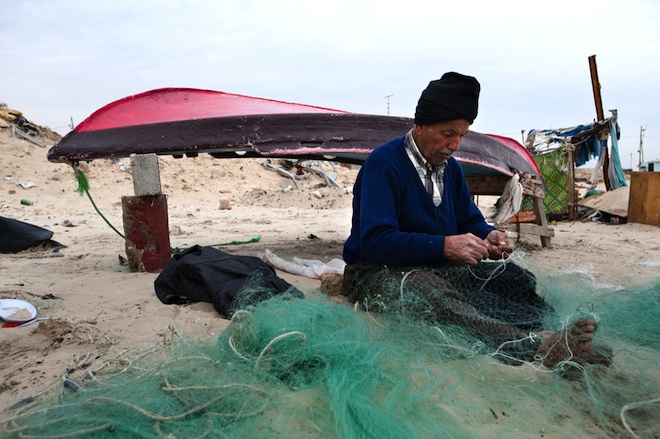
Image of Gaza fisherman, Shutterstock

Tafline Laylin
Tafline Laylinhttp://www.greenprophet.com
As a tour leader who led “eco-friendly” camping trips throughout North America, Tafline soon realized that she was instead leaving behind a trail of gas fumes, plastic bottles and Pringles. In fact, wherever she traveled – whether it was Viet Nam or South Africa or England – it became clear how inefficiently the mandate to re-think our consumer culture is reaching the general public. Born in Iran, raised in South Africa and the United States, she currently splits her time between Africa and the Middle East. Tafline can be reached at tafline (at) greenprophet (dot) com.
1 COMMENT

Comments are closed.

TRENDING

Nearly the half the world’s migratory species are declining, in new UN report for COP15

With larger, land-bound animals human encroachment and Middle East warns make it more troubling for the survival of migratory animals on land, air and at sea. A new United Nations report released this week warns that the situation is getting worse, not better.

Jordan’s $6 Billion Aqaba–Amman Desalination Project from the Red Sea Moves Forward

In 2025, the Jordanian government signed agreements with a consortium led by Meridiam and SUEZ, alongside VINCI Construction and Orascom Construction. Under a 30-year concession agreement, the consortium will design, build, finance, operate, and maintain the system before transferring it back to the Jordanian government. The total investment is estimated at approximately $6 billion USD.

The Saudi Startup Turning Desalination’s Toxic Waste Into Its Own Disinfectant

For millennia, the Middle East's water crisis seemed an immutable fact of geography — a region defined as much by what it lacked as by what lay beneath its sands. Today, a convergence of plummeting solar costs, advancing membrane technology, and hard-won engineering expertise is rewriting that story.

Yalla Parkour – A Gaza documentary of the movement before the war

Yalla Parkour, directed by Areeb Zuaiter, captures this culture from within. The film follows Zuaiter’s long relationship with Ahmed Matar, a parkour athlete in Gaza, as she reflects on loss, memory, and belonging after the death of her mother. What begins as a personal search gradually opens into a portrait of how movement shapes young lives under constraint.

Should You Invest in the Private Market?

startustartup Unlike public stock exchanges, which offer daily trading, strict...

How to build a 100-year-company

Kongō Gumi is a Japanese construction company, purportedly founded in 578 A.D., making it the world's oldest documented company. What can we learn about building sustainable businesses from them?

From Pilot Plant to Global Stage: How Aduro Clean Technologies’ 2026 Expansion Signals a Turning Point for Chemical Recycling Investors Like Yazan Al Homsi

The company's Next Generation Process (NGP) Pilot Plant in London, Ontario, has officially moved into initial operating campaigns, generating the kind of structured, repeatable data that separates laboratory promise from commercial viability.

How AI Helps SaaS Companies Reduce Repetitive Customer Support Work

SaaS products are designed for large numbers of users with different levels of experience, and also in renewable energy.

Pulling Water from the Air

Faced with water shortage in Amman, Laurie digs up...

Turning Your Energy Consultancy into an LLC: 4 Legal Steps for Founders in Texas

If you are starting a renewable energy business in Texas, learn how to start an LLC by the books.

Tracking the Impacts of a Hydroelectric Dam Along the Tigris River

For the next two months, I'll be taking a break from my usual Green Prophet posts to report on a transnational environmental issue: the Ilısu Dam currently under construction in Turkey, and the ways it will transform life along the Tigris River.

6 Payment Processors With the Fastest Onboarding for SMBs

Get your SMB up and running fast with these 6 payment processors. Compare the quickest onboarding options to start accepting customer payments without delay.

Related Articles

Popular Categories