
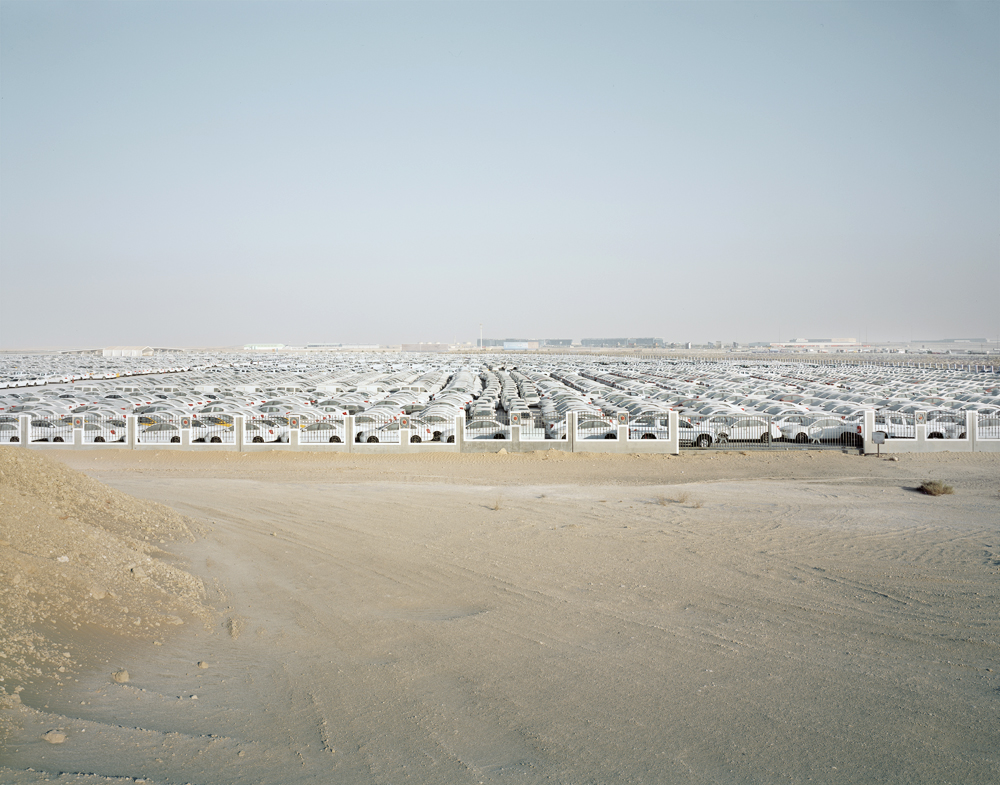
 This is a Chevrolet logistics depot in the Jebel Ali Freezone in Dubai. A rough estimate from studying the site on google earth puts the number of cars at about 8000 (on 12 Aug 2012.) Have a look for yourself at 24°55’40.06″N 55° 6’6.28″E.
I’ve heard it said that American car manufacturers in the 1950s started to fear that their products were reaching such a peak of technological sophistication and mechanical reliability that they were in danger of becoming victims of their own success, and demand for their products would inevitably dry-up as the market became over-saturated.
So they deliberately introduced the concept of ‘fashion’ into automotive design, so that ‘this year’s model’ could always be distinguished from last year’s and thereby encouraged status-hungry consumers to be dissatisfied with their perfectly functional machines.
The resultant design modifications grew ever more outlandish so that cars from the late 50s, with their massive rear fins, elaborate chrome embellishments and ever-increasing dimensions became the ultimate symbol of America’s economic miracle.
They didn’t care too much about gas-consumption back in those days.
Move forward to the 1980s, and possibly thanks to the 70’s oil crisis, we had cars that were boring to look at, but could return 50 miles to the gallon and work reliably for 200,000 miles or more if regularly serviced.
If we move forward another 30 years to the present day we find that little has changed. Obviously the boffins were too busy perfecting particle accelerators and inventing the internet to try and make the average car more fuel efficient or long-lived.
Note from the editor: this photograph is the third in a series called “Consumption” that seeks to document consumerism’s impact on the environment. From resource extraction and commodity production all the way down the supply chain to retail stores and waste processing facilities, Richard artfully examines what nature has come to mean in a world that depends on buying stuff.



Just checked with someone at GM Middle East. This car model is sold as a fleet vehicle in large numbers and a standardised colour. This is the distribution centre for the region.
My 4rth grade teacher told me that cars could be built to last decades but are not. It’s really bad for business.
Cars are not usually painted at point of retail. I used to work in a car factory in Canada – Chrysler. You are not even allowed to wear perfume or deodorant if you work in the body shop’s painting area. It’s a sterile lab where strange scents or specs of dust will ruin a paint job. Can’t imagine painting those babies in the desert. But white cars are best for beating the Middle East heat. Black cars are not.
Hi Bassemk, Sorry if you missed the irony. Seems like I don’t need a researcher when I have commentators like yourself! Many thanks for your contribution.
Hello again Michael, this is a distribution point for the region. I assume the cars are all white because they are painted to order at the place of retail. With regard to the surprising quantity; bear in mind that GM alone makes/sells something approaching 9 million cars a year. 9 million!!!! Imagine, for a moment, what a parking lot of 9 million cars would look like. And then there’s Toyota, Ford, Nissan, Chrysler, Mitsubishi, Honda, before we even start talking about the Koreans, Germans, French and Swedish…
This is art, not investigative journalism. But I am glad to see that it is provoking discussion. – Tafline Laylin, Managing Editor, Green Prophet.
Seriously? That is the extent of explanation? Wasting time on particle accelerators and the Internet? How about a conscious effort by the Auto and Oil industries to prevent any legislation that might promote fuel efficiency in the United States? Car manufacturers in both Europe and Japan made much more efficient cars because policy, including fuel costs that were much higher than in the US, reflected more socially- and environmentally-conscious governments than the industry-dominated revolving door government of the US. But even on a global level, how about some stats on fossil fuel subsidies and how they created perverse incentives for decades?
I appreciate the project, but I would recommend doing a little more (desk) research. Or maybe hiring an enviro-studies intern to fill in facts. @bassemk
Wow! This looks like about 15,000 cars to me. I did not understand why or how all these identical looking cars came to be in the same place at the same time. If they are surplus, why are they all the same color? Why didn’t they come from various enterprises in a multitude of colors and options?
Who could possibly need that many identical cars? UPS has less than 75,000 vehicles in their US fleet. This “lot” has 20% of that total sitting idle!