Ancestors of Desert Camels Roamed the Arctic 3.5 Million Years Ago

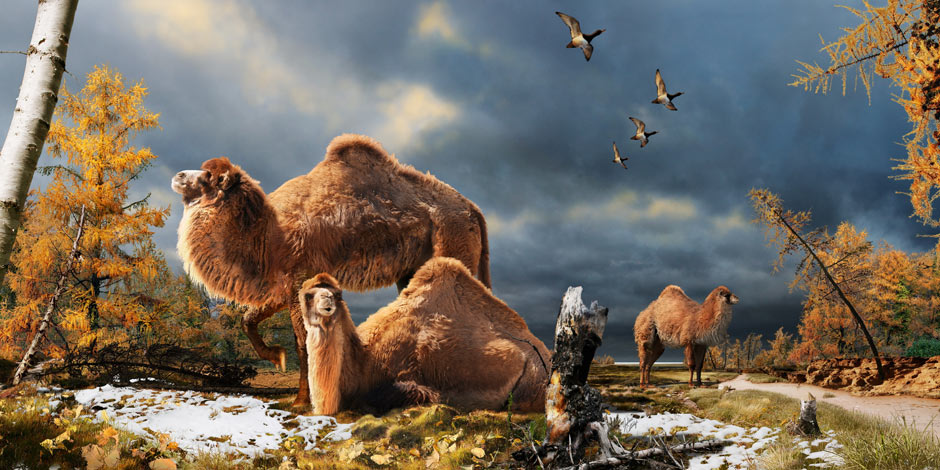
ancient camel, giant camels, Arctic, camel milk, Julius Csotonyi,An artist’s impression of the Arctic camel. Illustration by Julius Csotonyi via The Guardian

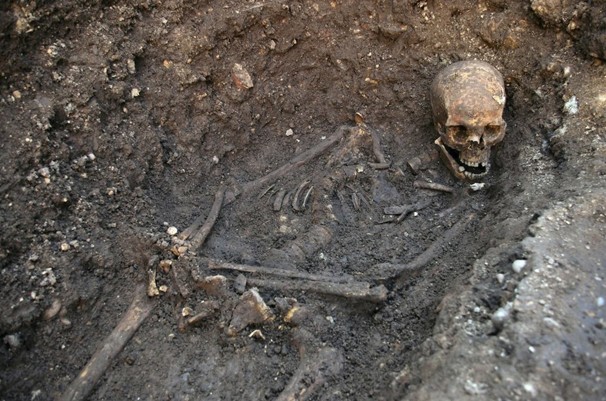
Millions of years ago, the ancestor of modern-day camels once roamed the Arctic, according to scientists from the Canadian Museum of Nature. While working in Ellesmere, a cold and unforgiving place that lies within the Canadian Arctic Archipelago, Dr Natali Rybczynski discovered what she at first thought might be a piece of wood.

Upon further analysis using collagen fingerprinting, a rigorous new tool more powerful than DNA fingerprinting, Dr Rybczynski realized that she had discovered bone fragments of a giant camel thought to be 3.5 million years old and roughly 30 percent larger than modern camels, The Guardian reports.

Scientists have long suspected that the same qualities that allow modern camels to thrive in desert environments – their energy-storing hump, wide feet and big eyes made them well suited to cold environments as well, according to a recent article published in The Guardian.

“However, it was the analysis of the collagen attached to the bones that provided proof that these once belonged to the family Paracamelus, from which all modern camels are descended,” the paper reports.

The results published in Nature Communications reveal that the collagen of the ancient, giant camel, is almost identical to that of the one-humped camel whose virtues we consistently laud on Green Prophet.

Albeit cold, the Arctic was warmer 3.5 million years ago than it is now, and scientists believe the camel evolved in North America before wandering to Asia across a land bridge linking Alaska and Russia.

Today camels are an Arab man (and woman’s) best friend. In addition to providing a healthy alternative to cow’s milk and a host of other ‘services’, they are a source of inspiration for biomimicry – a design discipline that looks to nature for adaptation clues.

In Australia camels are somewhat less popular, and the government has embarked on a series of culling exercise to cut down the number of feral animals roaming the Outback.

:: The Guardian
Tafline Laylin
Tafline Laylinhttp://www.greenprophet.com
As a tour leader who led “eco-friendly” camping trips throughout North America, Tafline soon realized that she was instead leaving behind a trail of gas fumes, plastic bottles and Pringles. In fact, wherever she traveled – whether it was Viet Nam or South Africa or England – it became clear how inefficiently the mandate to re-think our consumer culture is reaching the general public. Born in Iran, raised in South Africa and the United States, she currently splits her time between Africa and the Middle East. Tafline can be reached at tafline (at) greenprophet (dot) com.
2 COMMENTS
  1. I wonder how these beasts found their way to the Middle East? If the Arctic was warmer then that means there wasn’t much of an ice cap then, like there isn’t now. 3.5 million years is way after the dinosaurs roamed the earth.

Comments are closed.

TRENDING

Microplastics Are Becoming Superbug Highways — New Study Warns Beachgoers to Wear Gloves

Prof. Pennie Lindeque added that microplastics “act as carriers for antimicrobial-resistant bacteria, enhancing their survival and spread… each particle becomes a tiny vehicle capable of transporting pathogens from sewage works to beaches, swimming areas and shellfish-growing sites.”

Who gave the first kiss?

When you experience your first kiss you might feel like you are the first in the world to feel that way. Kissing, scientists say, occurs in a variety of animals (even if today it's not in every culture), and it presents an evolutionary puzzle: kissing, a learned behavior, carries high risks, such as disease transmission like herpes and hepititis, while offering no obvious reproductive or survival advantage.

Biodiversity Blueprint Set for 2026

If we seize this moment, the 2026 review can catalyse a new wave of finance (see Green Finance mechanisms in the UAE), innovation and policy coherence — and move us closer to the vision of a nature-positive world by 2050. If not, the checkpoint risks becoming another missed opportunity while ecosystems, livelihoods and economies continue to degrade.

Tonka Bean Trees Attract Lightning to Win the Rainforest Arms Race—And Science Thinks That’s Electrifying

Lightning is one of the leading natural causes of tree death in tropical forests. The raw voltage and heat from a strike can instantly boil sap, splinter wood, and reduce a once-living organism to charcoal. But not tonka trees.

Six “Green” Reasons To Drink Camel’s Milk

With 5 times the amount of Vitamin C in camel's milk, and full of iron, camel's milk needs no nutritional help. It has a shelf life of 5 days before pasteurization, after which it will survive for up to 3 weeks. Camel's milk is just as versatile as other milk, used as it is to produce low-fat varieties of cheese, chocolate, and a fermented delicacy that is used in areas that lack refrigeration.

Turning Your Energy Consultancy into an LLC: 4 Legal Steps for Founders in Texas

If you are starting a renewable energy business in Texas, learn how to start an LLC by the books.

Tracking the Impacts of a Hydroelectric Dam Along the Tigris River

For the next two months, I'll be taking a break from my usual Green Prophet posts to report on a transnational environmental issue: the Ilısu Dam currently under construction in Turkey, and the ways it will transform life along the Tigris River.

6 Payment Processors With the Fastest Onboarding for SMBs

Get your SMB up and running fast with these 6 payment processors. Compare the quickest onboarding options to start accepting customer payments without delay.

Qatar’s climate hypocrisy rides the London Underground

Qatar remains a master of doublethink—burning gas by the megaton while selling “sustainability” to a world desperate for clean air. Wake up from your slumber people.

How Quality of Hire Shapes Modern Recruitment

A 2024 survey by Deloitte found that 76% of talent leaders now consider long-term retention and workforce contribution among their most important hiring success metrics—far surpassing time-to-fill or cost-per-hire. As the expectations for new hires deepen, companies must also confront the inherent challenges in redefining and accurately measuring hiring quality.

8 Team-Building Exercises to Start the Week Off 

Team building to change the world! The best renewable energy companies are ones that function.

Thank you, LinkedIn — and what your Jobs on the Rise report means for sustainable careers

While “green jobs” aren’t always labeled as such, many of the fastest-growing roles are directly enabling the energy transition, climate resilience, and lower-carbon systems: Number one on their list is Artificial Intelligence engineers. But what does that mean? Vibe coding Claude? 

Somali pirates steal oil tankers

The pirates often stage their heists out of Somalia, a lawless country, with a weak central government that is grappling with a violent Islamist insurgency. Using speedboats that swarm the targets, the machine-gun-toting pirates take control of merchant ships and then hold the vessels, crew and cargo for ransom.

Related Articles

Popular Categories