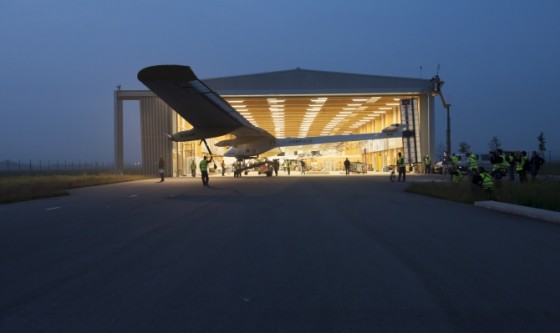

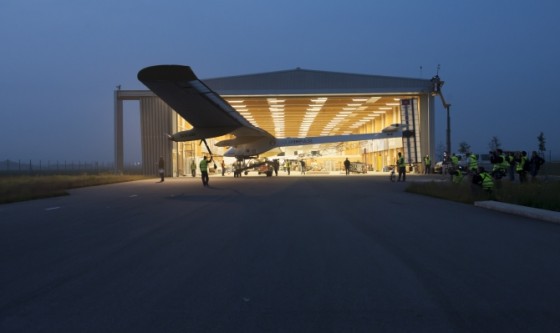
 They took their pilot run from Europe to Morocco, now the Swiss solar plane will fly across America.
Sometime next summer, an airplane with the wingspan of an Airbus A340 but weighing not much more than a Toyota will fly from San Francisco to Washington, D.C., and on to New York. The history-making cross-country trip will be achieved without burning a single ounce of jet fuel — or any other fuel for that matter.
If the two Swiss pilots behind Solar Impulse can pull that off, their next goal will be even more ambitious: a round-the-world flight in 2015 lasting 20 to 25 days.
“Ever since I was a kid, I wanted to understand the environment, to protect nature and to make a better life for humankind. Solar Impulse is exactly in that spirit,” said 52-year-old Bertrand Piccard, the project’s initiator and president. “We have an airplane that can fly day and night with absolutely no fuel. It’s important to show we can go from dreams to reality, and inspire people to make their own dreams come true.”
These lofty ideals are echoed by André Borschberg, the project’s CEO and co-founder. A businessman with a degree from MIT, Borschberg, 58, says “the time I spent in Boston allowed me to found startup companies. I know that dreams fuel innovation, and that human commitment and new technologies can really change the world.”
When it comes to results, Solar Impulse —a product of Swiss ingenuity and perseverance — has already achieved three world records. On July 8, 2010, the HB-SIA prototype succeeded in flying night and day for exactly 26 hours, 10 minutes and 19 seconds, with four hours worth of surplus energy still left in its batteries upon landing.
Less than a year later, HB-SIA spent flew to Brussels from its home base at Switzerland’s École Polytechnique Fédérale de Lausanne, cruising at an altitude of 6,000 feet during the 13-hour flight. And this past June, the same aircraft completed its first intercontinental trip, a 19-hour journey from Madrid to Rabat, Morocco.
On Dec. 12, the Swiss Embassy in Washington introduced Piccard and Borschberg to local media. The press event began with a three-minute video comparing their ambitious project to the Wright Brothers’ 1903 flight at Kitty Hawk, Charles Lindbergh’s 1927 transatlantic solo adventure in the Spirit of St. Louis, and Chuck Yeager’s 1947 breaking of the sound barrier in his rocket-powered Bell X-1 jet.
“Switzerland is very proud to be a partner in the next endeavor of Solar Impulse,” said Swiss Ambassador Manuel Sager. “As a country, we share the values of the project: technological innovation, competence and entrepreneurial expertise.”
Borschberg, an engineer who trained as a pilot in the Swiss Air Force, said Solar Impulse began in 2003 and grew into a collaborative effort involving 70 engineers and specialists.
“When we looked at the question of flying around the world, we immediately understood that we had to develop an airplane capable of flying day and night, collecting energy during the day, storing it and using as little as possible to continue the following day,” he explained. “We visited airplane manufacturers but were told that what we had in mind was impossible. So we decided to set up our own team and look for partners.”
Over the last nine years, the project’s backers have invested $120 million in Solar Impulse. Piccard — who in 1999 made the first-ever nonstop round-the-world balloon flight, landing in Egypt after a 45,755-kilometer flight lasting nearly 20 days — noted that “this is 4 percent of the budget of the Formula One team.”
The project’s main partners are Belgian chemicals conglomerate Solvay, Swiss watchmaker Omega, Germany’s Deutsche Bank and Swiss elevator manufacturer Schindler. Other sponsors include French aircraft maker Dassault Aviation, the Paris-based European Space Agency and the International Air Transport Association.
“We need additional partners for the U.S. and round-the-world flight,” said Piccard. “If you wait until you have all the money in advance, you never start. Until now, we’ve had only European partners, so we would be most welcome to have American companies join us.”
HB-SIA’s specifications are impressive. With a wingspan of 63.4 meters, the aircraft weighs only 1,600 kilograms and boasts a maximum cruising altitude of 8,500 meters (27,900 feet). Four lithium polymer batteries weigh 100 kilograms each; together, they account for one-fourth of the aircraft’s total weight. According to a fact sheet, every unnecessary gram has been eliminated in order to build the super-light aircraft.
“The average speed is 40 knots, but the higher you fly, the faster you go,” Piccard told reporters. “You can take off with empty batteries, climb to 30,000 feet, fly 12 hours and fill up the batteries. During the day, the more you fly, the more energy you produce.”
Solar Impulse is built of composite materials, consisting of a carbon fiber-honeycomb sandwich structure. Its upper-wing surface is covered with a skin of embedded solar cells; 120 carbon-fiber ribs placed at 50-centimeter intervals give the wing is aerodynamic profile while ensuring its rigidity.
“We are focused on preparing for next year. We’ve had many discussions with authorities, and the response has been extremely positive. People are interested in this project,” Piccard said, noting that “if it had already been done 10 times, nobody would be here in this room listening to us.”
One reporter asked about the practical applications of using a solar-powered aircraft for long-haul commercial flights.
“We don’t see how it would be possible to transport 200 people without fuel, but when we see how fast aviation has evolved, maybe technology will allow it someday,” Piccard responded. “When Charles Lindbergh crossed the Atlantic in 1927, nobody believed that someday it would be possible to do the same with 200 passengers.”
To pull off the coast-to-coast achievement, Solar Impulse’s current prototype will have to be dismantled, flown across the Atlantic and re-assembled.
“We will take off from San Francisco, aiming for Washington and then New York. The route is not defined yet,” said Piccard, adding with a smile: “Washington is a second home for me, since the capsule of my balloon is displayed in the Air & Space Museum. Why should I take a hotel room here? I can sleep in my capsule.”
More Solar-Powered Goodness:
The World’s Largest Solar-Powered Boat Pays a Visit to Qatar
Markus Kayser’s 3D Solar Sinter Prints on Sand – Could Replace Concrete
Morocco Airport Counts Solar Power Carbon Savings