
Masdar’s Winning Blog: Demystifying the Water-Energy Nexus

Engage, Masdar, blogging competition, water, energy, sustainable development, Abu Dhabi, GemasolarIf you are among the 70 or more bloggers who submitted an entry to Masdar’s blogging competition, or simply want to know what it takes to impress the jury of one of the leading promoters of sustainable technology and renewable energy, then this post might appeal to you.

Professor of public and environmental affairs at the University of Wisconsin in the United States, Dallas Blaney took a novel approach to the water-energy debate. Instead of telling us what we already know – that we’re running out of water and scurrying to generate more energy to meet rising demand – Blaney says we need to demystify the relationship between the two.

Distinctly academic, Blaney wastes no words getting to the point of his entry:

While it is generally well known that water is essential to the production of energy, we nonetheless lack a detailed understanding of the quality and quantity of water used in this process (1). Conversely, we know that the treatment and distribution of water is energy intensive, yet we know very little about the energy required or how this demand has changed over time (2). Given the expectation of dramatically higher demands for energy and water over the coming years, this knowledge gap poses a significant threat to the long-term sustainability of our political, social, and economic systems.

This is the crux of the matter. We know that there is some kind of relationship between energy and water, but we don’t have succinct numbers. And until we do, it will be difficult to demand more efficient conservation of either.

Blaney then answers the questions that instinctively arise in response to stating the challenge. How?

First, he says, the issue was raised as a “thematic priority” at the 6th World Water Forum in Marseille last year. He added that another important topic to address is how energy generation impacts water quality. This has become a particular concern in communities subject to “fracking.”

Shortly after this discussion convened, Blaney wrote, Gustaf Olsson published Water and Energy: Threats and Opportunities – further indication that the issue is receiving attention. This is what he said about it:

This book marks the first attempt to develop a comprehensive assessment of the energy-water nexus. Substantive chapters examine the water demands for a range of energy production systems, including crude oil and hydropower.

Up until now, Blaney acts like a good academic. Having this data, in theory, should promote better practices. But what about the throng of people, including 77% of Americans polled, who have no idea where their own water is sourced? How does this data help them?

Blaney realizes that in order to for there to be any kind of progress, real people have to be empowered with useful knowledge too. While more data about the intersection between energy and water might be useful to policy makers, the consumer needs to understand how their choices affect the overall availability of both resources as well.

What is being done to ensure that progression, according to Blaney?

Both The Nature Conservancy and WWF focus specifically on raising awareness within the business community. Capitalizing on their scientific expertise, these organizations have each developed water assessment tools that businesses can quickly and cheaply use to identify water-related inefficiencies and risks in their supply chains or production systems. In contrast, Project WET specializes in the creation of water-related textbooks and curricula for primary school children. Over time, these efforts have expanded beyond the US to reach tens of thousands of students spread across 19 countries.

There’s more, but I urge readers to visit Masdar’s site in order to read the full entry. Once you there, take a look at the UAE post that garnered the most social media attention in addition to all five finalist posts.

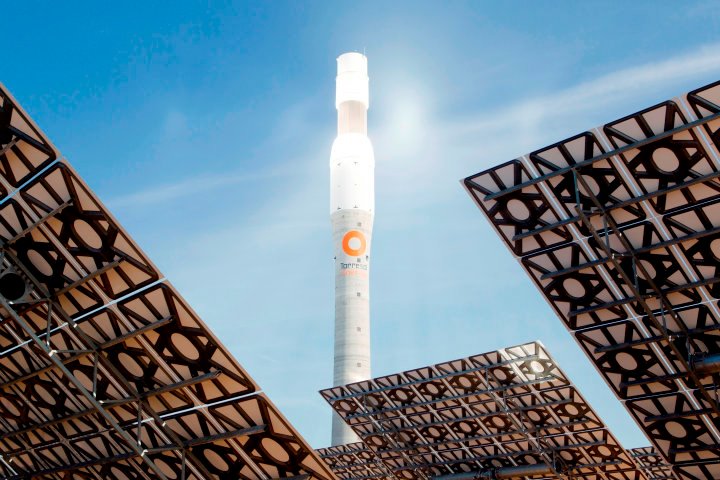
Image of the Gemasolar tower in Spain via Masdar’s Facebook page

Tafline Laylin
Tafline Laylinhttp://www.greenprophet.com
As a tour leader who led “eco-friendly” camping trips throughout North America, Tafline soon realized that she was instead leaving behind a trail of gas fumes, plastic bottles and Pringles. In fact, wherever she traveled – whether it was Viet Nam or South Africa or England – it became clear how inefficiently the mandate to re-think our consumer culture is reaching the general public. Born in Iran, raised in South Africa and the United States, she currently splits her time between Africa and the Middle East. Tafline can be reached at tafline (at) greenprophet (dot) com.
1 COMMENT
  1. You won’t even talk about what actions are needed to save the biosphere, let alone do anything to safely recycle 100% of human-generated waste materials and peacefully reduce the human population with family planning education. So, you self-doom yourselves and everyone to extinction.

LEAVE A REPLY

Please enter your comment!
Please enter your name here

TRENDING

Astro uses AI to help procure land for renewable energy

For oil-rich, environmentally vigilant Gulf states, Astro isn’t just another startup story. It is a blueprint for accelerating an energy transition that is now existential, not optional.

EU Ports Still Power Russia’s Arctic Gas Exports Despite Phase-Out Pledge

The findings suggest that rather than declining, Europe’s reliance on Yamal LNG intensified in 2025. Yamal cargoes accounted for 14.3% of the EU’s total LNG imports, equivalent to roughly one in every seven LNG ships arriving at European terminals.The findings suggest that rather than declining, Europe’s reliance on Yamal LNG intensified in 2025. Yamal cargoes accounted for 14.3% of the EU’s total LNG imports, equivalent to roughly one in every seven LNG ships arriving at European terminals.

Sink holes from over-watering farmers’ fields

Sinkholes are rapidly appearing in Turkey’s central Anatolian farming region, particularly around Konya and Karapınar. These giant gaping holes in the ground in areas of farmland, known locally as obruk, are not random geological events. They are linked to prolonged drought, climate-driven heat stress, and heavy groundwater extraction for agriculture in one of the country’s most important breadbaskets.

Oil pollution in Basrah’s soil is 1,200% higher than it should be

Soil pollution levels in parts of Basra are 1,200% to 3,300% higher than those typically measured in cities like Toronto or New York, according to new comparative soil data. It's getting into water.

Peace hospital opens between Jordan and Israel

The proposed medical centre, described by Emek HaMaayanot Regional Council head Itamar Matiash as “a centre for cancer treatment, so that people from Jordan or further away could come and receive treatment,” would become the flagship of a wider cluster of medical, academic and innovation-based services planned for the Israeli half of the zone.

Qatar’s climate hypocrisy rides the London Underground

Qatar remains a master of doublethink—burning gas by the megaton while selling “sustainability” to a world desperate for clean air. Wake up from your slumber people.

How Quality of Hire Shapes Modern Recruitment

A 2024 survey by Deloitte found that 76% of talent leaders now consider long-term retention and workforce contribution among their most important hiring success metrics—far surpassing time-to-fill or cost-per-hire. As the expectations for new hires deepen, companies must also confront the inherent challenges in redefining and accurately measuring hiring quality.

8 Team-Building Exercises to Start the Week Off 

Team building to change the world! The best renewable energy companies are ones that function.

Thank you, LinkedIn — and what your Jobs on the Rise report means for sustainable careers

While “green jobs” aren’t always labeled as such, many of the fastest-growing roles are directly enabling the energy transition, climate resilience, and lower-carbon systems: Number one on their list is Artificial Intelligence engineers. But what does that mean? Vibe coding Claude? 

Somali pirates steal oil tankers

The pirates often stage their heists out of Somalia, a lawless country, with a weak central government that is grappling with a violent Islamist insurgency. Using speedboats that swarm the targets, the machine-gun-toting pirates take control of merchant ships and then hold the vessels, crew and cargo for ransom.

Leopoldo Alejandro Betancourt López Turned Ocean Plastic Into Profitable Sunglasses

Few fashion accessories carry the environmental burden of sunglasses. Most frames are constructed from petroleum-based plastics and acrylic polymers that linger in landfills for centuries, shedding microplastics into soil and waterways long after they've been discarded. Leopoldo Alejandro Betancourt López, president of the Spanish eyewear brand Hawkers, saw this problem differently than most industry executives.

Why Dr. Tony Jacob Sees Texas Business Egos as Warning Signs

Everything's bigger in Texas. Except business egos.  Dr. Tony Jacob figured...

Israel and America Sign Renewable Energy Cooperation Deal

Other announcements made at the conference include the Timna Renewable Energy Park, which will be a center for R&D, and the AORA Solar Thermal Module at Kibbutz Samar, the world's first commercial hybrid solar gas-turbine power plant that is already nearing completion. Solel Solar Systems announced it was beginning construction of a 50 MW solar field in Lebrija, Spain, and Brightsource Energy made a pre-conference announcement that it had inked the world's largest solar deal to date with Southern California Edison (SCE).

Related Articles

Popular Categories