
 Jordan’s nuclear industry is wildly volatile, especially when you consider it doesn’t actually exist.
Arwa reported on last week’s parliamentary vote to shelve Jordan’s first nuclear reactor. Exploratory mining for uranium was also stopped. The program will surely resurrect once new feasibility analyses are complete, but against a backdrop of a pressurized economy, scarce water sources and corruption investigations, success is anyone’s guess. The time is now for Jordan’s renewable proponents to demonstrate the viability of alternative energy. Take a page from regional legend David and Goliath, and slay the nuclear beast.
Last April, Jordan’s Parliament adopted the Renewable Energy and Energy Efficiency Law (REEL). REEL is aimed at inciting private-sector investment in Jordan’s nonexistent commercial renewable energy sector, but the law targets homeowners and small businesses too:
- Net metering will be implemented: all citizens with solar energy systems or wind turbines now have the right to sell any excess electricity back to their electricity provider at the full retail rate.
- National Electric Power Company (NEPCO) is required to purchase all electricity generation from utility-scale renewable energy projects. NEPCO will also be required to cover costs of connecting renewable energy projects to the national electricity grid.
- The Renewable Energy and Energy Efficiency Fund will be established to assist in financing energy efficiency and renewable energy projects. Local or international developers can apply to the fund, which is overseen by a committee inclusive of The Minister of Energy, the Electricity Regulatory Committee and three private sector representatives selected by the Cabinet. Financing is provided by the French Development Agency, the World Bank and the Global Environment Fund. Other international aid agencies have expressed interest in providing additional assistance.
REEL brings Jordan up to speed on a number of energy fronts
Private companies looking to invest in renewable energy projects in Jordan may now be able to negotiate directly with the Energy Ministry. Enabling developers to bypass a competitive bidding process will significantly expedite the project start-ups, although it’s not clear how the process will transcend ubiquitous corruption allegations.
Jordan’s National Energy Strategy calls for the Kingdom to obtain 7 percent of its electricity from renewable energy sources by 2015, rising to 10% by 2020.
The Jordan Times reports a governmental strategy that anticipates installations of power generation for solar (300 to 600mW), wind (600mW), and biomass (30-50mW). While there is tremendous renewable energy potential in Jordan, it’s unlikely it could be realized without large-scale investments. Under the law, renewable energy projects will be required to clearly state fixed electricity tariffs in their proposals before being approved.
And is there any non-nuclear reaction?
Construction on Jordan’s first project to use concentrated sunlight to power air cooling kicks off in July. The pilot, which stems from a joint agreement between the Ministry of Environment and the German Agency for International Cooperation, will demonstrate that solar cooling can lower air conditioning costs by up to 60%. Funded by Germany’s federal environment ministry, the $4 million project is the first of its kind in Jordan. It’s expected to be operational in 2015.
Jordan imports 98% of its energy needs, at a cost of 25% of its annual gross domestic product. The national energy bill is expected to surpass $5.6 billion this year. Renewables contribute less than 1% of Jordan’s energy, although the Kingdom has significant amounts of untapped wind and solar energy. Jordan has one of the highest annual daily averages of solar irradiance in the world: it’s incomprehensible that this abundant solar power is not being tapped.
Energy demand is rising and resource security emerging as a multi-headed monster; there’s an army of unemployed college grads looking for a challenge and lots of idle construction equipment on hand. What will it take for these forces to align to make alternative energy projects real? Jordan’s nuclear was only voted into suspension. It will be back.
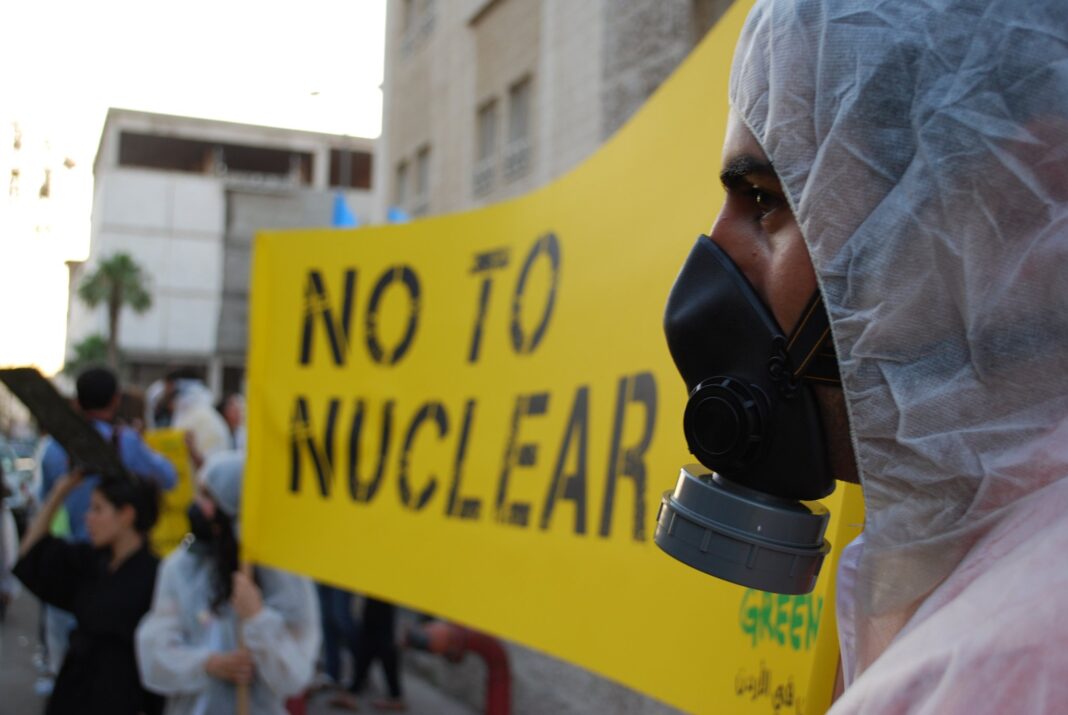
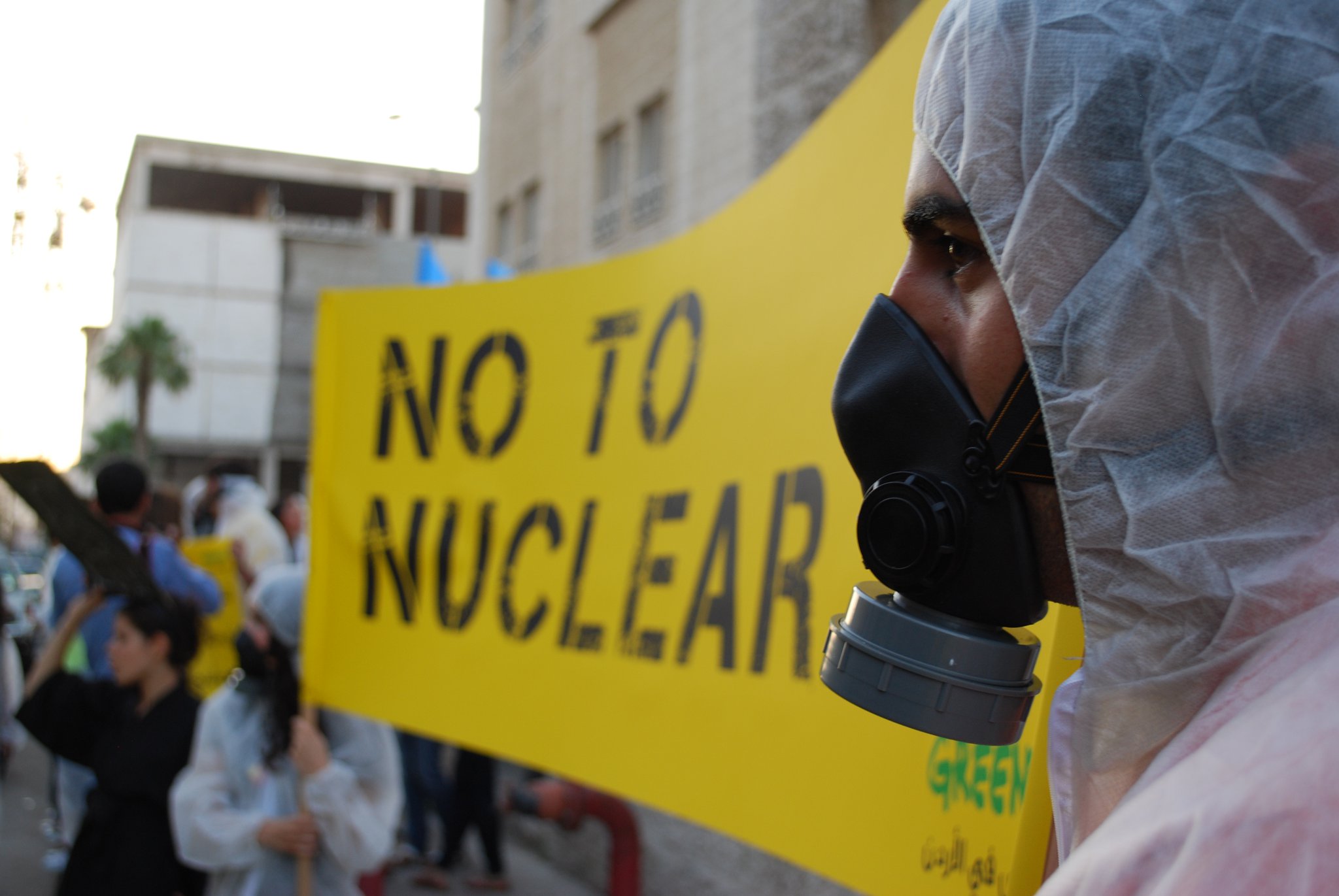
Image of previous nuclear protest via Hamza Omari/ Greenpeace Jordan