Green Prophet’s reports on happenings in the Gulf region have increasingly been using the acronym GCC, which stands for Gulf Cooperation Council. Perhaps a bit of an explanation is in order. GCC is a political and economic alliance between Bahrain, Kuwait, Oman, United Arab Emirates (UAE), Qatar and Saudi Arabia (KSA). It was formed in 1981 following Iraq’s invasion of Iran and the start of the Persian Gulf War, ostensibly to enhance regional security and bolster trade.
Collectively, these six countries possess nearly half of the world’s oil reserves. Neighboring Yemen has agitated for membership, but its crippled economy and status as a republic are key differentiators that have so far kept them out of the club. KSA is the most powerful member and the Council is headquartered in Riyadh.
Think of the European Union (EU), but for Arab Gulf states:
Common cultural characteristics link these nations. They share a language. Their sheikdoms and kingdoms are founded on Islam: patriarchal systems that are among the least democratic in the world. Member states are predominently conservative Sunni Muslims. The UAE and Bahrain are more open to foreign influence and, resultantly, are more socially tolerant. This is a cause for frequent inter-state dissention.
Their primary mandate is to increase coordination and cooperation among all members and across all fields, including:
Trade is a priority.
The GCC seeks to standardize regulations across industry, mining, agriculture, water and animal resources. Partnerships amongst private sector industries are encouraged.
Last month, as example, KSA called for common regional rules for regulating personal care products. Presently, each emirate in the UAE has a different set of rules governing the importation and regulation of everyday consumables such as toiletries and cosmetics.
“If we have the same rules in all GCC countries, it would be easier for companies to adhere to them,” said Al Tamimi, a supervisor at the Saudi Food and Drug Authority, in an interview with the Khaleej Times. “Companies say ‘we’re registering (our product) in Dubai, why do we need to again register it in Abu Dhabi or Umm Al Quwain?’ ”
While the alliance encourages free movement within the GCC of workers who are citizens of the member states, unrest amongst the GCC’s 13 million migrant workforce is increasing. Despite the ban on trade unions in KSA and the UAE, the mostly South and East Asian workers have organized regional strikes and protests over low wages and poor conditions for foreign laborers.
Talks with the EU on a free trade deal began in the early 1990s, but by 2010, efforts had stalled. US free trade agreements were passed in 2006 with Bahrain and Oman: but independent actions like these threaten GCC economic unification.
The GCC common market was born in 2008. Plans to adopt a single currency surfaced in 2010, but were never enacted. A customs union was declared in 2003, with little progress.
Security looms large
GCC members signed an intelligence-sharing pact in 2004 aimed at anti-terrorism. They seek to reduce dependence on US forces, but members have not agreed a strategy that satisfies all states.
In 1984, they formed the Peninsula Shield: a Saudi-based defense to guard against threats from Islamic extremism and non-GCC states. Troop deployment is controversial. Last year, the Shield was sent to Bahrain to boost security during anti-government protests, but it was not sent to Kuwait to counter the Iraqi invasion. GCC members disagree over the roles of neighboring Iraq, Iran and Yemen in future security pacts.
The members differed over the US-led invasion of Iraq. While some opposed the action, others were supportive: as example, Kuwait served as a launch pad for the military campaign.
After investing billions in US anti-missile technologies, the GCC failed to integrate systems or construct an early-warning system . Mistrust amongst members has stymied plans to deploy a joint missile shield, which the US maintains is the best defense against any Iranian strike. A robust military is constrained by lack of modern combat experience and miniscule forces.
Currently, a unilateral GCC position as regards Syria is unformed.
The GCC can be viewed as a means for the conservative Gulf monarchies to add muscle to any confrontation with Iran, and to collectively prevent recent uprisings from spilling into their territories. Tensions have heightened over Tehran’s nuclear ambitions, and there are concerns about the reliability of America.
Last year, the US backed expulsion of Egyptian President Hosni Mubarak, but was less supportive in backing the opposition in Bahrain. There is speculation that the US wants to maintain a strong Iran as a counter-weight to GCC power. The Iraq War is cited as example: toppling Saddam Hussein enhanced Tehran’s power, leaving in place a Shi’ite-dominated state.
Members lack solidarity over internal matters such as the divide within Bahrain’s ruling Al Khalifa family, who failed to quell a 15-month-long rebellion by the Shiite majority. Bahrain faces a possible Shi’ite government with additional Sunni demand for a direct role. Similarly, KSA’s Shi’ite population has also been showing signs of restlessness, but the real threat lies in that nation’s majority Sunnis, who, if they were to become politically active, could underpin the kingdom’s absolute monarchy. A united GCC approach to these matters has yet to be broadcast. Members differ over the pace and extent of political reform.
Going the next step to an Arab Union?
Last December, Saudi King Abdullah proposed a GCC political union that would adopt joint foreign and defense policies. In March, the GCC announced that they were evolving from a regional alliance to a confederation. Given the slow inter-state consolidation of the past thirty years, it’s unclear what the resultant impacts of this new action will be.
The Jerusalem Post reported Bahrain’s Samira Rajab, Minister of State for Information Affairs, saying that a union between Bahrain and KSA would be the first stage of a wider confederation. This was contradicted by Bahrain’s Foreign Minister Khalid bin Ahmed Al-Khalifa statement that confederation “covers all the countries.”
Bahrain Prime Minister, Khalifa Bin Salman Al-Khalifa said “The great dream of the peoples of the region is to see the day when the borders disappear with a union that creates one Gulf”. He emphasized a focus on security and defense, which Rajab contradicted, saying it would be an economic alliance.
Interesting times for the Gulf region. Watch as this middle-aged coalition maps a new path to unity, and see if a better future results.
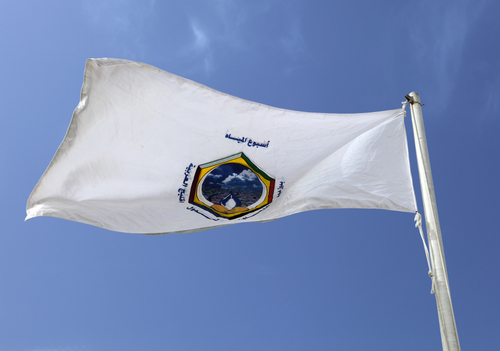
Image of Gulf Cooperation Council flag from Shutterstock.