


A new adaptor ring cuts noise pollution at airports.
Airports are like Desperate Housewives. Unpopular neighbors, but crazy sensual. You can see them, feel them, smell them, and you absolutely hear them. Ask anyone living or working near an airport and they’ll tell tales of noise pollution so extreme it wakes babies, rattles windows, and sets off car security alarms (of course, if a plane’s overhead, you won’t hear a word).
Beyond being an public audio menace, there’s a technical downside. The powerful sound waves generated by jet engine combustion can violently shake engine components, accelerating mechanical failure. Researchers at the University of Alabama quiet combustion at its source.
“Experimenting with combustion can be quite noisy and unstable, shaking the whole building, but when you put the foam in place, you can talk to the person next to you. It’s a night and day difference,” said Dr. Ajay K. Agrawal, professor of engineering at University of Alabama in a statement on the school’s blog.
Agrawal tested a sponge-like ring made of hafnium carbide and silicon carbide, placing it around the engine flame point to dampen sound before it escapes. Highly porous, the ring allows gases to flow and the composite material tolerates extreme conditions of combustion. It cuts noise without interfering with engine process.
By reducing noise at the source, there’s minimal need for pricey silencing equipment on the engine exterior. The ring is adaptable, inexpensive, and easy to install.
Agrawal, who worked with California’s Ultramet Corporation on this US Navy-funded project, has received a patent for the technology. The invention might also reduce noise generated by other industrial combustion devices.
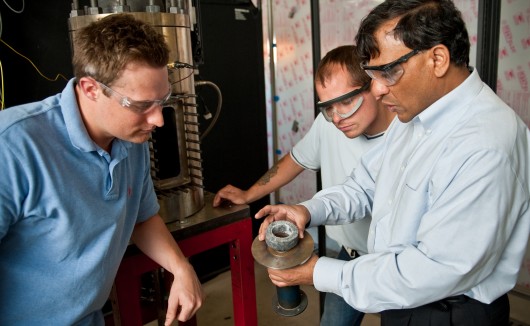
Dr. Ajay Agrawal, right, with graduate students Justin Williams, left, and Joseph Meadows, center, examine the noise reduction device, or noise sponge.
What’s all this noise about?
Noise is produced by aircraft components any time an airplane operates on its own power. Different aircraft generate different noise levels. Engine noise is maximal at takeoff, during climb and at landing. Our perception of noise can be affected by weather and geography.
Elevated sound levels do more than cause aggravation and disrupt sleep (both proven factors in causing stress, decreasing our performance, and increasing accidents). Noise can damage hearing and cause hypertension and heart disease.
In 2007, Germany’s central environmental office, Umweltbundesamt, correlated aircraft noise with health data from 800,000 people living near Cologne Airport. The study was prompted by local doctors who suspected that an observable concentration of medical cases might be traceable to nighttime air traffic.
Their research concluded that aircraft noise significantly impairs health, citing alarming statistics associated with “normal” airport sound levels. Daytime average sound level of 60 decibel (dB) increased coronary heart disease by 61% in men and 80% in women. Nighttime average level of 55 dB increased the risk of heart attacks by 66% in men and 139% in women.
Commercial aircraft on take-off generate in the range of 100 to 120 dB. For comparison, consider:
- Threshold of hearing – 0 dB
- Whispering – 20 dB
- Normal conversation – 60 dB
- Center stage at a rock concert – 110 dB
- Pain threshold – 130 dB
Shut up, already.
Aviation noise pollution grabbed headlines in the late 1960s, primarily as a problem at larger urban airports, where flight paths by necessity transversed dense residential neighborhoods. Affluent homeowners began the battle.
In the 1980’s, the Federal Aviation Administration (FAA) devised ways to insulate American residences from aircraft noise. California’s San Francisco and San Jose International Airports were among the first to use computer modeling to simulate the effects of aircraft noise on buildings. Retrofit strategies were evaluated and employed; results tracked and new strategies tested.
Four dozen homes near Florida’s Fort Lauderdale airport were soundproofed in advance of a runway expansion. Simple home improvements proved most successful: the airport paid to upgrade roof insulation and replace windows and doors.
The Port Authority of New York and New Jersey (PA) operates and maintains that region’s three major international airports: LaGuardia, John F. Kennedy and Newark Liberty. In 1983, the PA, in partnership with the FAA, undertook a program to soundproof schools located in federally defined aircraft “noise-affected areas”.
To date, 77 schools have been retrofitted by installation of accoustic windows, roof and wall insulation, and new ventilation and air conditioning systems. I worked on these projects and can attest to radically improved acoustical and energy preformance. Would be interesting to follow-up, check if the kids’ school performance also changed. When I last checked, that program’s price tag exceeded $180 million.
Aviation industry efforts to be good neighbors are not created equal.
Noise reduction tactics vary in effectiveness, and in cost. Earlier attempts have focused on muffling sound outside of the engine. More costly remedies involve soundproofing homes and schools in affected areas. Aircraft designers, manufacturers, and operators develop quieter airplanes and improve operating procedures.
Some airports restrict night flying, like all London airports and Germany’s Frankfurt Airport. Others strategically route flights over non-residential pathways. The approach to Dublin Airport is largely over seafront and coastal farms. Amman’s Queen Alia International is ringed by sparsely inhabited desert plains. But even if plunked in a remote location, the very nature of an airport will attract development and increased density.
Agrawal’s discovery may be the simplest and most economical solution to reducing aviation noise pollution, extending equipment life, and improving quality of life for all of us who live and work near airports.
Press images by Zach Higgins, University of Alabama


What a great breakthrough! This should allow the aerospace industry to cut costs and grow development considerably.
I agree, Randall. Will be interesting to track adoption by the bigger carriers; perhaps sustainability targets for airports will expand to include aircraft-generated noise. Airport authorities in urban areas might contribute to the cost of this modification – far easier and cheaper than soundproofing schools and homes and businesses located under flight paths. Often the best solutions are the simplest.