
Killing Birds for Pickled Dish is a Disgrace, Says Cypriot Minister

wildlife conservation, Cyprus, poaching, ambelopoulia, nature, migratory birdsLast year in Cyprus a total of 2.8 million migrating birds were trapped and killed to make a pickled dish called ambelopoulia.

It’s a serious crime and offenders face fines of up to €17,000 and three years in jail if caught, but Agriculture Minister Sophocles Aletaris told an EU delegation concerned about environmental issues that even though “this practice is a disgrace for his country,” it is also deeply rooted in the Cypriot mentality and will be very difficult to eradicate.

Old habits

A new story in Cyprus Mail outraged local readers. MEP Cristina Guttierrez-Cortines agreed with Aletaris that “old habits are hard to break,” though she insisted that they are very worried about the birds.

In the past, ambelopoulia was a delicacy for poor people, but trapping the birds to supply restaurants that serve this dish has evolved into a money-making racket.

Aletaris told the EU delegation that last year 3,000 people caught trapping songbirds with mist nets and 25 restaurants found to be buying them have been prosecuted, but locals don’t believe enough is being done.
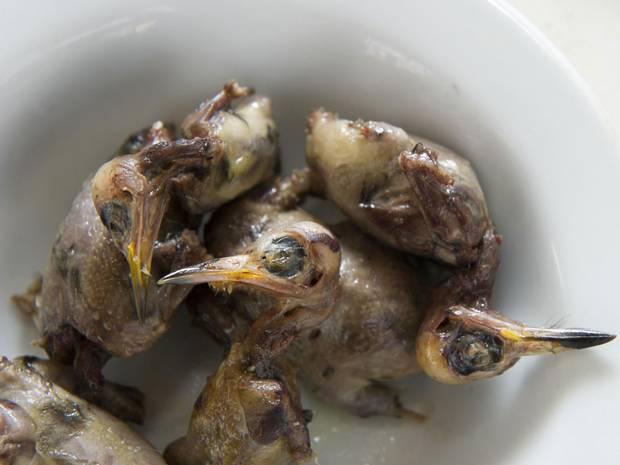
ambelopoulia songbirds cyprus
Cooked, pickled songbirds – ambelopoulia. Poachers can get 17,000 EU fine, but it’s not enforced

Enforcing the law in Cyprus

One anonymous reader wrote “And what punishment was meted out to these 3025 persons? A tap over the fingers? Just think, the government could have netted (no pun intended) over €50 million if the maximum fine were imposed – and others would be discouraged from doing the same.”

Another reader, Pete Adams, claims that the government should do more to enforce the law, “As far as enforcement goes,” he says, “was there not an incident recently where staff from the agriculture ministry or European commission were attacked by these poachers? If they ever got to court what happened? There’s absolutely no point having a maximum penalty unless it’s put use occasionally and that must include the forfeiture of all goods and establishments selling these animals.”

Incentive to catch the bad guys

BirdLife Cyprus has been monitoring the annual slaughter of songbirds and found that last year’s 2.8 million loss was the largest in five years. While many locals fear that corrupt government officials and police are enabling poachers, Alexey Golovanov takes a more forgiving view.

“I do not believe that police and game wardens are all corrupt,” wrote the  Managing Director & CEO at Arts, Arms & Antiques. “In many cases they are overworked and grossly underpaid. They should be entitled to a bonus (from the fine – that’s international practice) – as an incentive.”

More on Wildlife Conservation:

1 Million Migrating Songbirds Killed for a Pickled Dish in Cyprus
Thousands of Endangered Fruit Bats Gunned Down in Lebanon

Crazy Kuwaitis Use Shotguns to Kill 12 Flamingos

Tafline Laylin
Tafline Laylinhttp://www.greenprophet.com
As a tour leader who led “eco-friendly” camping trips throughout North America, Tafline soon realized that she was instead leaving behind a trail of gas fumes, plastic bottles and Pringles. In fact, wherever she traveled – whether it was Viet Nam or South Africa or England – it became clear how inefficiently the mandate to re-think our consumer culture is reaching the general public. Born in Iran, raised in South Africa and the United States, she currently splits her time between Africa and the Middle East. Tafline can be reached at tafline (at) greenprophet (dot) com.
1 COMMENT
  1. This ignorance is so huge that National Geographic did a story in their July-2013 edition. Cyprus is one of the biggest offenders when it comes to reckless destruction of birdlife. Considering the poor management of the islands flora & fauna, it seems clear that Greek Cypriots are environmentally ignorant! They want to be part of the EU but act like an undeveloped backwater that is still in the stone age.

Comments are closed.

Hot this week

How Renewable Energy is Revolutionizing the Way We Power Our World

Solar has become the star of the transition thanks to modular hardware and straightforward installation. It fits dense cities and remote towns alike. Many companies are turning to rooftop arrays and carport systems - and exploring commercial solar installation as a practical way to lock in future savings.

How does one start prepping?

Faced with an extreme winter storm this year, Americans wonder how to be prepared for catastrophe. Miriam has lived through wars in the Middle East - so she's prepared on giving you a guide to prepping.

Fishermen sue tire manufacturers on behalf of the salmon

A federal trial in San Francisco has brought US tire manufacturers, fishing groups, and environmental scientists into court over a chemical most drivers have never heard of — but which scientists say may be silently reshaping aquatic ecosystems.

Listening to Water: Tarek Atoui’s Next Work for Tate Modern

Born in Beirut, Lebanon in 1980 and now living in Paris, Atoui has spent years building instruments that don’t sit comfortably in concert halls. Many of them involve water, glass, and ceramics — materials that react to sound instead of simply producing it.

Leading Through a Dual-Energy Transition: Balancing Decarbonisation with Energy Security

Experience in one area of the energy industry isn't enough to guarantee readiness across all the others. That's where a structured program like an MBA in energy can come in. Today's advanced curricula explore energy economics, finance, policy, and strategic management alongside the technical subjects. And when pursuing an energy MBA online, professionals can skill up and retrain without having to step out of the labor market -- an important perk at a time when skilled professionals are already in short supply.

Topics

How Renewable Energy is Revolutionizing the Way We Power Our World

Solar has become the star of the transition thanks to modular hardware and straightforward installation. It fits dense cities and remote towns alike. Many companies are turning to rooftop arrays and carport systems - and exploring commercial solar installation as a practical way to lock in future savings.

How does one start prepping?

Faced with an extreme winter storm this year, Americans wonder how to be prepared for catastrophe. Miriam has lived through wars in the Middle East - so she's prepared on giving you a guide to prepping.

Fishermen sue tire manufacturers on behalf of the salmon

A federal trial in San Francisco has brought US tire manufacturers, fishing groups, and environmental scientists into court over a chemical most drivers have never heard of — but which scientists say may be silently reshaping aquatic ecosystems.

Listening to Water: Tarek Atoui’s Next Work for Tate Modern

Born in Beirut, Lebanon in 1980 and now living in Paris, Atoui has spent years building instruments that don’t sit comfortably in concert halls. Many of them involve water, glass, and ceramics — materials that react to sound instead of simply producing it.

Leading Through a Dual-Energy Transition: Balancing Decarbonisation with Energy Security

Experience in one area of the energy industry isn't enough to guarantee readiness across all the others. That's where a structured program like an MBA in energy can come in. Today's advanced curricula explore energy economics, finance, policy, and strategic management alongside the technical subjects. And when pursuing an energy MBA online, professionals can skill up and retrain without having to step out of the labor market -- an important perk at a time when skilled professionals are already in short supply.

From Green Energy to Healthy Societies: Why old systems thinking is becoming relevant again

Across the Middle East and North Africa, large investments are being made in green hydrogen, renewable energy, water infrastructure and sustainability. Most of these efforts are discussed in the context of climate change, decarbonization and economic diversification. That framing is important, but it may not capture their full value.

We saw peace – an interreligious encounter deep in our eyes

They came from Israel, Palestine, Jordan, Iraq, Yemen, Morocco, Tunisia, Lebanon, Egypt… There are Sunni Muslims, Shiite Muslims, Jews (Orthodox and Reform), Orthodox Christians, Coptic Christians, Protestant Christians, Druze, Baha'is, a Scientologist.

Can biochar reduce ‘Forever Chemicals’ in food if it’s used in farms?

Biochar is produced by heating organic material in a low-oxygen environment so it does not burn. This process, known as pyrolysis, transforms plant matter into a stable, carbon-rich material.

Related Articles

Popular Categories