
 Math helps us understand how people flow, and just maybe it could help Hajj pilgrims stay safe.
A Californian jogs to the beach. Coming towards him on the sidewalk is a Texan. Unless one steps aside they’ll collide. Quick: which way does the jogger move? If this is in Europe or the USA, heavy odds he moves to his right. In Asia (with Asians), the slide would likely be left. A crazy-making observation, and it’s not connected to driving: Irish drive on the left side of the road, but they’ll step to the right on the pavement.
The folks at Berlin’s Max Planck Institute (MPI) say this behavior is based on an improbable marriage of psychology and mathematical probability. When we correctly guess another’s intentions, we get a positive subconscious boost. We’ll probably choose the same move when the same situation arises; get another subliminal “high-five”.
Subconsciously, we record these near-misses. We adopt a directional bias. It becomes habit. Whether it’s right or left doesn’t matter. We’re suckers for Pavlovian conditioning.
Cars are constrained forms of transport: speed limits, travel lanes. By comparison, walking seems flexible and self-controlled. There’s that tricky “perception” thing again. Walkers are influenced by physical constraints and by other pedestrians, who turn out to be highly predictable.
Mehdi Moussaid of MPI and Dirk Helbing of Eidgenössische Technische Hochschule Zürich (ETHZ), theorize and model pedestrian patterns under endless scenarios. Understanding national tendencies to step in different directions is useful for organizers of events like this summer’s Olympics or the 2022 FIFA World Cup in Qatar. When people convene from around the glode, they bring personal sports preferences and equally ingrained crowd behavior. Understanding people flows makes for safer events.
Without a common reflex to move aside, collisions increase. Cultural biases go beyond a preference to steer left or right. Nationalities have different “personal space” and adjust walking to maintain that comfortable distance. Some don’t mind bumping into you; others are appalled at contact.
International walking speeds are similar in thin crowds; but when density increases, speeds vary. Variables could slow pedestrian passage to a tension-building crawl.
In 1995, physicists designed a computer model that assumed people are attracted by things (destinations) and repelled by things (pedestrians blocking their way). Experiments allowed them to reliably predict self-organizing crowd patterns which they could next analyze in real crowd situations.
They observed that dense crowds spontaneously split into lanes that allow efficient movement in opposing directions, allowing us to simply follow the person ahead instead of fighting through a mob.
When opposing flows intersect (imagine the entrance of a busy cafe), movement momentarily stops. As people leave, pressure on the exit line drops, traffic lessens, with greater space between each exiting person. An opportunity opens for those wanting to enter. They’ll push in until pressure on their side of the flow is relieved. A series of alternating bursts of opposing traffic flow results.
Dynamics vary based on the crowd.
About 70% of a crowd consists of groups, and groups have more “sticking power” than individuals, affecting flows. If you can see your destination in the distance, you’ll tend to take shortcuts through the crowd to get there. Seemingly random realities will affect overall crowd behavior.
Thin crowds have a constant flow. People in high density crowds tend to shorten their stride, periodically stop to avoid collisions, creating a stop-and-go pattern. Very dense crowds risk developing “crowd turbulence”, where people can’t control spacing between one another. Then powerful physical forces become chaotic: if someone falls, the void they create fills with other bodies. People are trampled; stampeding occurs.
I was in such a crowd at a NYC parade. My husband and I left a pizza parlor with our toddler in his stroller and were swept into a wave of partiers headed to Fifth Avenue. Easier to go with the flow than attempt a reversal, but on Fifth, blocked by barricades, the crowd slowed and quickly condensed. I could smell the cologne on the guy stalled in front of me, but the guy behind kept pressing forward. Real panic as we watched our stroller get swallowed by this mob. Strangers helped lift it above our heads and passed our son like a concert balloon above the crush. Never been so frightened, straining to keep him in view. A few moved barricades relieved some pressure. We found our kid, lounging in the stroller, enjoying his slice.
Computer simulations help anticipate crowd action and can gauge behavior in emergency evacuations. A primary danger is that people will herd towards a single exit, inciting that disastrous crowd turbulence effect. Flow analysis helps spot where crowding will likely occur. Once potential congestion points are identified, more sophisticated models are used to “cause and effect” architectural designs. Experimenting with physical forms, sound, and adaptable lighting will change flow patterns; alternatively attracting or repelling people from their directional target.
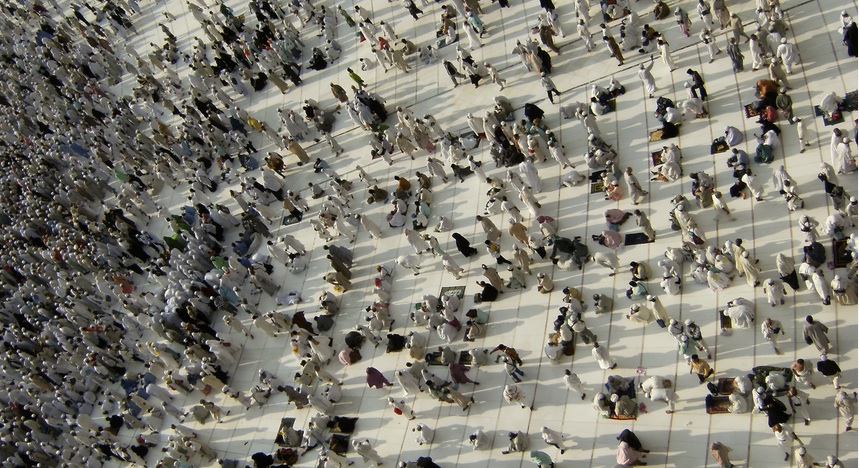
The Hajj, the annual Muslim pilgrimage to Mecca, is an opportunity to put this science through its paces. Millions of pilgrims make the journey; Hajj has experienced fatal stampedes.
Saudi authorities used crowd consultants to change the layout of the Jamarat Bridge, where pilgrims perform a ritual of throwing stones at three pillars. Enforcing one-way bridge passage improves pedestrian safety. Redesigning the pillars’ shape allows people to pitch stones from more locations, effectively disperses the crowd.
Paul Townsend of Crowd Dynamics, a consultancy with Hajj experience, says risks remain significant. Hajj presents unique challenges. It’s impossible to know how many pilgrims will turn up. Then there’s the spiritual focus of the crowd.
“Hajj pilgrims have the attitude that, if I die there it is God’s will,” says Townsend in an interview with The Economist. “There is a willingness to get more and more densely packed in the space.” Scientists can model many aspects of pedestrian behavior, but religious fervor adds an unpredictable element.
Scientific patterning should gelp reduce future crowd disasters. The real trick is to avoid serious crowding in the first place.
Image of Hajj pilgrims by AHMAD FAIZAL YAHYA from Shutterstock