


Country data reveals that Syria, Lebanon and Iraq are potentially the only virtual water exporting countries in the Middle East. Get in the know about blue, green and grey water footprints.
Following the previous article on measuring your Ecological Footprint, here we will focus on the Water Footprint. Let’s start with understanding the Virtual Water and Virtual Water trade: The virtual-water concept was established by J.A. Allen in 1998 to address water scarcity in the Middle East. Virtual water is a measure of the volume of water needed (and polluted) in order to produce a good in a specific country.
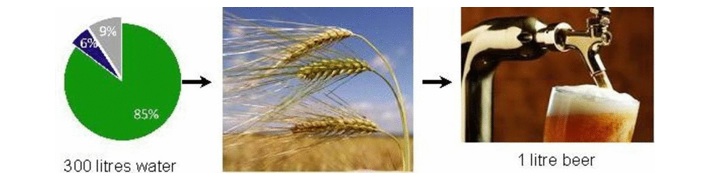
For example, the virtual-water content of wheat is 1,300 liters/Kg, while the virtual-water content of beef is 15,500 liters/Kg, to put this into perspective – one Kg of beef is the equivalent of letting the tap run for 1107 minutes (19.5 hours!) if there is 14 liters of water running from an average tap every minute.
The virtual water trade, refers to the idea that when goods and services are exchanged, so is what has been used to produce the good. When a country imports one ton of beef it is also importing water that has been used to produce the beef. By “choosing” not to produce one ton of beef domestically but importing it, the country is saving 15,500,000 liters of domestic water. On the other hand the exporting country has exported 15,500,000 liters of domestic water which will no longer be available for other purposes. Measuring the net virtual water flow for a country, especially for water scarce countries, is crucial to understand how to better achieve water sustainability. Here’s how it’s done:
For example:
“The Middle East imports 13,805 cubic meters of water per year, and exports 642 cubic meters of virtual water. Over all the Middle East is a net importer of virtual water 13,163 (cubic meters per year) (between 1995-1999).”
Country data reveals that Syria, Lebanon and Iraq are potentially the only virtual water exporting countries in the Middle East, while all other countries- especially Israel and Jordan – are more conscientious of their policy choices and have decided to reduce or even abandon exports of water intensive crops by importing those goods.
This however also means that the Middle East is largely externalizing their water footprint, so this impacts the use and pollution of water in other countries.
Global Water saving:
How does Syria, a net exporter of virtual-water, impact the local citizens and ecosystem? How does Israel a net importer of virtual water impact on the citizens and ecosystems of other countries? As we face water shortages in the coming decades, these questions will become more and more relevant and political.
Economists might have an answer to the above questions, they would tell you that international trade is an opportunity for global water saving. International trade can save freshwater globally if a water-intensive commodity is traded from an area where it is produced with high water productivity (small water footprint and water abundant country) to an area with lower water productivity (large water footprint and water scarce country).
In theory this sounds great – it can make a click – in practice this will not happen until the cost of virtual water use is integrated into the price of that product. For example, a product that requires a large amount of virtual water and is being produced in a water scarce country should have a higher price than a product that is being produced with less virtual water in a country that is water abundant. Only then, could we start to see the “global water saving effects”.
National water footprint:
The national water footprint is defined as the total amount of fresh water that is used to produce the goods and services consumed by the inhabitants of the nation. Part of this water footprint may lie outside the territory of the nation and this is captured by the net virtual water balance, ie whether it is a net importer /exporter of virtual water.
To get an overview of the per capita water footprint for each nation click here.
*For more detailed explanation on National water accounting framework. Source: Hoekstra et al. (2011).
A blue, green and grey water footprint:
Traditional water use accounting uses the rate of water withdrawal to gauge “water sustainability,” however this per se does not really indicate the impact water use is having on a hydrological system. Hydrological systems are becoming an increasingly important aspect to consider because global warming is expected to have adverse impacts on regional hydrological systems.
Therefore the sustainability of the total water footprint in a geographic area is best accomplished by evaluating the impacts consumption and production patterns have on different “types” of water within a hydrological system. The water footprint splits up into three elements:
The blue water footprint refers to the volume of surface water (rivers, lakes etc.) and ground water consumed during production processes (i.e. evaporated or incorporated into the product – that does not return to the catchment from which it was withdrawn).
The green water footprint refers to the volume of rainwater consumed while the grey water footprint refers to the volume of freshwater that is required to assimilate the load of pollutants ( the volume of water that is required to maintain an agreed water quality standard).
So, for example, the global average production of beef has a 93% green, 4% blue, 3% grey water footprint, this gives you an idea of how beef production impacts on the hydrological cycle – most of the water comes from fresh water sources but the amount of water needed to assimilate the load of pollutants is not as great compared to wheat which has a grey water footprint of 11% of its total water footprint.
Your water footprint :
The idea is not necessarily to stop consuming certain products, although that would be preferable, but to understand what your actions entail. Often there are many hidden environmental costs in the things we do that affect people and places that are on the other side of the world. That is globalization for you. Hopefully in the future we will have products that are labeled with the amount of green, blue and grey water footprint so that, as consumers, we can make more conscientious decisions.
In the meantime you can get conscientious by downloading and using this great app.




Slow down water-intensive crop production. Lebanon produces twice its needs of fruits (oranges, bananas, apples, grapes…) to feed some arab oil fat bellies, a water grabbing situation, especially when you see who is funding irrigation projects. On parallel, it imports 80% of its wheat (GMO “suspected”) to keep on eating this industrial loaf of white bread inherited from the war…
So what’s next , Hon? We stop drinking beer?